After a planning application for change of use was withdrawn last year,
The Old Bulls Head (Little Hucklow, Derbyshire) is currently for sale. The agents, Crosthwaite Commercial, suggest potential for a pub/restaurant.
The pub was a regular Good Beer Guide entry in the 1970’s and 80’s when it sold a fine pint of Buxton-brewed Winkle
Saxon Cross Bitter (3.8%). It later sold Wards Bitter.
However, the building has been unused for seven years and would require substantial renovation. The Old Bulls Head has historical interest dating back to the 12th.Century with the selling agents claiming it is the 5th oldest pub in England.
Little Hucklow was once the scene of much mining activity, with considerable remains of old shafts, gravel hillocks and rakes still surrounding the village. The Bull’s Head pub contained a collection of mining relics. In addition, the handpumps had Shakespearean characters carved in wood.
This year we are celebrating our 40th annual Steel City Beer festival – volunteers from Sheffield & District CAMRA have been organising and staffing this event in various venues since the 1970s!
We are pleased to announce the basic details and you may well enjoy the same excitement as us about what’s new.
The dates this year are the 29th October to the 1st November and the venue is Kelham Island Industrial museum. As usual there will be over 100 real ales to choose from plus a selection of continental bottled beers and a great choice of traditional cider and perry. Also as usual there will be a choice of foods plus stalls selling various goods, old fashioned pub games to play plus a programme of live music.
The various bars and stalls will be spread across 4 areas – the upper hall, the Mill Owners Pub, the marquee and the plaza – each area will offer unique character and atmosphere.
The beer range will showcase some of our local breweries along with new, rare and interesting real ales from across the UK with all the common beer styles such as pale ales, bitters, mild, stout and porter covered and our volunteers behind the bars happy to advise about beers and ciders and help you choose one you will enjoy.
At this point we are looking for businesses to help support us and promote themselves by being a sponsor at the festival – whatever your budget we will be grateful for your support, the most basic package is to sponsor an individual beer and see your company name on the cask and in the programme, up scaling you could sponsor the van we hire for set up/take down, sponsor the programme, sponsor the posters/flyers, sponsor a festival zone or for the top level of support you could sponsor the whole festival! All our sponsors package include complimentary tickets that include entry, glass, first drink and a go on the games, these tickets could be used for corporate hospitality or a staff thankyou – or just use them yourself!
Kelham Island Museum is easy to get to – walkable from the City Centre or served by buses nearby on Gibralter Street or Nursery Street, additionally it is only a short walk from Shalesmoor tram stop.
The location of the venue also makes it easy to combine a visit to the festival with some great nearby pubs.
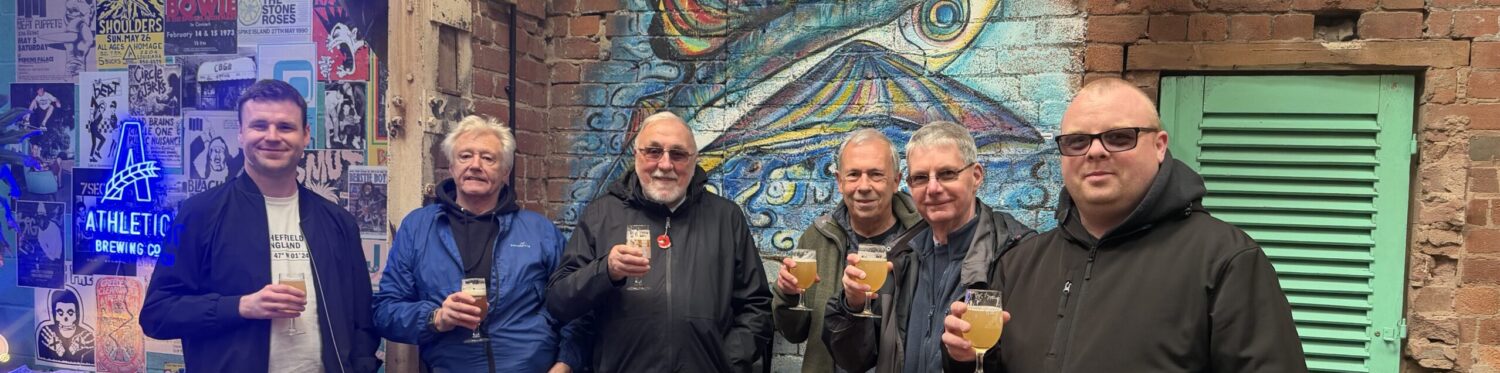
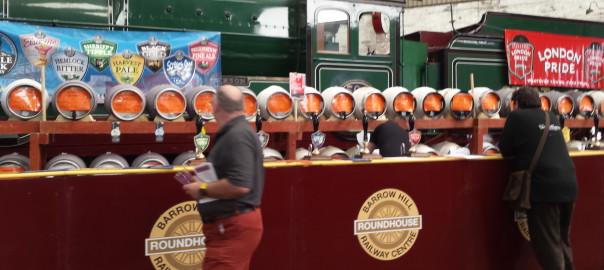
Members of our Dronfield & District sub branch got together for a working social at Barrow Hill on the Saturday of this annual festival, which was held in May as usual.
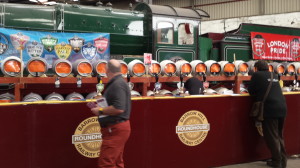
The festival hosts 5 real ale bars, a cider bar and a craft keg bar as well as various food and goods stalls and railway attractions.
Following a hectic few hours serving on the Derbyshire Brewers Collective bar members were able to enjoy a bit of social time, drinking the beer they had earned as well as sampling some of the foods on offer (Stalls sold options including burgers, liver and onions, hot dogs, noodles, curry, pies, cheeses, chocolate and fruit).
They also had a go on the train ride – 4 old ex BR carriages hauled one way down the remains of the branch line by a diesel shunter then back into the platform by a steam locomotive.
Once everyone had enough of this busy festival in the hot sunshine they made an escape by taxi to the Travellers Rest at Apperknowle for further beer and the end of the FA Cup final football match on TV with lifts arranged home from here!


Jon has left the Hive to join our friends at Lincoln Green Brewery in Nottingham. It may be too early to talk of a collaborative brew, but watch this space. We wish Jon all the best in his move and thanks him for all his hard work over the last few years. Of course Nottingham isn’t that far away so I’m sure we will still see plenty of him.
As Jon goes we are happy to promote Josh Jepson into his role full time and also to have taken on a new full time member of staff in Joe Berry as brewery assistant.
Beer-wise, Light Blue has made a welcome return for the warmer weather and plans are afoot for a series of new specials.
Making its annual return for June is
Summer Breeze 3.5%, a
New Zealand pale ale. Perfect for the warm summer day. This light refreshing golden ale uses the choicest hops from New Zealand. The legendary Riwaka hops add a zesty grapefruit flavour whilst Wakatu adds a resinous floral character. Tipple malt adds a slight biscuit malt character to round off this glorious summer pint.
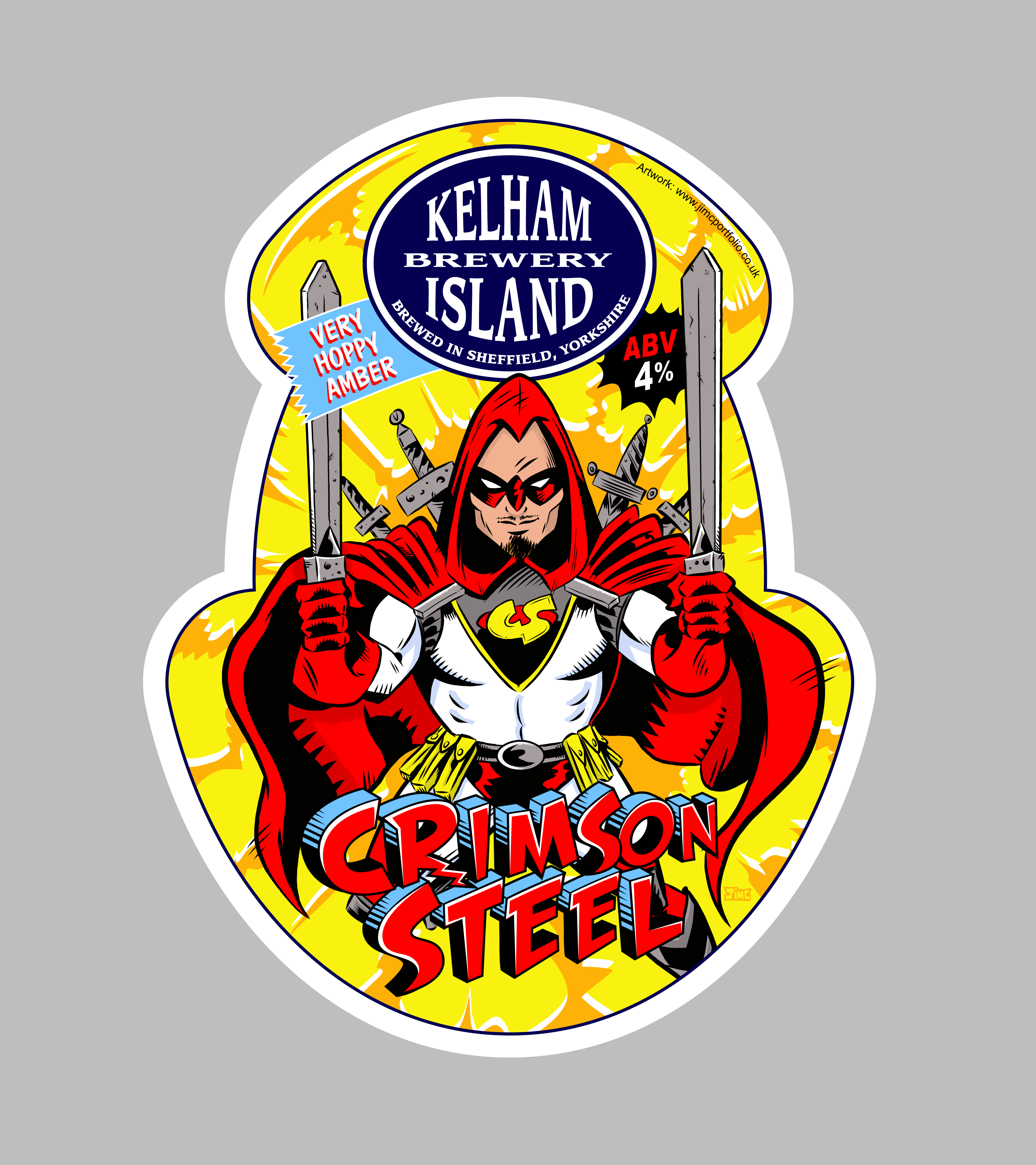
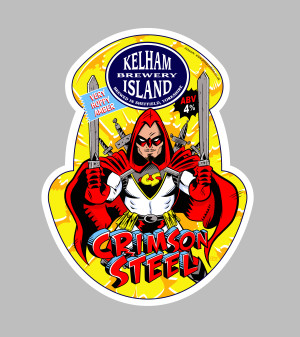 Crimson Steel
 4.0%, number five in our ‘Jim Connolly’ Light versus Dark series, is back. It’s a dangerously hoppy amber ale brewed with premium American hops for a charmingly pungent aroma of zesty citrus with a hint of nettle and aniseed. The colour comes from crystal and amber malt which balances the massive hop hit. Courageously hopped delicious ale.
If you were lucky enough to get a ticket to see the Arctic Monkeys at Finsbury Park over the May bank holiday you should have spotted the Kelham beer tent working hard to supply our
Easy Rider to 100,000 thirsty festival goers.
Don’t forget the Kelham Brewery shop for your BBQ beer requirements. 9 pint cans, 18 pint and 36 pint boxes are available.
Steel City’s bank-holiday-enforced hiatus continued through May, but Dave did manage to find time between trips to Austria, Poland, and France to travel to the slightly less exotic Mexborough, to brew not one but two collaborations with Dale at Imperial. Well, sort of!
Dave and Dale decided to indulge in a spot of parti-gyling, brewing 8bbl of Transatlantic pale ale and splitting it into two fermenters, one of which had dark malt and more hops added!
On the Light Side is
The Evil Empire Strikes Back, a Steel City-style Transatlantic pale ale with Maris Otter and wheat malts, Magnum for bittering, and a big flame-out charge of Galaxy, Citra, Willamette and Centennial.
On the Dark Side is
The Evil Empire Strikes Black which has added dark malt and Chinook hops.
Both have yet more hops added in the conditioning tank.
A few momentous things happened recently at the Devonshire Cat – it achieved 10 years in the Good Beer Guide, the owner who first opened the pub retired and Abbeydale Brewery took on the lease of the pub.
Sheffield CAMRA attended a special celebration at the pub where we presented certificates to mark the achievements.

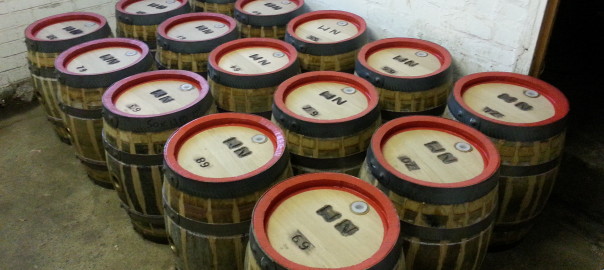
The ancient trade of making traditional casks from wooden staves for beer, wine, cider and spirits took on a new lease of life last year when Master Cooper Alastair Simms returned to God’s Own County to establish the White Rose Cooperage Ltd on the Thorp Arch Estate near Wetherby. Alastair, the last remaining Master Cooper, who, together with three Journeyman Coopers, preserves the ancient craft of making wooden casks bound by metal hoops for the brewing industry.
Born in Masham, North Yorkshire, Alastair became an apprentice cooper at Theakston’s Brewery in his home town in May 1979. Following a six month trial period he signed his indentures and went on to undertake his four year apprenticeship under the supervision of Master Cooper Clive Hollis. He successfully completed his training in 1983 with the “trussing in” ceremony and became a Journeyman Cooper. In 1994 he became a Master Cooper following the completion of his training of Peter Coates as a Journeyman Cooper. A year later, after sixteen years at Theakston’s Alastair moved to Wadworth Brewery at Devises where he took over from the retiring Eddy Hodder.
Meanwhile, at Theakston’s Clive Hollis passed away and his apprentice Jonathan Manby completed his apprenticeship under the guidance of Alastair in 1999. Eleven years later in 2010 he was admitted as a Liveryman to the Worshipful Company of Coopers which dates back over five hundred years.
After eighteen years at Wadworth, Alastair returned to his native Yorkshire to establish White Rose Cooperage at Thorp Arch on his 50th birthday in May 2013 as the country’s only independent commercial cooper. When he began back in the 1970’s, there were still around one hundred coopers in the UK but the advent of metal casks in the 1960’s saw numbers decline resulting in the craft almost fading away but for the handful of skilled craftsmen existing today.
However, the amazing growth in numbers of real ale microbreweries in Britain as a whole and Yorkshire in particular has meant that there is hope and the revival of demand for wooden casks is already taking place. Leading the way are Maureen Shaw and Neil Midgley at the Junction pub in Castleford, West Yorkshire where only wooden casks are now used for real ale. After purchasing the run down, empty, failed pubco pub, not only have they transformed it into a wonderful traditional local with many unique features but have backed it up with the gradual introduction of wooden casks. Now “wood only” is their mantra and people are taking notice of this revolution.
Neil and Maureen have invested in over 100 casks from Alastair and have around 10 local breweries supplying beers in the wood on a regular basis. The first and most regular supplier is Simon Bolderson and his Ridgeside brewery located in Leeds. Together, the pub and the breweries have proved that great beer can have that extra dimension if stored in wood. They have experimented with spirit casks and have also had great success with “Ageing in Wood”. Not only do wooden casks add a depth of taste to the stronger, darker beers which metal casks cannot provide but successful recent trials with lighter beers also show that they certainly add that something extra to them too.
Several progressive brewers in Yorkshire and a few from around the country have also take note of this great revival and have already purchased casks or placed orders from White Rose Cooperage. Alastair has also carried out contracts and orders from more pubs (e.g. Engineers Arms at Henlow), traditional cider makers and produces custom made bespoke furniture. From the beer and cider perspective, perhaps the most interesting creations are the glass head casks which enable the viewing of the activity and changes that occur when traditional real ales are clarified in wooden casks.
Alastair is hoping to take on an apprentice and wife Julie also plans to join the business. The long-term aim is to buy a few acres of land to build a cooperage and visitor centre so people can learn about this historic trade and watch coopers at work.
Back to the future – long may it continue.
Further information for Alastair can be found at:
www.whiterosecooperage.co.uk and the Junction at:
www.thejunctionpubcastleford.com.
David Litten
I was a bit taken aback by
Mark Coxon’s article about keg beer. (Beer Matters May 2014). He seems to be advocating drinking keg beers simply because it has been brewed by a craft ‘small’ brewer.
Just to be clear. Any pint of keg beer sold is a pint of real ale that isn’t. I thought the Campaign for Real Ale was about promoting real ale and not suggesting folk embrance keg. It seems to be a sell out on everything CAMRA has stood for these past 3 decades.
Nick Williams
I attended the recent CAMRA Members Weekend and was interested to note that “CAMRA recognises the term “craft beer” as describing beers with distinctive flavour brewed by artisans. Most real ales are craft beers but not all craft beers are real ale.” (CAMRA External policy Document, 2013-2014, para.3.8). The Oxford English Dictionary defines artisan as: “A worker in a skilled trade, especially one that involves making things by hand” with the modifier: “(Of food or drink) made in a traditional or non-mechanized way using high-quality ingredients.”
Hence, according to this CAMRA definition, ‘most real ales’ are brewed in a ‘non-mechanised way.’ This is clearly nonsense, (virtually) all brewers use some form of mechanisation as part of the brewing process. CAMRA needs to think again regarding this definition.
The American Brewers Association has also recently updated their definition of “craft brewer.” Before the update, their definition was, “A brewer who has either an all malt flagship or has at least 50% of its volume in either all malt beers or in beers which use adjuncts to enhance rather than lighten flavor.” Now: “A brewer that has a majority of its total beverage alcohol volume in beers whose flavor derives from traditional or innovative brewing ingredients and their fermentation.” The new definition allows brewers to use virtually anything (including corn or rice) and still be considered “craft.” Interestingly, the Americans do not define either ‘traditional’ or ‘craft beer’ – perhaps they agree, that as their definition of a ‘craft brewery’ becomes ever more wider, ‘craft beer’ has become a meaningless marketing term?
To take one example: our local supermarket sells ‘Hatherwood, Ruby Rooster,’ (3.8% abv) described, on the label, as ‘Craft Ale.’ The label reverse states that it ‘has been traditionally craft-brewed using Burton water, 100% British barley and a blend of Pale, Crystal & Chocolate malts.’ The only other clue to the brewer is the London address of the supermarket – Lidl Uk GmbH. After research, I discovered Ruby Rooster is a product of that well-known ‘craft brewer,’ Marstons plc ……. the price of this ‘Craft Ale’ is 99p for 500 ml, perhaps an indication of the quality of the ingredients?
Regarding quality of ingredients, Brewdog have recently opened a new bar on Division Street. The tiling is not yet finished but high abv ‘craft keg’ beers are available at over £4 for 2/3 of a pint. At these prices, the ingredients need to be the highest quality possible.
To summarise, ‘craft beer’ remains a meaningless term, perhaps it’s a phrase we should stop using?
Dave Pickersgill