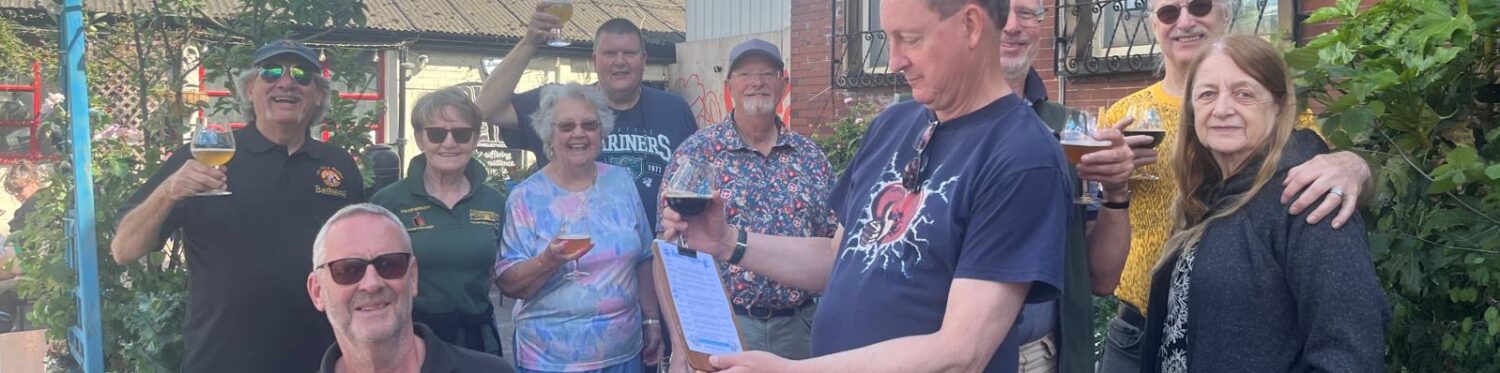
Dave has been a CAMRA member since the 1970s and has worked at almost 40 Sheffield CAMRA festivals, plus a fair number of others. He is Brewery Liaison Officer (BLO) for Abbeydale, Blue Bee, Bradfield and Loxley. He was also the Chair of the Local Organising Committee for the 2023 national CAMRA Members’ Weekend, AGM & Conference.
A member of the National Pub Heritage Group, he leads on planning and pub heritage issues. He also edited the Sheffield's Real Heritage Pubs book, for which downloads vastly exceeded expectations. The hard copy was available in October 2018 and again in 2021. On both occasions, it was a sell-out. The 5th edition (2023) is available as both a hard copy and a free download.
Congratulations to the Kelham Island Tavern on been voted as the Sheffield (Kelham Island) Pub of the Year 2022. Constructed in the 1830s as part of a terrace, and originally operating as the Sawmaker, the pub was later renamed the White Hart, and in 1995 became the Kelham Island Tavern, before closing in 1999.
Local CAMRA guides from this period describe the pub as:
‘Typical back street pub serving local factories at lunch times, quiet in the evenings’ (1979).
‘A three roomed unspoilt local, situated amongst the factories’ (1981).
‘Tiny three roomed pub. Rosettes and trophies adorn the bar.’ (1985).
‘Small open plan pub. Recently modernised from three small rooms’ (1996).
In March 2002, the derelict building was purchased and re-opened, specialising in real ale. By the following year, the local press had noted it as one of five pubs in the area among the ‘best real ale pubs in Yorkshire.’
In 2003, the Sheffield CAMRA guide described the pub as: ‘The newest free house to join the Upper Don Valley Ale Trail offering eight real ales of which seven are constantly changing. Opened in March 2002 after being closed for three years. A single room with a wood panelled bar, and a friendly welcome awaits you here. The scheduled garden to the rear is being developed.’
Over the last twenty years, the pub has continued to evolve from this promising start. Since 2019, under the new management of Josh and Louise, it has continued to offer a wide range of both cask (13) and craft beers: the beer garden is outstanding and the pub maintains the standards to which others aspire. The beer range is consistently excellent, always including at least one beer from Blue Bee. A simple bar snack menu is available including pork pies and samosas (while stocks last!).
The Kelham Island Tavern is the only pub to be CAMRA National Pub of the Year two years running (2008/9). It has been CAMRA Yorkshire Pub of the Year five times and Sheffield & District Pub of the Year on 15 occasions: a record which is unlikely to be overtaken.
Our presentation will occur on Tuesday 9 August: meeting from 8pm, presentation at 9pm.
CAMRA Sheffield & District Club of The Year 2022 is Stocksbridge Rugby Club. Luci Loxley, Bar Manager said: ‘this has come as a total surprise. Thanks to all the staff involved. We are very pleased.’
Previous winners in 2017, this busy social club is open weekday evenings and all day at weekends, offering two or three real ales: Bradfield Blonde as a regular plus one Bradfield guest and another guest from a local brewery.
The rugby club was originally formed in 1962 as a section of Stocksbridge Steel Works Social Services. Sixty years later, it has sports teams in local leagues, two teams in the pool league, and a very successful table tennis team.
The building originally opened in 1866 as Horner House Primitive West End Chapel. The Primitive Methodist church was an 1807 secession from the Wesleyan Methodists. It was particularly successful in evangelising agricultural and industrial communities at open meetings.
The 2nd December 1865 foundation stone celebrations for the chapel and schoolroom, part of the Sheffield Second circuit, are described by John Wenn in an 1866 Primitive Methodist magazine. The stone was laid by GH Benson Esq. and the ceremony was followed by a “plentiful tea” in the nearby Co-operative society store. Speakers included Revs C Lace, R Bryant and John Wenn and Messrs GH Benson, F Hill, R Holden and John Manterfield. In 1932, the name changed to the West End Methodist Church. The building was extended in 1889 and the frontage was remodelled in 1959. This as, ‘it was felt that the ever-increasing flow of traffic ….. constituted a real danger to our scholars as they came straight down the Church steps into the main road.’
Almost half a century ago, in 1974, the chapel closed and was left to rot. It was acquired by the rugby club in 1983. The building was gutted and the inside completely rebuilt. The original first floor which sloped from front to back was replaced. All the work was completed by members of the club. The new social centre reopened in 1985 using the old downstairs schoolroom. Three years later, in 1988, came the official opening when the upstairs function room came into use. This room has it’s own bar and is often used for private events: everything from barn dances to childrens parties.
The war memorial, originally fixed to the east wall was removed to the Wesleyan chapel at Old Haywoods, Deepcar. That is now closed, the memorial relocating to nearby Christ Church. It commemorates members of the congregation, ten men and one woman, who lost their lives in WW1.
The original 1865 Deed of Transfer signed by the Trustees with the vendor, Samuel Fox, states that: ‘No building erected upon the said plot of land shall be used as a beer house or public house …. without the consent in writing of the said Samuel Fox or his heirs or assigns.’ We assume that this consent has occurred.
Our presentation will be on Friday 3rd.June at 17:00, to coincide with their Jubilee Beer Festival. We hope to see you there. Bus 57 from Sheffield or Bus SL1/SL1a from Middlewood tram terminus will get you there.
Reference: Stocksbridge Primitive Methodist – West End Methodist Church 1866-1966. Centenary Handbook. pages 8, 19
The Sheffield Tap is our 2022 Sheffield City Centre Pub of the Year. Winners in 2020, the Tap has won this award on successive occasions (there were no awards in 2021).
The story of the Tap is well known (see March 2022 Beer Matters). Suffice to say that this multiple award-winning pub, re-opened in 2009, has become both an integral part of the nationwide beer-tourism network while providing an ever-changing range of beers, including those brewed on-site.
The space is adorned with Minton tiled walls and fine ornamented bar fittings. In the 1960s, the space lost its original use and by the 1970s was a waiting room. Thirty four years after closure, a £180,000 comprehensive overhaul saw the tiling, terrazzo floor and woodwork, including parts of the bar fittings, beautifully restored.
The later key development was when the Tap expanded into the former First Class Dining Room. The tiled and mirrored interior was restored and in January 2013, Tapped Brew Co., began brewing on-site. Two years ago, Ben Tysoe, took on the Head Brewer role.
Congratulations to the Tap for this award: long may they continue to provide a warm welcome to Sheffield while simultaneously causing many customers to decide to wait for ‘their next train.’
Sheffield Archives have updated their very useful research guide: ‘Sources for the Study of the History of Sheffield’s Public Houses.’ This invaluable A4, 22 page booklet, includes many information sources and useful suggestions as to how to gain access. Free download: https://tinyurl.com/2p88t5v9
Last October, we reported on the Sheffield Wheat Experiment in which 200 local people planted wheat. A year later, the wheat was harvested, allowed to dry and threshed. Two kg of the resulting 130 kg of grain went to local brewery Grizzly Grains to form part of a collaborative brew. A kilo of the remaining harvest was the seed for the second sowing of the experiment and the rest became flour.
Over two hundred, 33 cL, bottles of Growers’ Union, 5.2% ACV resulted. After a suitable maturation period, the beer was recently sampled as part of an online tasting event led by Sam. A brief introduction from grower, Ruth Levene, included the obvious: ‘What happens in beer tasting stays in beer tasting.’
Sam then provided a succinct description of the brewing process and explored the main differences between ale and lager. Over 40 participants then progressed to Helles Lager, 4.1% ACV, a gluten-free beer from the nearby Triple Point Brewery. This summer beer was a little incongruous on a cold January evening. However, the traditional light hops and floral malt flavours were evident. As one participant put it, ‘tastes of Germany.’
We then moved to the main event; the first commercially-produced beer that has included ingredients grown in our garden: Growers’ Union. This unfined, unfiltered bottle conditioned beer is a hybrid of styles. The nose, and taste, is predominantly malty, but includes notes of apple, biscuit, caramel, dates, dried fruit, honey and toffee. In short, an excellent use of locally grown wheat. The label was designed by local grower, Rachael McNiven.
Throughout the evening, Sam expertly responded to a series of questions as we progressed to the final beer of the evening: Grizzly Grains, Tilt Hammer, 4.9% ABV Stout. The original home of the brewery was above the Rivelin Valley, home to many such hammers in the 19th century. This traditional bottle conditioned stout has notes of blackcurrant, chocolate, coffee and even a hint of liquorice.
As the Sheffield Wheat Experiment goes into its second year, I look forward to the 2022 edition of Growers’ Union, a beer which is likely to reference Belgium, targeting a style which will allow the wheat to dominate.
Almost twenty years ago, Communications Engineers, Jamie Hawksworth and Jon Holdsworth established a specialist beer importing wholesale business, based in York: Pivovar, breweries/brewers in Slavic.
As part of their day job, they later found themselves on a roof at Sheffield railway station, adjacent to platform 1b. Looking down, into a semi-derelict building, they were convinced they could see a bar. Further investigation followed: the old First Class Refreshment Room was originally built by the Midland Railway (company architect, Charles Trubshaw) as part of the 1905 station extension. The rooms were disused in the 1960s, by the 1970s were a waiting room and were closed in 1975. They are adorned with Minton tiled walls and fine ornamented bar fittings.
Jamie and Jon suddenly had a new job. Restorations began and in 2009, the Sheffield Tap, the award-winning and undisputed best railway pub in the UK, opened. This followed a £180,000 multiple award-winning comprehensive overhaul in which the tiling, terrazzo floor, parts of the bar fittings and other joinery were beautifully restored, while items beyond repair were carefully replaced or replicated, including the entire coved and sky-lighted ceiling.
The next decade saw a hive of activity as Pivovar added new outlets: the York Tap (2010), the Harrogate Tap and Tapped Leeds (2013), Pavement Vaults (York, 2015) and the Newcastle Tap (2017). They also became partners in the bar group Thornbridge and Co. with outlets in Birmingham (Colmore), Leeds (Banker’s Cat) and York (Market Cat).
However, the key development was the 2013 extension of their flagship: the Sheffield Tap expanded into the former First Class Dining Room. The tiled and mirrored interior was restored and an on-site brewery, Tapped Brew Co. began brewing in January 2013. This 4 Bbl. set-up was a 2008 PBC Brewing Installations kit which re-located from Great Heck Brewery when they moved site.
Like many others, Head Brewer, Ben Tysoe, commenced his career working for Dave Wickett at Kelham Island Brewery, adjacent to the legendary Fat Cat. Aged 16, he was shifting and carrying, bottling and labelling. Three years later, in 2001, he moved to the new Kelham Island venture at the Devonshire Cat. By 2003, his name was above the door as one of the youngest pub managers in the city. 2011 saw changes: travelling, stints working at the Great British Beer Festival and more employment in breweries. Two years later came employment with Pivovar: accounts, deliveries, bar management, and by 2018 work in the brewery. Two years ago saw the seminal move to the First Class Dining Room.
In addition to the Sheffield brewery, Ben also uses the microbrewery at Tapped Leeds to produce pilsners while, in 2020, Pivovar established the Elvington Brewing Company at their York headquarters. The latter produces Mittel Pils, the recent winner of overall best keg lager, at the International Brewing awards.
Back in Sheffield, the all-cask output is sold onsite and at other Pivovar outlets. Tapped beers are occasionally seen in the free trade. The regular range is:
Mojo – the first beer brewed, a 3.6% Pale Ale
Toha – a 3.6% Pale Ale using New Zealand hops
Jericho – a 4% West Coast Pale Ale
Sorsby Stout – 4%, named after Sir Robert Sorsby (1577/1643), the first Master Cutler.
Sheaf Street Pale – a 4.5% session IPA
Station Porter – a rich dark 5% brew featuring chocolate malt
Tapped are currently looking to the future: some minor rebranding coupled with an increased emphasis on collaborations, one-offs and pilot brews. With experienced, enthusiastic and knowledgeable input from Ben, we anticipate hearing many positive reports.
In December 2021, the Frecheville was demolished without planning permission. The owners, Nelson’s Development & Construction Limited, had applied for planning permission for demolition and erection of a three-storey building to create 11 apartments (7 x 2 beds and 4 x 1 bed) with associated car park, bin store and landscaping works.
However, at the time of demolition, no decision had been made by Sheffield City Council regarding the planning application. We note comments from local residents regarding the planning application and recent press reports which quote local councillors.
The Carlton Tavern (Kilburn, London) sets a clear precedent for actions of this sort.
This Carlton closed in April 2015 then, two days before Historic England was due to recommend the pub be granted Grade II listed status, the owners demolished the building, without planning permission. They expected a £5000 fine. However, Westminster Council had a different opinion. They ordered the owners: CTLX, to rebuild the Carlton brick by brick. Earlier this year, having been totally rebuilt, it re-opened.
CAMRA Sheffield & District believe that Sheffield City Council should take a similar hard-line approach to that adopted by Westminster. Developers should not be allowed to demolish, without first achieving the appropriate planning permission.
The national Planning Inspectorate has recently upheld an appeal against the second (2020) Sheffield City Council (SCC) planning decision to refuse the demolition of the Plough Inn (Sandygate Road, Crosspool, Sheffield). As the local Community Group puts it:
‘It’s time to say goodbye to the Plough. The Planning Inspector has upheld Spacepad’s appeal, and the pub will now be demolished, and the site redeveloped. The Planning Inspector reached the conclusion that there was no realistic prospect of the pub reopening. It is a sad ending for our campaign, but we feel we did everything we could to save this piece of Sheffield’s heritage. We would like to thank everyone who supported our campaign over the years.’
The Inspector has accepted that the pub is not a viable commercial proposition, that it has been properly marketed and that there are suitable alternatives close enough by. Both the local Community Group and CAMRA Sheffield & District believes that all these judgements are highly contentious.
This is the latest twist in a saga which commenced, almost a decade ago, when the previous owners, Enterprise Inns (Ei), decided to deliberately run-down their historically important asset before closure in 2015. Two years later, a planning application to SCC to turn the site into a branch of Sainsbury’s was rejected. The pub company then refused to sell to the Plough Community Benefit Society Ltd. (PCBS), a local Community Group and instead, sold to a property developer. They, in turn, allowed the condition of the building to deteriorate: there has been no serious maintenance work. Ei and the subsequent owners, Spacepad UK, left the pub to rot.
The site deteriorated to such an extent that it became the subject of a Planning Enforcement enquiry regarding unauthorised use as a waste disposal facility and a storage site for unregistered vehicles. It was Spacepad who, according to SCC Planning Enforcement, used the land ‘to store unwanted building materials, a caravan, a JCB type digger, a static cabin, trailers, pallets, a fork truck, vehicles, building and non-building materials and other paraphernalia.’ An Enforcement Notice was recommended.
The Planning Appeal Form completed by Spacepad, makes much of the poor condition of the building, blaming ‘vandalism, burglary and fly tipping.’ Many believe that this is a red herring: the current poor condition of the building and site is solely the fault of the owners. Planning law places responsibility for the condition of the site with the owner. By law, the building should have been maintained in a fit and proper condition for its permitted use as a public house: the owners have not carried out this legal obligation.
At the time of the purchase from Ei, an independent report, commissioned by PCBS demonstrated that, for the pub to reopen, no major building work was required and that internal refitting costs were manageable within a realistic business plan. Currently, the Plough would require substantial refurbishment before it could be brought back into use. A figure of ~£450.000 is quoted in the Appellant Statement. The owners have failed to make this investment and have failed to reinstate the property.
Dave Pickersgill, Pub Protection Officer for CAMRA Sheffield & District states: ‘The recent planning application and the appeal documents do not provide any evidence to suggest the building is not viable as a public house. The developer states that no offers were received to lease the pub. This was because it was offered for a completely unrealistic rent of £50,000 pa. In 2019, average rents in this area were between £24,000 and £29,000. In addition, this planning application would see the Plough replaced by eight houses, none of which would be affordable housing.’
The recent planning history of a site is also a relevant consideration in planning decisions. In 2017, the local authority rejected Sainsbury’s application for change of use based on the Plough’s listing as an Asset of Community Value (ACV) and it accepted that there were no alternative community facilities within a reasonable distance. In 2018, following the sale of the Plough, the local authority re-listed the pub as an ACV. As there have been no material changes in the reasons why the Plough was listed as an ACV, this should have remained an overriding consideration in any decision.
The Plough was rebuilt in 1929 and is an important example of an inter war public house which, according to Historic England, are ‘rare and overlooked buildings’. National planning policy recognises the importance of protecting historic assets and their ‘setting.’ This was confirmed in the decision of the local authority to refuse the application from Sainsbury’s.
According to Historic England, about 3,000 pubs were built during the inter-war years. Very few survive. A recent study finding that inter-war pubs are under greater threat of disappearing than pubs of any other date.
In short, as this appeal was allowed, it implies:
the Secretary of State ignores local community opinion
if a developer allows a historic building to slowly decay: eventually, they will be given permission to demolish.
The covid pandemic has highlighted the importance of local community facilities and high streets, both of which contribute to supporting vibrant, successful and sustainable communities. The Plough, ran as a community pub, could bring countless economic and social benefits to the area. It also has the added attraction of its key place in the history of world football – it is adjacent to the site of the official first inter-club football game: Hallam v Sheffield at Sandygate (26 December 1860) and has played a part in the development of football. A small internal museum would not have been inappropriate.
1695
The Plough opens as a public house
1897
Tennant Brothers acquire the lease to the Plough and the adjacent sports ground
1929
The Plough Inn is rebuilt
1969
The lease is assigned to Whitbread who become Patron of Hallam FC
2003
Enterprise Inns acquire the pub
2015
Closure of The Plough Inn by Enterprise Inns (Ei)
2015
The Plough Inn achieves ACV status
2017
Planning application from Ei to replace the building by a mini-supermarket is refused by SCC
2017
Ei refuse to sell the pub to a local Community group, instead selling to a property company, Spacepad
2018
The Plough Inn achieves ACV status for the second time
2020
Planning application from Spacepad to demolish and replace by flats, is refused by SCC
2021
An appeal by Spacepad to the planning refusal is upheld by Planning Inspectorate
The Maison du Biere in Elsecar is now selling copies of our guide to Sheffield pubs with surviving heritage features and editor Dave Pickersgill will be visiting for a book signing event on Saturday 11 December from 2pm to 4pm.
The South Yorkshire Local Heritage List identifies heritage assets that are valued as contributing to the distinctiveness and history of South Yorkshire but that are not protected by statutory national designations, such as Listing or Scheduling. Inclusion on the Local Heritage List can allow the more local significance of a building, place or site to be taken into account in planning decisions that affect it or its setting. It does not provide the same level of protection as national designation, but will be of assistance when planning applications are submitted.
Sheffield and District CAMRA has ensured that pubs mentioned in the recently published book, Sheffield’s Real Heritage Pubs which are not nationally listed or in a Conservation Area, have been put forward for the Local Heritage List. However, this leaves many pubs which are not listed – possibly your local?
From the website, you can view the existing list, see the assessment criteria and nominate candidates. Please make sure your favourite heritage buildings are nominated!