Welbeck Abbey

As we wistfully leave summer behind, we are winding down to a slower pace with these autumnal specials.

Cathedral Beeches  is a 3.7% pale English bitter. This brew is full of heady herbal aromas from British Phoenix hops, making it surprisingly delicious and certainly more interesting than many of its counterparts. The name of this classic ale stems from an area of woodland with towering Beech trees in which young lovers at Welbeck used to come and carve their names.

Our second offering for September is 43’ South, a New Zealand hopped session pale at 4.3%. There is a little farmstead called ‘Welbeck’ on the South Island of New Zealand. Situated at 43° South, it looks like a perfect paradise. This sessionable pale ale uses Wakatu and Wai-iti hops, grown in New Zealand. The combinations of these New World hops give this pale ale the subtle flavour of peaches and apricots, lifted with a delicate floral aroma.

Finally, we have the next brew in our Found and Foraged range. Pick of the Bunch is brewed with our dedicated community’s hand-picked blackberries. This 4.8% Blackberry pale is subtly pink, slightly tart and extremely refreshing. Thank you to our local friends who have gathered a hoard of hedgerow blackberries for us to brew this September special.

Louise

The decline of independent cider farms

2019 was one of the worst years of cider production in the UK not because sales were down but due to the amount of small producers that closed. Over the last five years the UK has lost around fifty independent farm producers, twenty four of which were in 2019. I regularly talk to producers who are not just my suppliers but over the years have become friends and I have met several characters who I have the utmost of respect for even though they still make me smile especially when I go on buying trips and am given tasters of their latest ciders in full pint glasses. 2020 for those who don’t yet know is the last year of our membership to Europe, for ciders this may actually be a good thing as the EEC currently have a new bill which will become law by 2021, this being the 92/83/EEC Duty Bill, this will bring in the ability to add 1.2% industrial alcohol to cider and perry during production. Also allow the current rule of only 5% juice being required to be called a real cider. Here in the UK the minimum juice is currently 80% and the Small Independent Cidermakers Association wants it to be 90-95%. But I digress; when I talked to the farmers that were closing there seem to be two main reasons, one a result of global warming and the other the government being greedy through taxation. In fairness the taxation and increased duty only affects farms producing more that 7000 litres of cider and perry or just over 1500 gallons per year. The revised duty rates were changed yet again on the 1st October 2019, Alcohol Duties Act 1979 section 55B(1) and Excise Notice 162, but were in use since the previous April. There are three duty bands for still ciders: (A) 1.2%-6.8% (B) 6.9%-7.4% (C) 7.5%-8.4% Ciders of 8.5% and above are classed as ‘made wine’ and taxed at the wine rate, ciders with additives like fruit flavours will be taxed as ciders up to 4.5% any fruit ciders over 4.5% being taxed as ‘made wine’. Also ciders of 7.5% may no longer be watered down to produce lower ABV ciders. Incidentally the HMRC definition of Cider & Perry is the fermentation of apples or pears with nothing added with an ABV of between 1.2-8.5%. According to CAMRA guidelines the Cider and Perry definition is very similar and states it is the fermentation of apples or pears with nothing added, no syrup or artificial carbonation or pasteurisation may be included. In Shepton Mallet the Cider Mill which has been in use since 1770 is set to close with a loss of 127 jobs, the mill is currently run by the Dublin owned C&C company which is behind the well known industrial ciders Gaymers and Blackthorn. Although we don’t mind an industrial cider company closing it does affect the apple growers, with over 70 farms, of which some 30ish are in Somerset and the remainder in Herefordshire. C&C state the mill is no longer a viable option and the business will be moved to their Clonmel operation in the Republic of Ireland, they will then export the ciders back to the UK, bit of Irish logic at work there we think or making full use of the European fake cider rules of the low juice content in their ciders is a more likely option. As to global warming, this has increased the risk of flooding; many will remember the 2014 floods in Somerset which flooded great swathes of farmland and orchards alike. Particularly across the Somerset Levels and the creation of flood defences along the A372 is now required. One particular cider farm in Aller which has produced cider since 1925 had to close its doors due to there been no access to his farm shop by the public after local road closures and no access to local market towns to sell its ciders, Somerset Council have been seen to be dragging their feet and have recently stated that these flood defences are still several years from completion. High winds are also blowing the apples from the trees before they’re fully grown. The Welsh government is to also bring in a new tax which is due to start on the 2nd of March 2020, a new alcohol unit charge of 50p is to be added for all producers in Wales wishing to retail their ciders and perrys in Wales. This is 50p per unit of alcohol sold, one unit being the ABV as a integer, multiplied by the volume in ml divided by 1000 so a pint of 7.5% cider becomes: 7.5 x 568ml / 1000 = 4.26 x 50p an increase of £2.13 per pint! Are they purposely trying to cease Welsh cider retail sales? Of course the way round this is to sell to a wholesaler who will then sell it outside Wales and not incur the new tax? Last lot of doom and gloom is down to Heineken who have announced an end to their cider apple deals. Up until now Heineken were buying a third of all the cider apples grown in the UK, mainly from Herefordshire and will soon terminate these deals with 180 farms, they were being used to produce Strongbow cider brand. Heineken have announced due to new equipment and brewing processes theses apples are no longer required to produce their ciders, yet they have increased production of these ciders. A total loss estimated to be between 6000 and 9000 tons of cider apples, farmers are now considering bulldozing their orchards, which is a real travesty. So what can be done? Well if CAMRA stick by its guidelines and only sells real cider and perry at its festivals or at least separate the fake ciders from the real one and educate their customers to know the difference and buy more real and less fake ciders, advise pubs to do the same, stop pushing Mango syrup cider then there is a possibility that the small farms will gain popularity and stay in business. Nottingham CAMRA festival is a great example of what ciders to sell, always doing very well on cider sales and not stocking the fake or fruity ones. None CAMRA student festivals are heading in the right direction with increased real cider sales although there are still fruit ciders available for those people who normally drink pop. After all you need some fruit pop to compare the real stuff against for educational purposes. If anyone would like and advice on real cider and perry please use the contact form from our website which can be found at cidermen.uk if we can’t help you ourselves we can point you in the right direction enabling you to get the information you require. Andy Parkin Ciderman UK

Loxley Brewery

This month we are kitting out our brand new bottling plant and we are extremely excited to give the bottles a home of their own! The ‘container’ is situated right next door to the Brewery itself, behind The Wisewood Inn. The demand for our bottled beer has been better than we could ever have hoped for, so we are expanding to keep our customers happy, hoppy and hydrated. Our core range of bottle beers: Revill, Fearn, Gunson, Halliday and Lomas will be flying out of the plant and onto local shelves in and around Sheffield. If you fancy a bottle, our full range is available at both The Wisewood Inn and The Raven Inn. Our new series of beer is already underway, taking inspiration from the countryside which is on our doorstep. We kicked off our latest series with a 5.0% American Pale Ale named Windy Bank, which has proved to be a fan favourite! Work is already commencing on part 2, and hopefully it will be in pint glasses very soon. Follow us on social media for updates on the release date!

Abbeydale beer series celebration of Sheffield

Sheffield-based Abbeydale Brewery have this week launched a new series designed to shine a spotlight on the lesser known ‘Hidden Treasures’ of their hometown, starting with a focus on their very own history, and bringing the story of their industrial heritage to the fore.
The first of the series is named ‘Family Heirlooms and Tuneful Endings’, and the artwork, created by Abbeydale Brewery’s designer, James Murphy, depicts what was once the Morton family scissor factory on West Street, and the tuning fork bollards inspired by their business which can now be seen on Bailey Lane.
Before establishing Abbeydale Brewery in 1996, Patrick Morton worked in the family cutler business alongside his father Hugh (himself a cutler since the 1950s) and brother Chris. Manufacturing scissors was the primary operation, and what the Morton’s made were considered among Sheffield’s finest. They were a long-lasting, high quality and expensive product, and so by the 1980s the shop did more scissors, knives, and sheep shears repairs than selling new products. Bric-a-brac and cutlery was sold from the Mortons shop on West Street, often bought by the hundred-weight at auction from Sheffield’s dying industries.
By the 1990s, the Morton family eventually moved out of the cutlery business (after Chris spent a brief stint as a tuning fork manufacturer) and established Abbeydale Brewery. The business has been growing continually ever since with Patrick Morton still very much at the helm, along with his wife Sue, who joined the company in the early 2000s.
The tuning fork sculptures shown on the pump clip appeared without fanfare when the now Morton Works was redeveloped into flats and a bar, when builders found and were seemingly inspired by hundreds of part-manufactured tuning forks made by Chris. They now commemorate part of Sheffield’s industrial heritage. Nobody seems to know much about why they are there, a story which Abbeydale Brewery are happy to bring back to life!
Director Dan Baxter says of the new series: “So much of the everyday is overlooked in favour of more glamorous and visible landmarks. We wanted to focus on the bits of our city that we think are truly special, and that you might not necessarily have come across before. Here’s to the humble and the timeless!”
The series will continue throughout 2020, with other quintessentially Sheffield landmarks and features such as the Dragon of Wantley and Simpkins Sweet Factory being reimagined in James Murphy’s distinctive illustrative style.
The beer itself is a classic pale ale and casks were available for trade customers to order from Monday 9 March while stocks last.

The Tram Train to Rotherham

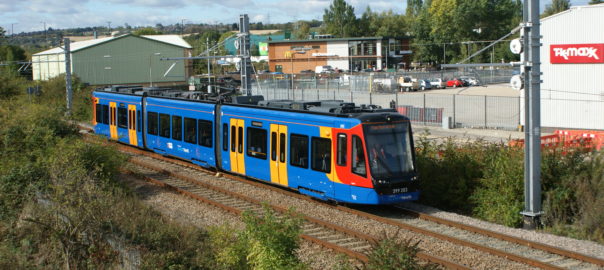
The Tram Train is the newest route on the Supertram network, so called as it is the national pilot of using a vehicle designed to operate on both the tramway and Network Rail lines. It runs about every half hour from the Cathedral tram stop in Sheffield City Centre along the tram route to Meadowhall then on the main line railway to Rotherham town centre and Parkgate. The Tram Train service lends itself to visiting various pubs and breweries for a different beery day out! The service runs until midnight most days (9pm Sundays) and you can buy an all day pass to hop on and off as you please. Tickets are available from the conductor on board or on the Stagecoach app.
If you have a little wait before the Tram Train is due, there are a choice of pubs near the Cathedral tram stop including the Church House, Three Tuns, Cavells, Bankers Draft and Dove & Rainbow. Once on your way, here are the stops and pubs to know about! Attercliffe tram stop If you enjoy modern craft beers, alight here for a short walk to the Brewery of St Mars of the Desert, which has a tap room that opens most weekends showcasing their beer, run by the friendly Dann and Martha who are always happy to talk beer and impromptu brewery tours are not unknown! Valley Centertainment tram stop Walk through the complex onto the main road and you will stumble across a classic pub, the Wentworth House offering a selection of real ales, they also have a dining room serving food at meal times. Next door and across the road from the Arena is the Eighteen Ten, this is a more modern food led chain pub owned by Marstons Brewery under the “Grill & Pizza” banner. Meadowhall South tram stop Enter the Meadowhall shopping centre across the road and head for the Oasis dining quarter where you will find a Wetherspoons pub, the Steel Foundry. Rotherham Central station Turn right out of the station and this will take you into the town centre for a choice of real ale outlets: Bridge Inn: The original home of Rotherham CAMRA, the pub reverted to its original name after a spell as Nellie Denes. It is an Old Mill tied house, originally built for the Mappin Brewery, opposite, in 1930 using stone from the original Bridge Inn, which dated back to the 1700s. up to five real ales are on the bar and the guest ales are usually from local breweries. There is live music most Saturday evenings and karaoke on Thursday and Friday evenings. Upstairs, two function rooms are used by local groups. The nearby Chantry Bridge has one of only three Bridge Chapels still existing. Opening hours may vary, and may extend if there is a function on. Will only open on Sunday for special occasions. Changed manager in 2018. There is a wall mural by Phil Padfield in the outside yard area that was done for the 125th anniversary of Arthur Wharton’s signing for Rotherham Town FC. Arthur was the first professional black player in the UK. Three Cranes: The oldest secular building in Rotherham town centre, originally built as a town house in 1470. With Tudor and Victorian additions it later became the Three Cranes Inn public house and operated as such until 1907, when the licence was surrended. It was used as various shops until it fell into disrepair in recent times. It was bought by Chris Hamby in 2011 and restored and reopened as Hamby’s Antiques shop in 2015. Following closure in May 2019, it was refurbished and reopened as a pub again on the 10th of August. Though called a micropub, it is on two levels. The Heritage rooms on the two upper floors have the most period features but but can only be viewed by agreement. As well as four real ales, there are also several craft keg beers and real ciders on sale. Real ales may be sourced locally and from further afield. Bluecoat: Former charity school, opened in 1776 by the Ffeofees of Rotherham. Became a pub named Ffeofees in 1981 and a Wetherspoon‘s in 2001. The selection of up to ten hand pulled beers is listed on a screen at the end of the bar and those from local microbreweries are favoured. Three real ciders or perries are served from boxes behind the bar. The pub commissions a specially brewed beer four times a year. There is a quiz on Wednesday evenings. A Good Beer Guide regular, local CAMRA Branch Pub of the Year five times and winner of several other CAMRA awards. Cutlers Arms: Originally dated 1825, the pub was rebuilt for Stones Brewery of Sheffield in 1907. Architect R. Wigfull was responsible for the impressive façade and other features. It was faced with demolition in the early 2000’s but was saved following statutory listing in 2004. Following a period of closure it was newly restored to its original Edwardian splendour by Chantry Brewery, reopening in February 2014. It retains some of the original art nouveau windows, tiling and original curved bar counter with elegant dividing screen. Local craftsmen were employed on the restoration. Offering a full range of Chantry beers, guest ales, two real ciders and quality craft beers on tap. Live music is on every Saturday evening, Sunday afternoon and most Fridays. Featured in CAMRA’s National Inventory of Historic Pub Interiors New York Tavern: A pub since 1856, it was re-opened by a team from Chantry Brewery in Sept 2013 and has been fully refurbished as a real ale led pub. At least six Chantry beers are available and two real ciders or perries on hand pump, all at very competitive prices. A large selection of foreign bottled beers and, unusually, snuff is available. Pickled eggs are also available. Originally the Prince Of Wales Feathers, it was renamed after the old name for the area and a pub demolished when the nearby ring road was built. Handy for the New York football stadium and Rotherham United memorabilia is displayed. The Jukebox has an eclectic selection of music. Parkgate tram train terminus The tram will deposit you behind the huge retail park which you will need to walk through onto the main road and then turn right. Chantry Brewery: A couple of minutes walk up the main road and on the left, on a small industrial estate, you will find Chantry Brewery, which now boasts a tap room on the mezzanine level, which opens Thursday to Saturday, offering the opportunity to enjoy their beer at source! Note some Friday evenings the brewery hosts ticket only live music gigs. Little Haven: A bit further up the main road, beyond the roundabout, is this friendly little micropub offering a choice of real ales (usually from a local brewery) and bar snacks. It also hosts events such as quiz nights and live entertainment from time to time. Onward by bus If you aren’t ready to get the tram back yet, bus 22X towards Barnsley can be boarded in Parkgate, along the route there is Something Brew Inn at Rawmarsh, the award winning Wath Tap micropub in Wath on Dearne and the Anglers Rest (Geeves brewery’s tap pub) at Wombwell to visit as well as a choice of venues in Barnsley town centre. Buses (2 or X17) and trains are available from Barnsley Interchange to Sheffield or alternatively return to Rotherham for the tram. Travel tickets Tram Only Dayrideroffers unlimited travel on Supertram services including tram train. Stagecoach Dayrider Silveroffers unlimited travel on Stagecoach buses and Supertram in South Yorkshire and Chesterfield South Yorkshire Connect offers unlimited travel on all buses and trams in South Yorkshire South Yorkshire Connect+offers unlimited travel on all buses, trams and local trains in South Yorkshire. For more information on the above travel tickets including prices visit stagecoachbus.com or sytravelmaster.com respectively.

Kelham Island Brewery

Kelham’s April specials being brewed are:

Risen Rider: A robust stout blended from dark malts that give rise to a classical burnt and roasted aroma with caramel flavours coming through from the malts and a little something later on for a bold yet sweet finish.

Operation Wolf: A pale amber hue forged from a combination of pale and Vienna malts for a sweet and malty finish. Offset by a light hop bittering whilst pine, floral and fruity notes compliment the late addition of honey for an added sweetness.

Joe

Ingle all the way…

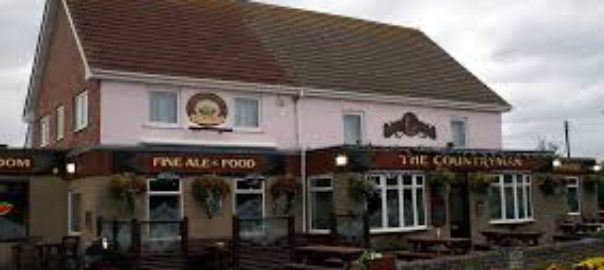
Ingoldmells a village 3 miles from the beer desert of Skegness. A village which surprisingly has a brew pub and great real ale. Jenny Chamberlain’s family have owned the Countryman pub in Ingoldmells since 1960 and Barry Good has been there since 1974. Originally the Countryman was the Ingoldmells Social Club. Later, the name was changed to the Ace of Clubs (still a members-only establishment) and then, in 1988, it transmuted into the Ace Inn, a fully fledged public house. The Countryman we know today was created when the original building was altered and enlarged at a later date. Looking at the front elevation, you can be forgiven for thinking that the building is wholly a product of the 1960’s or 70’s. The secret history is revealed when you check round the back and spot the brickwork of the original Leila Cottage, reputedly an eighteenth century building. By the middle of the nineteenth century the house was occupied by James Waite, a famous and successful local smuggler. This may seem a fanciful idea now but the Lincolnshire coast between Boston and Mablethorpe was notorious for such clandestine activity and old Ingoldmells was at the heart of the trade. Indeed, Tom Paine (1737-1809), the famous author and revolutionary (and formerly an excise officer) was based at nearby Alford between August 1764 and August 1765 for that very reason. Scott Colebourne with the half barrel plant The idea for a brewery came in the summer of 2007 after Barry had spotted an advertisement in “The Publican” for a half-barrel plant. He and Scott Colebourne (who was working at the Countryman at the time and became head brewer) decided to experiment with a “hobby” brewery and were easily persuaded by the manufacturer who also supplied a simple recipe and brewing kit. Fortunately, the pub had previously stocked beers from the Fugelestou Brewery (Louth) and Phil Ellis provided free and friendly advice to the Countryman team. The first principle Barry and Scott agreed upon was to keep things simple. Honey, coriander and hedgerow weeds were definitely off the menu! Ace Ale (a mid-brown session bitter at 3.8%) duly emerged and was eventually accompanied by a light-coloured summer IPA (Leila’s Lazy Days at 3.6%) and a dark ruby autumn/winter beer (Lincolnshire Life at 4.2%). Success bred success and Barry purchased a 2.5 barrel plant from Poacher’s Brewery in Lincoln which had downsized production. A stable on the Countryman site had become vacant and this was converted and the plant installed between December 2008 and March 2009. By summer 2010, brewing was sufficiently advanced to have all three beers permanently on. At present, Leila Cottage has to use informal arrangements (the backs and boots of cars!) to supply beer festivals and the odd pub. Although there’s no official delivery system, casks can be collected and Fugelstou, Oldershaw’s and Small Beer at Lincoln have assisted at one time or another. Advance notice will allow you to see the brewery and there is a large car park as well as facilities on site for caravans and camper-vans. So, if you are holidaying in the area or just passing through, both the “Countryman” and Leila Cottage Brewery should be on be a must visit if your in this area. From Skegness Platform A take the Number 1 bus which takes 20 minutes and is every half hour. Alight at St Paul church and The countryman is a minute walk away. Philip Brown

T’Ale of Three Cities

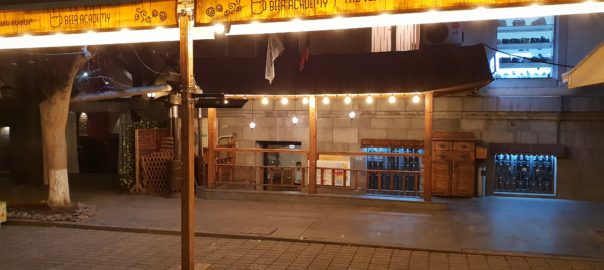
It’s been a while since I’ve written of my beery adventures, then just as I was thinking to pen something Dom & Poppy went on their adventure and wrote about all the places I’d been… however, I think I may have beaten them to this one! I’d been planning a trip to the Caucasus region for a while, in fact I went as far as booking a trip in 2014… only for Russia to invade/liberate (depending on your viewpoint!) Crimea and eastern Ukraine days later, from which I’d booked to fly – by the time of my planned trip my departure airport Donetsk was literally rubble. Since then, Wizzair and Ryanair have introduced more cheap routes to the region, and Azerbaijan has massively simplified (and cheapened!) their visa requirements (Armenia and Georgia require no visa). The trip was thrown together at short notice following the collapse of a planned Far East trip due to Coronavirus, but I was able to find cheap flights mere days in advance. I flew from Doncaster to Debrecen for the princely sum of £8.99, then next night from Budapest to Baku for £32 and a week later I flew Kutaisi to Milan for £7.49 (all with Wizzair). Travel between the cities was by train, I booked Baku to Tbilisi online and bought my tickets to and from Yerevan at the respective railways stations as they have no online sales platform. Each leg was approximately £27 in two-berth sleepers. Landing at Baku around 6am meant I had a wait for beer o’clock, especially as not everywhere even opens at noon, so I did the tourist bit first, wandering along the Caspian ‘sea’ front, then as the funicular didn’t start ‘til later I walked to the top of the hill to look down over the city, before descending to the Old Town and greeting some of the many street cats. I then checked into the hotel and had a nap, having barely slept on the overnight flight, then it was beer time! First port of call was Paulaner, a subsidiary of the Bavarian brewer, and with the same beers but brewed on site. The beers were decent but not exciting, and around £3 for a half litre so expensive by local standards.  As I had two days I decided to call it a night and tackle the rest the next day, and adjourned to my hotel. Next day I had a lie in then set about the rest of the beer scene, starting with the NZS brewery, the largest independent brewery in Azerbaijan, which has an onsite restaurant serving their one beer, a fairly standard lager (the menu advertises an unfiltered version, but it wasn’t available on my visit). I blagged a tour of the brewery, being given a bottle of the beer fresh off the bottling line at the end. I jokingly suggested a collaboration brew next time I’m over, but I’m not sure Azerbaijan is quite ready for what we think of as craft beer! From there, it’s a short 13p bus ride to Mala Praga, a largish brewpub serving 4 beers – filtered and unfiltered pale lagers, a honey beer and a dark lager. Again the beer was expensive by local standards but average to us. I also had a bowl of merji shorbasi, a local lentil soup, served with a quantity of bread more commonly associated with the feeding of the 5000. The other brewpub, Beerbasa, is at the opposite end of town, though easily reached using a metro then a bus, at 26p for the journey. The three beers here, a light, a dark and a red, were all fairly average, and halfway through my second beer the waiter put down an unsolicited bowl of pistachios on the table, which then appeared on the bill for about £6! Fortunately some brief remonstration got them removed from the bill, but it’s something to watch out for. I had a couple of other leads as coincidentally a mate was going a couple of weeks later and had done far more research than I, my own efforts being limited to the Ratebeer places lists. The Brewery has closed down and been replaced by a fancy cocktail bar, Mesopotamia brewpub seems not to exist, at least not where it was purported to be, and Hops turned out to have nothing but macro beer and football fans shouting at the tv. My last port of call did exist though, Beer O’clock, and unlike the brewpubs is a proper locals’ pub rather than a tourist trap, both beer and food being less than half the prices I’d paid in the brewpubs. There’s no craft beer as such but independent breweries are served including Stara Praga and Falken. The train from Baku to Tbilisi is very sociably timed, leaving at 2330 and arriving at around 10am, with the border formalities being 7-9am. I’d opted for ‘Spalny’, two-berth sleeper compartments, and fortunately nobody else was allocated in my compartment. Like Baku, not many bars open at lunchtime, so I did the touristy bit first. Unfortunately a combination of the late opening of bars and early departure of the train to Yerevan meant I only had time to visit three places in a little cluster of bars near Liberty Square, my mate’s research has another couple of bars nearby, and another little cluster in another part of town. 9MTA is a modern craft bar, with 18 taps serving a few Georgian beers plus imports from the likes of Warpigs, Mikkeller and Brewdog. Four of the beers are from their own brewery, I tried the red ale and the IPA, both of which were pretty good, and then a Cherry Tripel from Lost Ridge brewery and a milk stout from Megobrebi. I didn’t try any imports due to time constraints, though unusually in my experience they were cheaper than in the UK. Also unusually for outside the UK, a 150ml measure cost exactly half the price of 300ml, no ‘ticker tax’! The nearby Black Dog Bar has six beers from Number 8 Brewing, no small measures are served, so I just had a Zulu Run IPA before moving on. It was a decent IPA although nothing exciting to someone used to the UK beer scene. My last stop, sadly brief as it didn’t open until 1900, was SMA Bar. 6 Georgian beers on tap, plus usually a Belarussian lager, sadly off on this occasion so I had a raspberry blonde from Underground brewery and an IPA from Lumberjack brewery. I also acquired some takeouts for the train as they have a good bottle selection. I particularly enjoyed the Breccia, a gooseberry and tkemali (a tart berry native to Georgia) sour. I also had a cucumber kolsch from Megobrebi, and from Underground brewery a coconut IPA and a coffee stout with 20 grams of coffee per litre, possibly not the best idea just before bed! A  combination of the train to Yerevan only running every other day in winter, and cheap flights from there being only twice a week, meant the only way to fit it in was to make a return trip from Tbilisi on consecutive nights. The outward journey is earlier than ideal, leaving at 2020 and arriving just before 7am. The border crossing was relatively painless though you can expect a bit of questioning if you have Azerbaijan stamps in your passport. Again I took a touristy wander, but at least here the bars mostly open at lunchtime, so I was in Dargett on the dot of 11am. I spend several hours here, during which I tried all 16 beers on offer – fortunately they offer three different flights of four beers each. I started with a barrel aged wild ale, before setting about the flights including everything from lager to IPA to stout along with fruit beers. I then finished up with a Double IPA and a very good Imperial Stout. From Dargett I headed south to Dors Craft & Kitchen, another modern craft bar serving 8 of their own beers. Two different flights of 4 are available, I went for the one including a farmhouse ale, a cherry ale, and APA and a DIPA, the latter being a tad weak for style at 6.5% but packing a respectable 80IBU. Again all well brewed and refreshing. 4 x 100ml was about £2. Next up was Labeerint, an underground bar with a selection of their own beers. Their Lager and Munich ale are available from self-serve taps at your table, while the bar has others including a Helles, a Weissbier and a Dark Lager along with another lager Kilikia brewery. Finally, Beer Academy is another ‘brewpub’ though it seems the brewery isn’t actually on site, serving about half a dozen of their own beers, sadly on my visit these included a ginger brew, which the brewer insisted I try. My final day was in Kutaisi, the city I visited on my one very brief previous visit to the region. The pseudo-brewpub (the beers actually came from the sister pub in Tbilisi) I’d visited then is long gone, but a new pseudo-brewpub has opened since, namely Bagrati. The waitress spoke no English, but via google translate I established the brewery is not on site but is ‘nearby’. The one beer is a fairly standard lager. I found English was spoken in almost all the craft bars visited, but otherwise not widely spoken, Russian unsurprisingly being the second language in all three countries. Getting around the cities is easy and cheap, all have metros and frequent buses. Baku uses a ‘Baku card’ which can be loaded with any amount or disposable 4 ride cards (available from machines, which I only saw at the airport and at metro stations), these are the only way to pay for metro and red bus routes, while white bus routes are cash only. Tbilisi has a similar card system for the metro but bought in person from a ticket booth, I didn’t use any buses. Yerevan metro is cash based, again I had no cause to use any buses. Baku metro and bus schedules are loaded into Google Maps meaning it’s easy to plan getting around, I didn’t check in the other cities but the metros run frequently. Wi-Fi is fairly widely available, but to be sure I downloaded all three countries in maps.me for navigation while offline. www.ratebeer.com/places has most of the visited places listed, and handily has a map feature to assist planning. Overall a fascinating trip. Yerevan, Dargett in particular, had the best beer, but Tbilisi had the most bars worth a visit. Azerbaijan and Armenia I think can now be filed under ‘been there, done that’, but I will go back to Georgia in the not too distant future. Dave Unpronounceable
Peak Ales

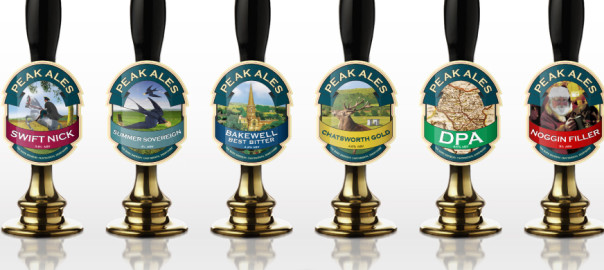
2013 was rather a hectic year at Peak Ales brewery, and since Easter, hardly a week went by where the brewery hadn’t brewed at full capacity, although the brewery has been grateful that the winter weather has (so far) not adversely affected deliveries. Personalised bottled beer was a big hit for Christmas presents, with over 60 cases going out. With the daylight hours starting to draw back out, hopefully they can look forward to the spring/summer seasonal, Summer Sovereign, being brewed before too long. A cask of Peak Ales’ Noggin Filler and a cask of Bakewell Best Bitter were served at February’s Chesterfield Beer Festival. Two casks of winter seasonal Noggin Filler were donated to the National Winter Ales Festival at Derby. Peak Ales are currently looking at moving the production side of the brewery to brand new premises near Ashford-in-the-Water  in order to brew more beer to be able to cope with the demand. It is still unclear when this will take place but they are working hard to arrange all the small niggly things that need to be dealt with. Exciting times ahead!

Pub of the Month March 2014

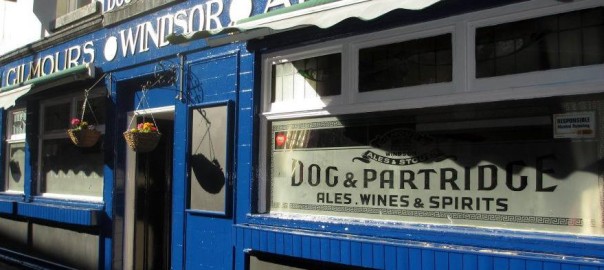
A pub on the site since 1797, the Dog & Partridge was acquired by Duncan Gilmour at some time after 1860 as shown by the distinctive Gilmour’s frontage. Internally the pub still retains some of the original room layout with seating areas on both sides of the entrance. On the left there’s a small enclosed snug whilst the right leads to the main bar area with a comfortable lounge to the rear. Conor and Sarah Smith took on the lease in February 2013 following a refurbishment of the pub in 2012, Conor having previously had over ten years’ experience in the licensed trade. Currently the opening hours are Monday – Thursday 12-11 and 12-12 Friday and Saturday (closed Sunday). Food is available Monday to Friday lunchtimes 12-2.30. There are now six handpumps dispensing Black Sheep Bitter and Kelham Island Easy Rider as regular beers and up to four guest beers, many from local breweries but also from independents from further afield, with around 200 different beers in the first year. There’s a 10% discount on cask beers for CAMRA members on production of a current membership card. Traditional pub games available include darts, table skittles, shove ha’penny and bagatelle. Monday is quiz night with a £20 bar tab for the winners, Tuesday there’s an acoustic jam session and there’s a DJ on Saturday nights. To mark the pubs transformation in the last year to become a quality showcase for real ale, the pub will be receiving the Pub of the Month award on the evening of Tuesday 11th March 2014, when all are welcome to join us was presented with their award on an evening of good beer, music, buffet (including Connor’s excellent home made hot scotch eggs!) a raffle and a space hopper. B Feb-March 2014 006 Alt Dog & Partridge, 56 Trippet Lane, S1 4EL The nearest tram stop is City Hall. Buses 51, 52, 70, 95, 120.