Food Festival beer tent a success!

Local thirst for local beers The Sheffield Brewers Cooperative tent was in the peace gardens as part of the annual Sheffield Food Festival in May. Brewers from Abbeydale, Blue Bee, Exit 33, Kelham Island, Sheffield and Wood Street manned the bar showcasing two beers from each local brewery. The weekend was a success selling a whopping 3,240 pints in just 26 hours of trading! Next year the plan is to take to the stage in the main tent to do a joint meet the brewer with a live brewing demonstration and a special local food and beer-pairing event. Pete Roberts, Exit 33 Brewing.

CAMRA members discounts in Sheffield

The following pubs in Sheffield are known to offer discounts off a pint of beer to card carrying CAMRA members. Please note there may be some restrictions (eg not Fri/Sat nights) – check with pubs first. If you know of a pub missing from the list let us know and we will mention them next month. Ball, Crookes Castle Inn, Bradway Dog & Partridge, Sheffield City Centre Dove & Rainbow, Sheffield City Centre Hop, Sheffield City Centre Red Deer, Sheffield City Centre Additionally, the following City Centre pubs and bars offer discounts on real ale to all customers at certain times of day: Anchorage Old House Wick at Both Ends

Steel City Beer Festival Volunteer stories – the Cellar manager

BEER FESTIVALS – THE CELLAR TEAM TASKS chris_0045 30092010004 Ever thought of working at a CAMRA beer festival and looking after lots of  casks  of beer ?  I started helping at the Sheffield festival about 15 years ago, initially on the bar, but now on the cellar. My aim is that every pint served reaches the drinker in prime condition, cellar cool and  does justice to the skill of the brewer.  I wouldn’t want a warm,  flat , cloudy or contaminated pint if I went in a pub and I don’t expect festival goers to accept that either. Here’s a guide to what’s involved in being part of the cellar team. The title is a bit of a misnomer, as unlike your local real ale pub, there is no physical cellar to keep the beer in.  We start and end in an empty hall.  Everything is assembled  from scratch,  a daunting task, but with plenty of volunteers it becomes straightforward . BUILD A STILLAGE The beer needs the maximum time to settle, so the earliest  task is to build a “cellar.  The stillage is heavy duty steel  racking , usually seen in warehouses. It just locks together like a giant Lego set, with plywood shelves to take the heavy weight of the beer.  Once this is built, the 9 gallon casks  of  beer are lifted onto it, and held in place, tilted slightly forward , with wooden chocks for   support There is also a separate row of casks, on end on the floor in front of the stillage.  These  will be under the bar ,which is also being erected from fold flat kits . This is a major milestone as the beer should not need to be moved  again, and the yeast sediment can begin  to settle leaving the beer clear.  However, the beer is now quickly getting to room temperature , making  the yeast more active and the beer could  be served too warm . STAY COOL Years ago we used mutton cloth sleeves  on the barrels, sprayed with water. As the water evaporated this cooled the casks, but wasn’t really up to the task. These days the casks are cooled by a bespoke cooling system from CAMRA HQ. It’s just like a home central heating system in reverse ,  with chilled water instead of hot water. Large refrigeration units chill water to just above freezing and it is  pumped through insulated plastic pipes to a metal coil which straddles each cask. The pipework is all simple push fit, but a leak can quickly spill gallons of water so it all has to be carefully tested for leaks .  An insulated jacket drapes over each cask  to “keep the cold in”. The cooling also extends to the floor based casks beneath the bar  . Great first day over, all beer racked on the stillage and keeping cool. CLEANLINESS Like handling any food product, cleanliness is paramount, and beer can quickly be ruined by contamination from other yeasts,  mould or fungal infections. It can make it hazy or turn it into vinegar in a short space of time.  The bungs of all casks are sterilised.   Cleaning this way reduces the risk of infection from anything picked up in transit or on site.  All taps, beer engines,  plastic beer lines and other equipment that comes into contact with the beer   have  to be cleaned and sterilised too..  Buckets of line cleaner have to be pulled into the beer engines and left to do its work , then thoroughly flushed  through with water.  The same has to be done at the end of the festival as stale beer left hidden in a beer engine or tap quickly becomes  a source of infection next time it is used.  Cleaning all these beer engines is a tedious but essential task, but at least it limbers the arm muscles up for pulling pints ! The line cleaner is hazardous to our skin, so gloves  and other safety wear are essential for those handling it.  All the newly sterile equipment is  rinsed  thoroughly and kept in  buckets of clean water until needed.  A load of chores, yes , but far better than the risk contaminated ale , and having to pour  thousands of pounds  of down  the drain, leaving  drinkers thirsty. OPEN SESAME!!!!! Our cool beer is happily resting,  and the casks can be vented.  Our beer is a living product and the yeast is still causing a secondary fermentation in the cask, which builds up carbon dioxide . This sits in the small air void above the beer and builds up  pressure in the cask. A hollow tapered metal spike(the venting tool)  is hammered into the centre dimple  of the shive (bung) The excess gas in the barrel is vented out by the tool into  a small tube and away. If the cask has a lot of “condition” (gas) inside it hisses violently and frothy beer can also be sprayed out. If the cask has been left to get warm, this can be a Vesuvius spectacular.  I’ve never been able to vent all the casks without at least one drenching.  Once the eruption has died down a tapered wooden peg (spile) is loosely put back in the vent hole . Next the plastic taps, each with tapered  shaft , are hammered into the keystone on the front. It has to be done firmly and quickly, and with the tap turned off, otherwise you get  a face of beer. Too timid and the bung will leak, too hard and you’ll knock the cask off its chocks.  As a novice you will undoubtedly get it wrong in every conceivable way,   but the quick learners avoid getting a repeat soaking.  So now , as long as it settles ,the beer is potentially ready to serve. Different beers  have different settling times, usually 1-3 days and in many ways you can only make a guess based on previous handling of that beer. QUALITY CONTROL – IS IT FIT TO DRINK? Spiles are removed  and a sample of beer  tasted.   Held to the light, is it crystal clear, hazy or are there great dollops of yeast floating in it?  Next taste it – is it  clear of any vinegary sourness , musty or woody taste which denote infection or contamination? You may have no idea what flavours the brewer intended for that particular brew, but put simply does it taste OK . If its not your style of beer, let others in the cellar team taste it .  When there are a couple of hundred beers to inspect  this has to be a shared task as  even a small sip from each cask renders you unfit for further tasting- or much else- after a while.  Working to  a master list , record the results  for serve , waiting or condemn the beer from each cask. Amazingly, when it comes to tasting you discover that you have suddenly become very popular with everyone on site…… WE’RE OPEN All these tasks have to be done before the beer goes on sale. Everybody the first day  wants to sample the beer and expects everything to be available.  Tickers in particular want to sample each beer, and have sometimes pleaded with me to let them sample a beer that is simply not ready yet.  (Strangely  I’ve never seen anyone plead with a pub landlord to sell a beer that he says isn’t ready yet), however I can understand that people may have travelled miles to  a festival to experience a particular brew.  So sometimes you have to bend to their wishes  , give them a secret sample , but keep the beer off open sale until it comes good.   Generally though if its not right , don’t serve it – the brewer would be disappointed his wares weren’t at their best  and drinkers will mostly be underwhelmed .  As opening hour approaches,  spiles are removed, taps on ale extractors turned on, and some beer drawn through the hand pumps so the first customer servings are fresh. The ones that aren’t on sale have to be clearly marked for bar staff, who will be busy and may not notice that the spile is still in and that’s why only a dribble of beer comes out. Anyway at this stage stand back and watch people happily drinking beer for  a while- well ten minutes at least, then the problems will start to flood in KEEPING ALL THE BALLS IN THE AIR Cleaning uses copious buckets of clean water, and there is dirty water and beer ullage to get rid of with  minimum spillage. Water taps and drains are rarely as close as you want so you will often have a lengthy trek.   Drip trays have to emptied and spilt beer from the taps mopped up. Bar staff will  be under pressure to serve crowds quickly and accidents can happen, so there is constant  mopping up to do. As the beer is sold from each cask, the rear chock has to be moved carefully to stoop the cask  so clear beer runs out the tap. Ale extractors have to be pushed further in the cask as they are meant to take the bright beer from the top .  At the end of each session the spiles have to be put back, as leaving the casks always open to the air causes the beer to go stale as the contents drop. Spectacular or acclaimed beers can run out in less than an hour, so any reserve casks must be prepared for changeover. Beer lines must  be cleaned with water for each new cask, any equipment from used casks must  be cleaned before re-use , and frequent checks have to be made for leaks  from the cooling or cask bungs/faulty taps. Beer unready at the outset has to be rechecked  before it can go on sale. As the festival progresses stooped casks will be down to the dregs, and as fewer beers are  on sale, this causes a bit of a domino effect on the remaining beers.  Hopefully at the close all beer is sold.  Anyway things never happen smoothly- casks at different ends of the stillage need changing at the same time. The mallet you had in your hand a moment ago has gone walkabout ( all tools have a life of their own once it is busy , believe me). Oh quick someone’s knocked a cask over…….. As the festival winds down, you switch from set up and beer dispense to thoughts of take down. Empty casks can be removed, redundant beer engines and taps cleaned, and even the cooling equipment can be truncated in situ and packed away.  At final close any unsold beer can be supped, for in the morning the rest  has to go down the drain. Cork bungs and spiles are  whacked in casks  and then stacked for the dray to collect. All the equipment has to be cleaned and  packed away and refrigerating units emptied . Lastly the stillage is taken down . As you take a last glance at the empty hall you started in ,you are left with a memory  that the cellar team built a temporary shrine to the joys of real ale and  that everyone who came enjoyed the marvels  of the beer they so lovingly nurtured. It all passed in a busy blur, you may remember some of the glitches , however a record amount of beer was sold, and no-one complained of a duff pint . Then something up on a window ledge catches your eye. So that’s where I left that damn mallet!!!!! Now, fancy joining me? Cheers! Chris Pearce
Pubs offering CAMRA members discounts

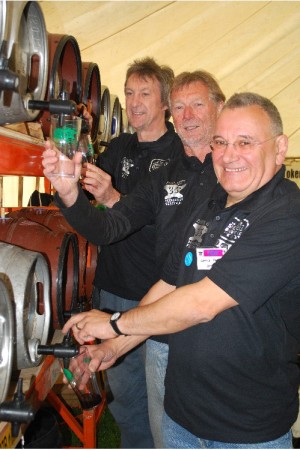
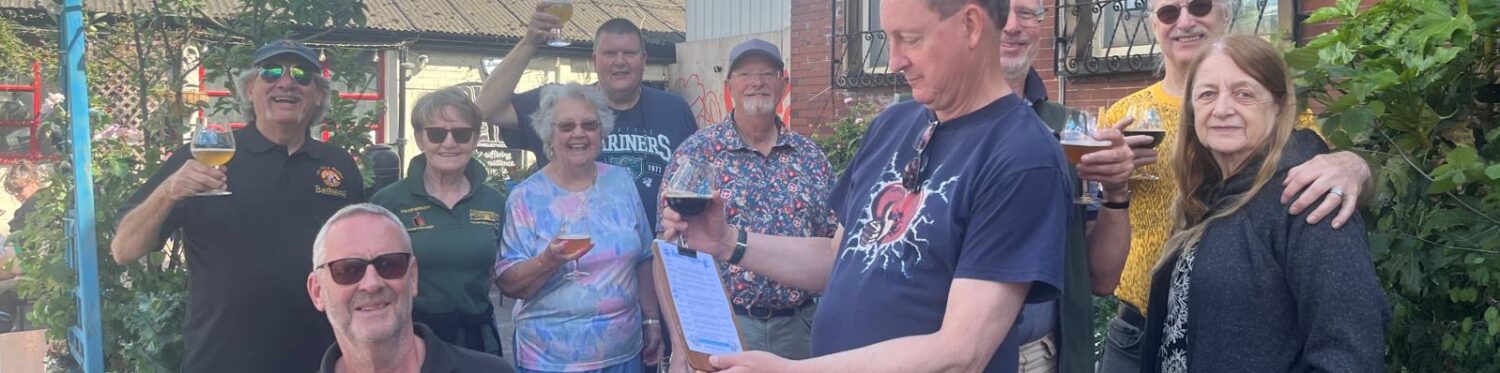
This month we feature all the pubs in the Dronfield sub-branch area that offer a discount on beer if you produce your current, valid CAMRA membership card before placing your order. Next month we will feature Sheffield pubs – please let us know if you know of any and don’t forget members can download a National Pub Discount Scheme poster from the members website for the pub to use to promote the fact. The Beer Stop, Dronfield – 20p per pint The Coach & Horses, Dronfield – 20p per pint The Travellers Rest, Apperknowle – 20p per pint The Miners Arms, Hundall  – 30p per pint The Jolly Farmer, Dronfield Woodhouse – 15p per pint The Talbot, Dronfield Woodhouse – Discount available Please support the pubs by going to check them out, drinking the beer and taking advantage of their offer of a discount! Some terms & conditions or restrictions may apply, please check directly with the pubs.

Worksop & Retford Brewery story continues

Local Sheffield CAMRA members, Dave Pickersgill and John Stocks gave an illustrated talk, ‘The Worksop and Retford Brewery,’ at The Station Hotel, Worksop on Thursday 26th March. This event was supported by the Worksop Archaeological and Local History Society. It attracted 36 attendees, including a number of ex-employees of the brewery. A repeat event is planned for Worksop Library on 16th September. The associated e-book is available on Kindle.

Editor’s bit

It is the time of the year in CAMRA that is AGM season. Our Dronfield sub-branch has just held theirs and their committee has been appointed for the year ahead with lots of discussion on things they wish to achieve including upgrading to full branch status, publish a local pub guide, put on a beer festival and more. The Sheffield & District branch AGM is coming up on the 7th April and the national AGM & Members Weekend is in Nottingham 17th to 19th April. It is a time of year that I – and others currently on the committee – think about what we are trying to achieve as a branch of CAMRA – or even as a member of CAMRA. You may recall my comments in the February issue that we’ve never had it so good in terms of the availability of real ale and good beer in general, there are beers of many different styles out there, lots of pubs and bars serving it and a record number of breweries producing it with more and more opening! I think CAMRA does still have a role of getting people excited about good beer, celebrating it, helping people understand it and engaging with the brewers producing it – but this now apart from putting on beer festivals should probably be more on a social level. On the campaigning front the focus has moved on. We need to focus on issues like perfectly viable pubs closing down, looking at behaviour of pub companies and planning law for example, there are also issues on tax to continue campaigning on – things are generally improving on beer tax thanks to very good campaigns jointly with other like minded organisations – however there is a new European tax threat to small Cider producers so we aren’t entirely winning. There are also the little consumer issues in pubs that still irk some members too – short measures, being served off beer, prices not clearly displayed etc – although of course in most good pubs and bars the customer service is good enough to rectify such things without argument. With all the above in mind, it still frustrates me that I’m still reading and hearing the whole cask and keg thing and whether CAMRA should embrace keg beer if it is good, tasty beer. Obviously CAMRA’s heritage is campaigning to save and ensure the availability of traditional cask beer – aka real ale – in the days when keg was the threat to real ale because it was cheap, nasty and had a longer shelf life. To be able to campaign for something, you have to be able to define what it is you are campaigning for. Real Ale has a specific definition – Good or Craft beer doesn’t. Tom’s article about defining craft beer this month picks up an element of this, however my view is spending so much time debating such matters is a complete waste of time given that the current campaigning priorities are more about saving pubs rather than beer….. So for the year ahead in Sheffield CAMRA I think we are looking at a much improved programme of social events, not just brewery visits but getting out and about visiting pubs outside the City Centre and the usual popular circuits like Kelham Island – come with us and try a pub you’ve never visited before. We also need to revitalise the Pub of the Month award – this is another way of helping promoting good pubs across our area. Also we need to repeat the success of last years beer festival at Kelham Island Museum – all the signs are it will be even better this year with more beer and a bigger capacity. To achieve want we want to we do need new people involved on the committee. Many of the old faces are stepping down due to other commitments – some work, some family. Others remaining on the committee have been doing multiple roles for a few years now and are looking at taking a lower profile. Therefore it is the perfect time for some new volunteers with enthusiasm and ideas to join the committee and start making things happen and get members more engaged and involved! If you think you could do that, please come along to the AGM and put yourself forward! Don’t worry if you don’t know ‘how things work’ – there will be people to help with that! Finally, April is National Community Pubs Month – celebrate with a pint in your local – Cheers!

Dronfield CAMRA new members social

Three years after Dronfield was established as a sub-branch of Sheffield CAMRA, we invited all new members to a social evening and buffet at the Coach and Horses in Dronfield. We were pleased to see several new faces in a cheerful atmosphere, We hope that more members will join in with us in the coming years so that we can extend our activities and trips. Ruth Hepworth

The definition of Craft Beer

(or… oh no, not this subject again!) Craft beer is regarded as being quite the in thing at the moment. Pubs, bars and off-licences are offering more and more beer described as “craft” and a number of brewers have gained big reputations as craft breweries. Many article and blog posts have been devoted to the subject, and the letters page of CAMRA’s monthly members newsletter “What’s Brewing” tends to be full of fulminating on the subject, often from people seemingly convinced that craft beer is nothing more than an evil conspiracy to bring back the dreaded keg beers of the 1970’s. But what is Craft beer actually meant to be? The official American definition of a craft brewery is one that has Annual production of 6 million barrels of beer or less. Under that definition even the biggest of the big UK brands such as Carling and John Smiths would be defined as “craft”. And in any case, it is possible for big breweries to produce good, well made beers. Just because a brewery is small doesn’t automatically make it better. Craft beer is often described as being much hoppier then other beer, but does a beer have to be a massively hopped IPA in order to be considered craft? The answer to that is a firm no. For one thing the terms is often used to describe a huge variety of beer, from imperial stouts to Belgian-style sour beers. I have yet to hear any proper explanation of how a beer like Might Oak Oscar Wilde Mild (CAMRA’s champion beer of Britain in 2011) is any less of a craft beer then the likes of Thornbridge Jaipur. Some people have claimed that craft beer is beer made from new world hop varieties such as Simcoe and Nelson Sauvin. Really? Even the likes of Brewdog have made beer using English hop varieties such as Challenger and Goldings. There are some people who argue that craft beer tends to be much stronger than non-“craft” beer. But I don’t buy that argument. I don’t see how a beer such as Oakham Citra is any less of a craft beer then it’s stronger bigger brother, Oakham Green Devil IPA. It’s also worth noting the current trend for “session IPA’s” at lower strength then your usual India Pale Ales. There are those to claim that craft beer is nothing more than a euphemism for keg beer. This is simply a load of nonsense. A beer such as Magic Rock High Wire does not become any less “craft” when it’s served out of a cask rather than keg. There have even been some people who have claimed that craft beer is pasteurised and filtered. Well, a few beers being marketed as “craft” might be but a heck of a lot isn’t. It’s worth remembering that these days unpasteurised, secondary fermented beer can be, and is served on keg and even in cans so the boundaries of what an unabashed unpasteurised beer loving CAMRA member like myself might consider acceptable are being blurred. And if pubs replace the likes of Carlsberg & Stella with much better keg beers from the likes of Kernel then surely that has to be a good thing? Is craft beer expensive? Again not necessarily. Although a lot of the new keg beers are undoubtedly pricey, the term encompasses such a wide variety of beers that inevitably, it includes beers made for much less cost. Is craft beer automatically good? Well no. I’ve had quite a few craft beers that I haven’t tasted good at all. But equally, it’s absurd to portray any beer marketed as being “craft” as being automatically rubbish. Is craft beer the beer that’s fashionable? Well that might be the closest we can get to what craft beer might possibly be, although even that doesn’t cut the mustard as a definition. For one thing, fashions change. For another, who’s to say that a beer such as the excellent Darkstar Partridge Best Bitter is made with any less “craft” then Revelation IPA from the same brewery? In summary, it is actually quite futile to provide any sort of clear, workable definition of what craft beer is. There have been many developments and improvements made to the British beer scene in recent times, and a great deal of this is to be welcomed. But trying to pin down what people actually mean by craft beer can all too often be like trying to nail jelly to a wall. And on that note, I could have been drinking nice beer instead of writing this! I shall rectify this by heading off to my local to drink a pint of real ale. Thomas Sturgess

Fancy joining the committee?

As we approach the branch AGM, we are looking for volunteers to join the committee that does the day to day running of the CAMRA branch – the committee for the new year ahead gets voted in at the AGM. At present we do not have enough volunteers to fill every role on the committee and have a small bunch of old hands that do more than one job to keep things ticking over. There is a feeling that the branch needs some new people with fresh ideas and enthusiasm to shake things up, bring some passion back to the branch and in turn get more people involved across the board. Any new volunteers that get voted into roles will of course enjoy support and guidance from the ‘old hands’. The committee positions include Chairman Secretary Membership Secretary Treasurer Social Secretary Pubs Officer (including What Pub database management) Heritage Pub Protection Officer Beer Matters Editor Stakeholder/Local politician relationship Young Members Co-ordinator (including University Real Ale Society Liaison) Aside from the committee, we also look for people wishing to help out with roles such as co-ordinating our Pub of the Year and Pub of the Month competitions, the selection of pubs for the Good Beer Guide and writing articles for Beer Matters magazine. We also still have some vacancies for Brewery Liaison Officers.

Hope Valley Ale Trail

The licencees of various pubs in the Hope Valley are getting together to promote themselves as easy to reach via the various public transport routes from Sheffield with a website, app and published guides.  Real Ale is available in all the participating pubs and from time to time beer festivals are held in some of the pubs on the route. One of the champions of this scheme is Rick Ellison, landlord of the Old Hall in Hope and the Peak Hotel in Castleton, who is holding one of his regular Hope Valley beer festivals this Easter. The public transport routes from Sheffield into the Peak District include: Hope Valley railway line runs from Sheffield to Manchester, taking in Dore & Totley, Grindleford, Hathersage, Bamford, Hope and Edale. Bus 218 runs from Sheffield to Bakewell via Totley and Baslow Bus 240/241 runs from Sheffield to Bakewell via Ecclesall Road, Ringinglow, Fox House, Grindleford  and Baslow. Bus 272 runs from Sheffield to Castleton via Ecclesall Road, Fox House, Hathersage, Bamford, Bradwell and Hope. Bus 273/274 runs from Sheffield to Castleton via Crosspool, Ladybower, Bamford and Hope.