Champion Winter Beer of Britain

Elland 1872 Porter named ‘Champion Winter Beer of Britain’ for second time in three years

1872_Porter_2013_2

Elland 1872 Porter has today been crowned CAMRA’s Supreme Champion Winter Beer of Britain 2015 by a panel of judges at the National Winter Ales Festival in Derby, which begins today (February 11th) at the city’s Roundhouse venue.

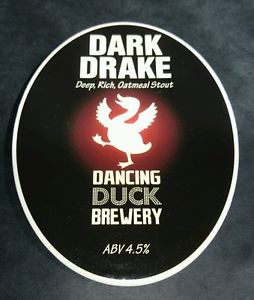
The winning 6.5% abv beer is described in CAMRA’s 2015 Good Beer Guide as a “creamy, full-flavoured porter with rich liquorice flavours and a hint of chocolate from the roasted malt. A soft but satisfying after taste of bittersweet roast and malt.” Mike Hiscock, Elland Brewery Manager, had this to say on the win: “It’s absolutely fabulous to win the Champion Winter Beer of Britain, though we certainly weren’t expecting this, it is amazing to get the hat trick and win this award for the third time. We know it is independently judged so for it to keep coming out on top is testament to the depth of flavour and complexity that we get into the beer. This really is fantastic news.” The Champion Winter Beer of Britain competition judges the best of the best in terms of classic winter warmers – from thick, rich, dark porters and stouts, to sweet and strong Barley Wines. A panel of beer writers, members of the licensed trade and CAMRA members judged the competition. Elland 1872 porter will now go forward to compete in the overall Champion Beer of Britain competition at the Great British Beer Festival this August. Nik Antona, Champion Winter Beer of Britain Director had this to say on the importance of the competition: “Elland 1872 is a fantastic example of what a traditional porter should taste like and has been hugely popular for many years, particularly it seems with competition judges, who have named it Champion Winter Beer of Britain twice and overall Champion Beer of Britain once in the last three years – a huge achievement.” National Champion Winter Beer of Britain Winners moonraker dark side of the moose DARK DRAKE Overall Champion Elland – 1872 Porter Silver Purple Moose – Darkside of the Moose Bronze Dancing Duck – Dark Drake Category Winners: Barley Wine and Strong Old Ales Gold:  Lees – Moonraker Silver:  Orkney – Skullsplitter Bronze:  Darwin – Extinction Ale Old Ale/Strong Milds Gold:  Purple Moose – Darkside of the Moose Silver:  Ulverston – Fra diavolio Bronze:  Castle Rock – Midnight Owl Stout Gold:  Dancing Duck – Dark Drake Silver:  Plain Ales – Incognito Bronze:  Highland – Sneeky Wee Orkney Stout Porter Gold:  Elland – 1872 Porter Silver (joint):  Bath Ales – Festivities Fuller’s – London Porter Bronze: Blakemere – Deep Dark Secret

Happy New Year from your local CAMRA branch

Welcome to the first Beer Matters of 2015, we hope you had an enjoyable Christmas and the new year so far is being kind to you! We seem to be living in good times for the discerning beer drinker, in our news columns you will read of various new, improved, reopened or reinvented pubs and bars and our growing number of local breweries continuing to be successful – with some of them trying  interesting and unusual beers to keep us intrigued and excited – and others consistently producing house staples to a high standard. On the campaigning front things seem to be going our way too thanks to putting across a clear and intelligent argument with one voice – CAMRA itself, it’s members and other organisations with aligned interests. The government finally started to listen on the subject of beer tax and are beginning to make the right noises on Pub Company reform. From our point of view we want to continue to have nice pubs with real ale at affordable prices to visit in the future – however economically having businesses such as pubs open, trading and employing staff makes sense to the government as it generates tax revenue. Another interesting development in 2015 seems to be that the bubble is beginning to burst for Supermarket chains in the race to open convenience stores, so the rate of pubs being turned into such shops may slow down. The concept of Micro-Pubs along with off-licences featuring sampling bars is growing and really capturing the imagination and whilst we have seen some traditional pubs being turned into shops, we have also seen some shops turned into micro-pubs! Perhaps this reflects a cultural shift as to what is wanted from a community pub – more the atmosphere of a local coffee shop where the family can drop in and relax after shopping with something nice both on the beer and the soft drinks front? So, the local beer scene has seemingly never had it so good and it is exciting times to be part of it. Here in Sheffield & District CAMRA (and also in our Dronfield & District sub-branch) we are looking for new people to get involved and volunteer. We need people to help keep our pub database up to date (which powers whatpub.com), we need people to be official brewery liaison officers, we need a new membership secretary and more. The branch AGM is coming up in April and it would be wonderful to get more than the usual old faces on board, shake things up a bit and get everyone passionate about what we do. Of course it isn’t just about doing voluntary jobs – we want more people enjoying the social side too and enjoying beer together and we intend to have lots going on during 2015 including brewery tours, beer tastings and more. Finally, following the success of our new look Steel City Beer & Cider Festival at Kelham Island Industrial Museum last October, we have started planning this years and have provisional dates – 21st to 24th October with set up commencing from Monday 19th and takedown on Sunday 25th. We intend to build on the success of last year with a few tweaks to improve certain areas based on feedback from staff and customers. If you are a CAMRA member and interested in joining the committee that organises the festival, please do come down to the next planning meeting. You do not need to have any experience in organising festivals, just enthusiasm and a willingness to get things done.

The local history column – Earl Grey update

How did a bottle from Sheffield reach the Western Front? Thanks to John Stocks and Martine Welsh for responding to my notes in the December edition of ‘Beer Matters’ when a glass bottle which on display in the Hooge Crater Museum in Belgium was mentioned. This bottle has these words: W J Downes, Earl Grey Hotel, Sheffield The Earl Grey (97 Ecclesall Road) opened in 1833. The landlord from 1907-1939 was William Jackson Downes .The 1911 edition of ‘White’s Sheffield District Directory’ describes him as a ‘victualler.’ The prestige of the Earl Grey is indicated by the entry in this directory. There are five pages of listed, ‘Hotels, Inns and Taverns.’ Only two entries are listed in bold print: one is the Earl Grey. William married Florence Ann, the 1911 census including their son, William Sidney, born in 1894 and named after his father. On 18th.October 1915, the Sheffield Evening Telegraph announced the marriage on Thursday 14th.October, ‘by the Rev.F.Okell, of Private W.S.Downes, City Battalion, the only son of Mr. and Mrs.Downes, Earl Grey Hotel to May Crook.’ The Sheffield City Battalion was instigated by Sheffield University and aimed to recruit ‘professional men.’ By the end September 1914, 1,131  had enlisted. Training commenced at Bramall Lane, but quickly transferred to a Redmires. Accommodation was created on Redmires Road, this site becoming a POW camp in WW2. The area is currently forestry with a perimeter wall, a remnant from a 65 acre 1873 racecourse. Racing lasted for only four years, the final meeting taking place on 19th.July 1876. The City Battalion was in camp for about six months. They left on 13th.May 1915, arriving in France, via Egypt. After taking part in the Battle of the Somme (the ‘big push’ on 1st.July 1916), the Battalion withdrew on the evening of 3rd. July, having lost 513 officers and men killed, wounded or missing; a further 75 were slightly wounded. By the early weeks of 1918, the battalion was disbanded. It seems that William Sidney, returned to Sheffield and married before the Somme. As for the bottle, perhaps, it returned to France with William as a toast for his wedding? Subsequently, it was probably reused, before finally reaching Belgium. As for the Earl Grey, the pub was immortalised as part of a 1959 short film, ‘Short Stop’ http://yorkshirefilmarchive.com/film/short-stop. This film includes scenes which were shot in the ‘back room.’ Martine, whose parents, Pam and Arthur Beardow, were  licensees of the Earl Grey from 1972 to 1979, has confirmed that this is the case. In the late 1950’s, the Earl Grey hosted a Friday night  jazz club where the Imperial Jazz Band played, filming taking place at one of the regular weekly sessions. The room was also used for private functions and included a small bar: by the 1970’s this dispensed Whitbread Trophy and Heineken Lager. The pub was demolished in the late 1980’s as part of the Sheffield Inner Ring Road development. Dave Pickersgill

Beery Bits and Bobs – with Dave Pickersgill

Greene King takes over Spirit Burton-based pub company, Spirit, has agreed to a £774 million takeover from Greene King. In September, Spirit rejected an initial offer, which valued the company at 100p a share. The new offer is 115p/share. Spirit, which was split off from Punch Taverns in 2011, runs the Chef & Brewer, Fayre & Square, Flaming Grill,  Good Night Inns, John Barras, Original Pub Company, Taylor Walker and Wacky Warehouse brands. It was originally part of the Bass empire and has over 750 branded, managed pubs throughout the UK and over 450 leased pubs. Sheffield outlets include: Drakehouse Mill (Waterthorpe), Peacock (Owler Bar), Red Lion (Gleadless Town End), Ridgeway Arms (Mosborough) and the Wagon and Horses (Millhouses). ‘STRIKES BOCK’ BEER NAME SPARKS TRADEMARK DISPUTE Star Wars creator George Lucas and Lucasfilm have filed notice to force Empire Brewing in Syracuse, New York, to stop using the name Strikes Bock for a beer it has been brewing for seven years. Empire recently applied for a trademark for the beer, which it previously sold only at its brewpub and now plans to distribute from a larger brewery it is building. “The thing is the beer is called ‘Strikes Bock,’ not ‘Empire Strikes Bock,'” owner Dave Katleski told a local newspaper, “It’s ‘Strikes Bock,’ by Empire.” In its legal argument, Lucasfilm, now owned by the Walt Disney Co., contends that the Empire Brewing beer label could infringe its trademark rights and cause confusion among consumers. BEER, THE FERTILITY DRUG? A study of men whose partners were undergoing In vitro fertilization at Massachusetts General Hospital found that those who drank the equivalent of a pint of beer a day had the best chance of conception. Men who consumed an average of 2.7 alcohol units each day had a 57% chance of the process ending in pregnancy — double that of those whose intake was lower. Health experts have attributed this to alcohol’s ability to temper stress levels, and for those consciously trying for a child, removing some of the pressure during sex could be the key to aiding conception. Speaking at the American Society of Reproductive Medicine’s conference, Dr. Allan Pacey of the University of Sheffield, agreed: “There has been conflicting data about the benefit or harm of drinking alcohol when trying to conceive. However, I firmly believe that moderate social drinking within guidelines (three to four units per day) can be of benefit for couples trying to conceive… It helps to reduce stress.” Earl Grey Hotel, Sheffield  IMG_5155 This half-pint glass bottle is in the privately owned, Hooge Crater Museum (Canadatlan 26, Zillebeke, West Flanders, Belgium). It was found locally on the WW1 Western Front, close to the site of the Hooge Crater. This crater was created by the British when they smuggled 1,700 kg of dynamite into tunnels which ran under the German front line. Detonation occurred on 19th.July 1915 during the Second Battle of Ypres. The Earl Grey (97 Ecclesall Road, Sheffield 11) opened in 1833. At the time Charles, 2nd.Earl Grey (1764-1845) was Prime Minister (1830/34). He put through the Wilberforce Act which abolished the African Slave trade. Hence, the pub is highly likely to have been named after the PM. At that time, the location would have been at the edge of the city.  It is known that from 1907-1939, the landlord of this Tennants pub was William Jackson Downes. The pub was demolished in the 1980’s as part of the Sheffield Inner Ring Road development. At the time, the Earl Grey was a Whitbread pub. (Whitbread took over Tennants in 1962.) Can anyone tell us how a half-pint bottle from Sheffield made it’s way to this corner of Belgium? It is unlikely that it was full of beer, probably spirits. It was also probably carried by an officer. But, who, and how? Any answers to dpickersgill1@googlemail.com

40th anniversary celebrations – a look back at our 1st beer festival

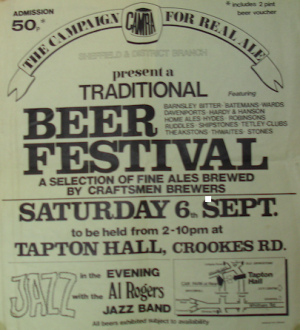
As the Steel City’s 40th Beer Festival now becomes another happy memory, John Dowd, founder member and former branch chairman, looks back at the first festival in 1975….. First Fest poster I well remember our branch chairman, Tim Parkin, ringing me up sometime in early 1975 and asking if I would like to organise a beer festival in Sheffield. Nothing remarkable about that, you might think, except that back in those early days of the Sheffield branch none of us had any experience in putting on such an event, although some of us had attended the CAMRA AGM in Nottingham that year where the organisers had put on a small Beer Exhibition. But apart from that we were definitely in our ‘green and salad days’ when it came to beer festivals and the hope was that our enthusiasm would make up for what we lacked in experience. Remember, also, that very few of the CAMRA branches in existence in 1975 had mounted a beer festival – Cambridge was one exception – so CAMRA HQ was not able to offer much advice. However, a small organising committee of John Beardshaw, Tony Scholes and myself was formed and, as the pints flowed during our deliberations, we began slowly to form a plan of action. In the first couple of years of its formation the branch had adopted the Brown Cow on the Wicker as an unofficial HQ and the landlord Harold Godson gave us much useful advice. We were fortunate in receiving help from other quarters as well. The tricky problem of finding a suitable venue was solved when we were granted the use of Tapton Hall, one of Sheffield University’s halls of residence. The premises seemed ideal as it was big enough to accommodate the barrels, serving tables, etc., was surrounded by extensive grounds and on the Crookes bus route. I seem to remember that there were some trees close to the pavement that came in handy for stringing up a few improvised banners and posters that Pete Henshaw produced for us. The Tapton venue meant that it would be a one-day festival but we did get a licence that allowed us to serve throughout the afternoon – something of a novelty back then – and we also put some basic food on. We even had the Al Rogers Jazz Band playing in the evening! Not having any previous experience to rely on, we had little idea of how much beer to order but, according to the archives, we ended up ordering 32 kilderkins of beer, including Milds from Yorkshire Clubs, Robinson and S.H.Ward. Remember that a kilderkin holds 18 gallons so quite a few pints were consumed by closing time. Our crystal ball got it about right as I do not remember having too much beer left at the end of the night. The menu included products from the following breweries: Barnsley Bitter, soon to be strangled to death by John Smith of Tadcaster, Bateman, Ward, Davenport, Hyde, Robinson, Ruddle, Tetley, Yorkshire Clubs, Theakston, Sam Smith and Stones plus the Nottingham beers mentioned below. Sadly, very few of these breweries exist today – remember these were the days of the rise of keg(brewery conditioned) beer and ‘real ale’ was fighting for its life. The branch members were not able to fill the staff rota completely but the Nottingham Branch, which came up and supported us at our inaugural meeting at the Travellers Rest, Holmesfield, in April 1974, again came to our aid. Naturally, we put the Nottingham branch in charge of serving the Nottingham beers(Shipstones, Hardy Hanson and Home ales) which we were able to fit all together in one room. However, we were ignorant of the subtleties of the glass deposit system. We simply issued beer in a glass as you would in a pub and, of course the inevitable happened. Instead of each drinker having just one glass, a fresh glass was issued with each pint served. By the end of the night(we stopped serving at 10.00pm) the bar staff, who had done sterling work washing glasses throughout the day, spent much time after ‘last orders’ searching for glasses, particularly from the lawns and shrubberies, by now in the dark! Nevertheless, everything, apart from one minor incident, went off well and we managed to break even financially, with an entrance fee of 50p, which included a two pint beer voucher! We invited both Stan Crowther, then Mayor of Rotherham(he later became MP for Rotherham), and the Lord Mayor of Sheffield along but only Stan turned up and thoroughly enjoyed himself, knowing that his chauffeur would deliver him safely home at the end of the day. Unfortunately, the Lord Mayor of Sheffield missed a seminal event in the branch’s early life. The organisers of the 40th Beer and Cider festival will have plenty of past experience to guide them and help everyone to celebrate the 40th anniversary of the Sheffield and District branch. Cheers everyone! Footnote Because of the event’s success at Tapton, we decided to move the 1976 Festival to the ground floor of University House, which was then a students’ refectory and much bigger than Tapton. Indeed, ‘the lower refec’, as it was known, became the venue for many successful beer festivals until well into the 1980s. The Al Rogers band has now morphed into the Jazz Preservation Society(JPS) but still has two musicians who played at Tapton that night: bassist Dave Green and clarinettist Trevor Barnes. The JPS play every Monday at the Norfolk Arms, Ringinglow, but Draught Bass has now been replaced by Abbeydale and Bradfield cask beers.
Woodthorpe Hall Cider Run

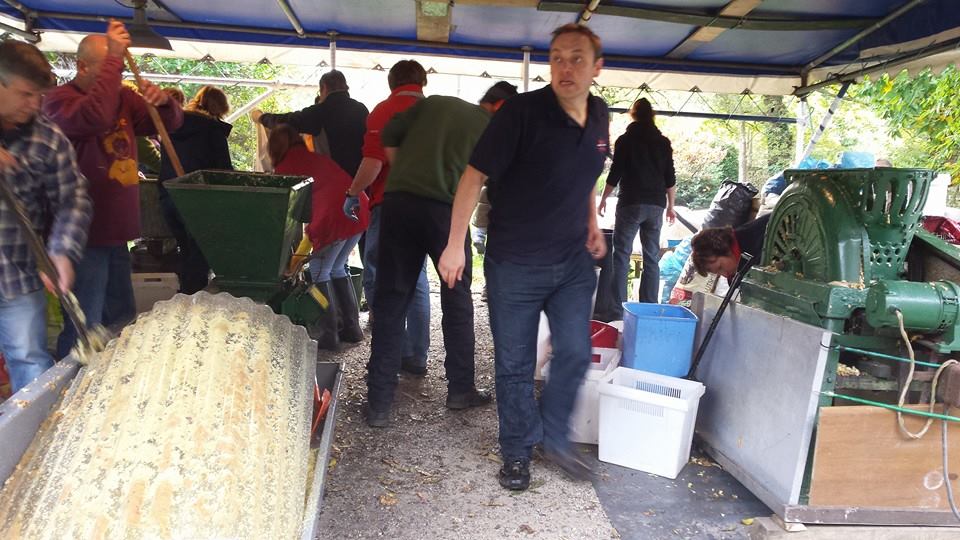
woodthorpehall2014f woodthorpehall2014e woodthorpehall2014d woodthorpehall2014c woodthorpehall2014b woodthorpehall2014aOn Saturday 11th October a number of Sheffield CAMRA members along with some regulars from the Three Tuns in Dronfield joined Dick Shepley and team at Woodthorpe Hall for the annual Cider Run and apple pressing. The Cider Run is a local CAMRA tradition started by Chesterfield branch, possibly as a parody of the wine world’s Beaujolais Nouveau race, where we hand deliver a tub of Owd Barker Cider to the local village and enjoy lunch in a local pub (this year the Rutland Arms) before returning to Woodthorpe Hall to help with the apple pressing to make next years supply of cider. Once the days work was done the team was able to relax, socialise, enjoy tea, coffee, cider and home made cakes all around the bonfire. Which is in a shopping trolley. You can enjoy what is left of last years production at the Steel City Beer & Cider Festival from 29th October to 1st November.

Hopping down to Hereford – with Sue Morton of Abbeydale Brewery

Early September brings one of the treats of the brewers calendar, a trip to the Hop Walk organized by hop merchants Charles Faram. This year the location was Pridewood Farm, Ashperton, Herefordshire. Hops have been grown there since the 19th century and the Powell-Tuck family have been continuing this tradition for almost 20 years. There were over 300 UK brewers there to participate in a day of learning more about hop growing and harvesting and to listen to various experts giving updates on state of the hop harvest around the world and the effect on price and availability of this essential brewing ingredient. Alongside all of this there was of course, the chance to sample some beer, this year some beers brewed in the conventional way and some with the addition of hop oils. This may be a way in future of making hops go further by extracting the oils and adding those to beer rather than whole hops or pelleted hops. Of course this stimulated much debate between traditionalists and those who see this as a way forward. I am sure it is a debate we will hear more of if the growth in small brewers continues to outstrip the planting of hops. This year Abbeydale decided to take advantage of the opportunity to obtain some hops straight from the field and make a “green hop” beer. Normally hops, once separated from the bine (stalk and leaves), are dried gently. This stabilizes them so they can be packed and stored for quite long periods so they can be transported and used thoughout the coming year or so. Green hops are taken from the field, separated and then put into sacks. They then need to make their way into beer within hours or, like any vegetable matter they will start to rot and compost. Because the hops are not dried we needed eight times as much in weight, so at the end of the day we loaded up our van with 100kg of freshly harvested Early Goldings hops and in less than 24 hours they were in the beer. Indeed one of the main challenges was fitting them into the hop back! Making a green hop beer is such a special thing – a sort of brewery harvest celebration – that we wanted to make a big thing of it. We have wanted for some time to do a series of beers featuring English hops, our Albion Ale series, so what better way to launch them than to start with this green hop beer. It will be called Scepter’d Ale, ABV 4.1% and in fermenter it is tasting very soft, floral and sweet. Final flavours have yet to develop, but with no dark or crystal malts to hide the hops, this should be one lovely beer. greenhop1 greenhop2 greenhop3 greenhop4 greenhop5

letter to the editor…

I’m a great believer in giving credit where credit is due, so I would like to give some to the Robin Hood in Millhouses. A pub that has always served cask ales – up to half a dozen – following a recent (relatively minor) refurbishment it  now boasts some 11 hand pumps. As of 21/08/14 it has on -or due – some nine cask conditioned ales, as follows:- Brakspears, Wadsworth 6X, Tetleys,Pedigree,Black Sheep, Landlord, Bass,Moonshine, and London Pride. Cider drinkers are also catered for.  Also worthy of note is the fact that it gives a 20p a pint off for CAMRA members. On this latter point, I believe that some other local CAMRA groups print a list of pubs giving such discounts in their districts – perhaps we in Sheffield should follow their lead. Tony Bateman

Debate…

We’ve covered all points of view now in the whole craft keg and whether CAMRA members should embrace it, Mark Coxon who wrote the original article now wraps up the debate (no more please!!) If you take the article I wrote back in May by itself, at no point do I actively encourage CAMRA to start including keg beer as part of the campaign or ask for them to be included in any of their definitions. I am not calling for people to only drink keg and give up cask. The general vibe I get from standing at the bar waiting to buy a pint, is that there is a lot of negativity from real ale drinkers towards keg beers. Andy Cullen describes the poor quality of these beers in the past but also realises how this type of beer form has improved over time and now there is a lot of exciting choice available. Therefore from this and my personal experience of trying keg beers, I always like to give them a chance every so often. While I generally prefer cask overall, I do sample keg for a change and believe that it offers some different insights to cask. While this may seem counterintuitive to the “Campaign for Real Ale”, it is important to realise that this campaign also supports the drinking of real cider. Therefore for every pint of real cider that is sold, a pint of real ale isn’t. Yet CAMRA encourages the production and distribution of real cider. Maybe this is getting into a completely different argument. To summarise, I wasn’t putting forward that CAMRA should include them in their initiative. All I was commenting on is that this form of beer is on the rise and there seems to be a negative feeling from ale drinkers. I was simply raising the point that people may want to simply try keg every so often (even if it is just a taster). Each to their own. (As a side note, it’s great to see more people getting involved with beer matters and striking up some interesting discussion and opinions). And now Dave Unpronouncable of Steel City Brewing moves the debate on in his own special way… As far as the Campaign for Real Ale goes is the war won and should we now move our focus to beer quality? At the moment there is much debate around ‘Craft Keg’, whether it’s good or bad, and whether CAMRA should embrace, vilify, or ignore it. I’m not going to wade into that debate, but I am going to pick up one of the recurring points and follow a tangent… repeated phrases heard from the ‘Anticraft’ lobby is ‘cask is cask, keg is keg’, as if the container is the be all and end all of decent beer. Frankly, it isn’t. It’s a small factor in the long process chain from harvest to glass. The reason the likes of Watney’s Red Barrel were so dire is not that it was in a keg (though pasteurisation certainly doesn’t help!), but that what went into the keg was so poor. Believe it or not, neither casks nor kegs have magical powers – if you put decent beer in a keg, it will come out decent (even if you feel it would be even more decent from a cask!). If you put rubbish beer in a cask, it will remain rubbish – contrary to what some CAMRA stalwarts would have you believe, a handpump is not a guarantee of divine nectar. Britain now has well over a thousand breweries. This is more than any time in the last hundred years, in fact more than any time since transportation of beer became viable and so we moved away from nearly every pub brewing its own beer. I haven’t counted, but given how few breweries there were in 1980 there must be around a thousand breweries that are younger than me. These ‘new’ breweries come in various forms. Some have been opened by experienced brewers moving from being employed brewing somebody else’s recipes to ‘going it alone’. Some are started by new graduates of brewing degrees. And some are opened by people starting a brewery because it ‘looks like a fun living’. The latter have varying degrees of success, and varying approaches (which must be pretty strongly linked!). Often we see media articles about how lots of new breweries are opening ‘despite the recession’. I’d argue it’s in no small part because of the recession. A familiar story from any local newspaper tells how ‘brewery xyz’ opened when the brewer was made redundant from his (or less frequently her) IT/Finance/Marketing/etc job and invested their redundancy in a brewery. All well and good if you go in with your eyes open, learn how to brew and learn how the beer market really works. But in many cases it’s clear that they’ve ‘learned’ to brew by reading a homebrew book and scaling up (and in many cases it seems to be a homebrew book from 30 years ago, judging by the recipes!). The trouble with this (aside from the fact scaling up doesn’t really work…) is that they perhaps don’t learn the ‘why’ of the processes. They take shortcuts either deliberately or inadvertently. They may miss crucial cleaning or not do it right. So they get off flavours in their beer, but don’t know why so don’t know how to correct it. I’ve lost count of how many new breweries I’ve tried recently that had off flavours such as Phenol (smells like TCP), Diacetyl (smells/tastes like butterscotch), Esters (pear drops) or ethanol (caused by fermenting at high temperature, smells like nail varnish remover!). Unfortunately, often the unknowing customer blames it on the pub not keeping the beer right – but again, if that’s what goes into the cask, the cask won’t magically make it taste right. Obviously, keg is also not a cure for this either, but the ‘craft’ breweries that are heavily involved in kegging beer are generally drawn from those who get the brewing right (that’s not to say there aren’t plenty of breweries making excellent cask beer!). The other issue is the recipes themselves. Some brewers brew ‘traditional’ beers because that’s what the brewer likes, or because they think that’s what the market wants (the latter is more true in some areas than others). Others do so because it’s cheaper and has wider appeal. However, while ‘middle of the road’ beer has wider appeal, you also have more competition, both from other local micros, and from the big boys (who can probably brew it cheaper and more consistently than you!). In any industry you can aim for market penetration based on cost leadership, or on differentiation (can you tell I’m an accountant in my day job…). Some breweries go for the former, the old-fashioned ‘pile em high, sell em cheap’ – the trouble with that is you reach the Progressive Beer Duty cut-off a lot quicker, and have to brew twice as much to make the same return (i.e. work twice as hard!), as well as having the big and regional brewers to contend with. If you go for differentiation, you immediately create your USP (unique Selling Point). You pay more for ingredients, you give the beer more time, but you sell your finished beer for more – and people will pay more for it if they think it’s worth it. We all agree it’s worth paying two or three times as much to drink a proper beer in a proper pub than to sit at home swigging supermarket bitter, and many of us would think it worth another 10-20% more to have a really good beer rather than an average one. As with anything else in life, you (usually!) get what you pay for. If a brewery is flogging firkins for £50 and offering big multisave discounts, they probably can’t have spent much on ingredients. So, in conclusion, the ‘war’ to save Real Ale was won a long time ago. It’s not going anywhere any time soon, but if there is a threat to the popularity of Real Ale it’s certainly not from craft keg, but from the abundance of mediocre to poor cask beer. Even as a CAMRA life member, given a choice between a well-brewed hop monster in a keg or a brown twig juice from a handpump, I know which I’ll choose every time! So before we throw stones at the ‘craft keg’, let’s make sure cask isn’t in a glass house…

Tour de France – Yorkshire Grand depart Stage 2

The Tour de France is the world’s greatest cycle race and one of the big sporting events of Europe and this year there is an opening stage in Britain that includes Yorkshire. Stage 1 is from Leeds to Harrogate and Stage 2 is from York to Sheffield. The race and associated road show arrives in our area on Sunday 6th July with the key locations that have fan zones being High Bradfield, Oughtibridge, Meadowhall (for Jenkin Hill and Wincobank) and Don Valley Bowl (the stage finish). There will be lots going on and many thousands of people visiting Sheffield for the event. However note many roads in North Sheffield will be closed for the day and many bus services suspended (some buses will still run in the North Sheffield suburbs but not run into the City Centre). Trams and trains will continue to operate. Northern Rail will be running extra trains Sheffield-Barnsley via Meadowhall and Chapeltown. Stagecoach Supertram will be running an altered service with a high frequency service to Meadowhall and regular trams to Middlewood and Malin Bridge (where special shuttle buses will operate to Oughtibridge and Low Bradfield). See www.travelsouthyorkshire.com for travel information. Bradfield will be hosting ‘The Steel Stage’ festival on Kirk Edge Road where as well as seeing the race come past (and the rest of the stage on big screen), there will be live music and beer from Bradfield Brewery.  Entry is free, camping is also available (at a cost, please book in advance). See www.steelstage.co.uk. Le Tour de France Camping & Music festival takes place 3rd – 6th.July with Langsett Beer Festival – 3/4 July in the Festival Tent from midday. Tickets: £5.00 for both days with two free drinks www.langsetthub.com