Plea for brewery energy bill help

The Campaign for Real Ale is making a plea to the Chancellor to confirm before Christmas that breweries, pubs and hospitality businesses will receive support with their rocketing energy bills when the current scheme runs out in April 2023. 

It comes after a string of announcements in recent months of small, local and independent breweries closing down as they can’t make ends meet. 

Research by Steve Dunkley of Manchester-based Beer Nouveau has revealed that dozens of breweries have closed their doors in 2022.  

Brewers, and the wider pub sector, face a Christmas of uncertainty as the Government has failed to make key announcements about economic support and fiscal arrangements in 2023.  

The sector is anxiously awaiting news on which businesses will get energy bill support past April, as well as a decision on whether or not general beer duty will be uprated next year (which could see huge inflationary rises in the price of a pint at the bar), leaving brewers and publicans in the dark.  

CAMRA’s campaign has now reached the House of Commons where Chair of the All Party Parliamentary Pub Group Charlotte Nichols MP has submitted parliamentary questions to the Chancellor and Business Secretary asking for support with energy costs to help stop more pubs and breweries having to call last orders for good. 

Commenting, Steve Dunkley of Beer Nouveau said: 

“It is deeply worrying to see scores of small breweries announcing in recent weeks that they are having to close down for good due to the soaring costs of both making beer and keeping pubs open. 

“Coupled with customers tightening their belts and the risk of energy bills rocketing when the Government support scheme ends next year, these closures could go through the roof if the Government doesn’t offer urgent support to save this crucial part of British brewing.” 

Charlotte Nichols MP commented: 

“With pubs and other hospitality businesses facing a cliff edge in support for a crisis that will last long beyond April, it’s vital that Government give the trade some certainty over the festive period. The risk of spiralling future energy costs will leave licensees and brewers in limbo as they try to mitigate the impact of consumers being forced to tighten their belts. There are a huge range of measures that the Chancellor and Business Secretary could take to support pubs and I look forward to hearing from them both about their plans.” 

CAMRA Chairman Nik Antona added: 

“Small and independent breweries have been a huge success story for the UK economy over the past 30 years, employing local people and reviving the UK’s beer scene and massively increasing the choice of tasty and distinctive brews for drinkers.  

“If we are to make sure that our beloved breweries can survive and thrive, then the Government urgently need to give brewing and pub and club businesses certainty and make key announcements about ongoing energy bill support and freezing general beer duty as soon as possible. 

“CAMRA are also calling for venues to receive more help with the burden of business rates – and for the new, lower rate of duty charged on draught beer and cider to be introduced as quickly as possible to help pubs and small, independent breweries.” 

Sources of information on brewery closures: 

Parliamentary Questions submitted by Charlotte Nichols MP are as follows and are due for answer by 19th December: 

  • To ask the Chancellor of the Exchequer if he will make it his policy to extend the Energy Bill Relief Scheme beyond April 2023 for hospitality businesses; and if he will make a statement. 
  • To ask the Secretary of State for Business, Energy and Industrial Strategy what support he plans to provide to (a) pubs, (b) social clubs (c) breweries and (d) cider and perry producers for the cost of energy once the Energy Bill Relief Scheme ends; and if he will make a statement. 
  • To ask the Secretary of State for Business, Energy and Industrial Strategy what recent assessment he has made of the rate of closure of small and independent breweries in the UK in the last 6 months. 

Hearth of the Community

It’s scary out there at the moment isn’t it? Whether you read this as a drinker, a landlord or a hospitality worker, you’ll have either a shared or individual reason to be concerned. Sadly, that doesn’t seem to be going to change anytime soon either. There’s the overall Russian concern, concerns over job stability and, for our beloved pus and bars, concerns over financial sustainability. Like those sitting at home, how are they going to pay their electricity bills?

With everyone, myself included, facing imminent price hikes for utilities, food and other bills, will there be room for beer in our budgets? Will we be able to venture out to our locals (or beyond) for a pint in a bid to ‘do our bit’ and help them keep their lights on? Well, we just might be able to…

It’s impossible to avoid the numerous saddening news stories of venues closing (The Griffin in Castleford being one of the latest) but between them, there are small glimmers of hope, and opportunity for those able. Pubs have been the beating heart of communities for generations now and if we’re not careful, we’re in danger of losing that. Whilst the word ‘pub’ might instantly mean beer that could, particularly over the winter, change to warmth.

In a world where home-working has become the norm, sitting at home might not be as comfortable as it once was. Instead of staring at the thermostat with scrutiny before sticking on a tenth layer of clothing, pubs and venues could provide the answer; allow people to work from them. For a fee of some sort, perhaps with a pint or cup/s of tea/coffee thrown in, not only could someone work remotely in relative comfort, but the pub can also cover a portion of their heating/electricity bill at the same time. And, let’s be honest, who isn’t going to stop for a pint after work too?

This isn’t a new or ground-breaking idea either as venues such as Springwell, North Brewing’s taproom, and Horsforth Brewery cater for those needing a workspace, but it’s one I’m surprised we haven’t seen more of. Not only can those working from home find some company and conversation by working outside of their own four walls, but the pub could find itself some new customers too.

Of course, this isn’t going to be applicable to every venue across the district, but how many would otherwise potentially be heating an empty space wishing for customers? Not only is it beneficial for both parties if done correctly, but it could be the first crucial step in re-connecting with the local community and prolonging the pub being the centre of its local community. If people are happy to work there, they’re certainly going to be happy to eat, drink and socialise there after. Done properly, the pub could become people’s second homes, much like they used to be, with a thriving community look and feel.

It’s a novel idea, and one that may not generate thousands in income but, in the current climate especially, surely something is better than nothing? The potential long term effect is worth considering too, with plenty of opportunity to advertise upcoming events & community projects, enticing further revenue and support.

If I worked from home and my local offered such an idea, I know where I would rather be sat. Imagine being able to say, “I’m going to work,” meaning the pub and having the best of both worlds; a comfortable & welcoming space in which to work, then having a pint after. Sounds perfect to me.

Stephen Carter, Points of Brew 

https://pointsofbrew.beer/

Wendy Woodhouse

Wendy Woodhouse 1944-2022. By Chris Bamford.

It is with great sadness that we are passing on the news that one of the most important, influential, respected, and downright nicest people in the Sheffield pub scene, Wendy Woodhouse, passed away in late September.

Although many already knew Wendy from her many years running a newsagents on Ecclesall Road, and from her many other business interests, she became well known in the real ale scene after opening The Harlequin in October 2006. The Harlequin, in the former Manchester Hotel on Nursery Street, took its name from a much-loved pub on Johnson Street around the corner, which was unfortunately demolished, despite Wendy’s attempt to save it. In typical Wendy fashion, she was not to be deterred and simply bought The Manchester instead, a former Wards pub which had fallen on hard times.

Under Wendy’s stewardship, and later that of her step-daughter Hannah after Wendy’s partial retirement, The Harlequin fast established itself as one of the best real ale pubs in a city not short of such places. Having diligently learnt her craft during a short stint at the Kelham Island Tavern, and through friendship with other highly respected Sheffield publicans, the pub soon became famed for its beer festivals and vast array of new and rare beers from around the country, as well as local favourites. Before long, the pub was the recipient of several CAMRA awards. Characteristic of Wendy’s dedication to authenticity, there was also a nod to the history of the building’s past life as The Manchester, in being one of the few places still serving John Smith’s Magnet on cask.

Driven by Wendy’s love of rock and roll, the pub hosted regular live music nights, including frequent performances from Sheffield’s legendary guitarist Frank White. There were quiz nights, folk music sessions, good value food at lunch time, and a function room hosting all manner of events, emphasising another of the values Wendy held most dear – community spirit.

Perhaps the story from the Harlequin that best reflects Wendy’s sheer determination was the fact the pub, despite being located only a road width away from the banks of the Don, did not close during the 2007 floods – a fact of which Wendy was most proud. This is reflected in this correction issued in an online local history group when it was suggested otherwise: 

“The information you give about The Harlequin during the Flood is incorrect.  I was the licensee at the time and the pub did not close, not even for one day.   I continued to trade the whole time by selling Kellham Island Brewery bottled beers.   The pub and cellar were cleared and cleaned, the cellar sanitized and re-equipped and up and running with cask ale by Friday the 6th July. On Saturday the 30th June we catered for a couple who were celebrating their joint 50th and 60th Birthdays, again with bottled beers but it was nonetheless a huge success.  By the way its original name was the Manchester Lincoln and Sheffield Railway Hotel.”

Wendy was never one for taking it easy, and after leaving The Harlequin it wasn’t long until she popped up behind the bar of another of Sheffield’s resurrected pubs. Shortly after it reopened, she fast became a weekend evening fixture behind the bar at Shakespeares on Gibraltar Street. With Wendy entertaining the regulars, many of whom came specifically to see her, she was always on hand to provide advice, parkin, and support. It wasn’t long before Shakespeares, as the Harlequin had before, established itself in Sheffield’s beer scene. She was part of the team when Shakespeares won Sheffield CAMRA Pub Of The Year in 2013, and kept her regular shift up until the COVID-19 pandemic hit in 2020.

Not content with this already impressive impact on the pub industry, 2018 saw the start of another chapter in the story of Wendy’s influence. After thwarted attempts to save a couple of other Sheffield pubs (sadly now lost to us), Wendy bought the building housing the former Crown Inn on Scotland Street, then operating as The Sleep Hotel.

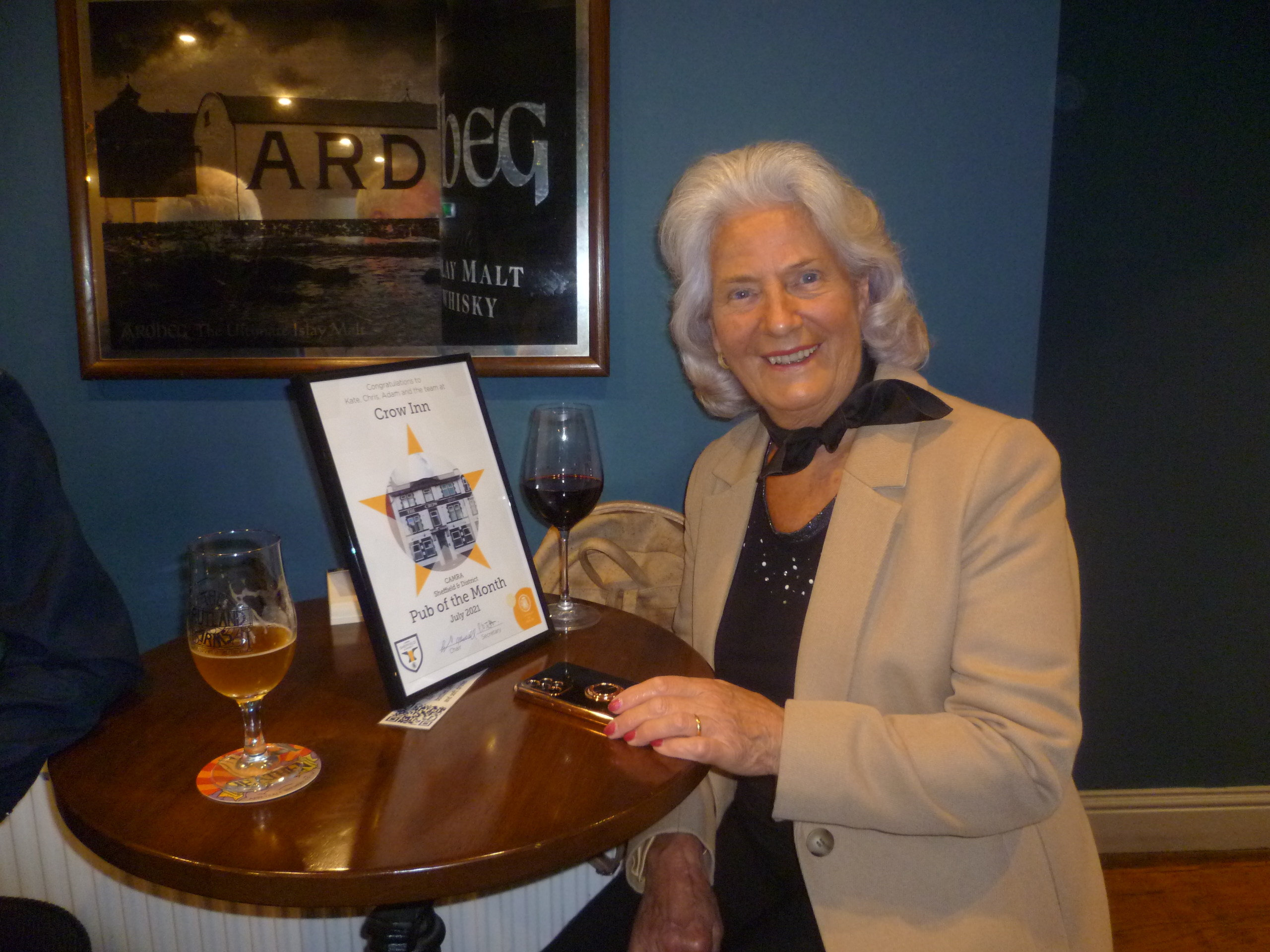
With significant investment, not to mention her drive, resourcefulness and experience, this has become The Crow Inn, which opened in June 2019. With Wendy available for assistance, advice and with her unwavering enthusiastic support behind the tenants, this too has become an award winning pub, and seven room hotel. In fact, The Crow will be presented with its second CAMRA Pub of the Month award on Thursday 3rd November, an occasion of which Wendy would have been immensely proud.

Most people would be content to be involved in one award winning pub. To have been part of three, which have in many ways helped shape the evolution of the real ale and craft beer scene in Sheffield, is testament to the sheer energy with which Wendy approached everything throughout her life. She will be sorely missed.

About Wendy and Me

I first spoke to Wendy on Christmas Eve 2007, when she called me to ask if I still wanted a job at The Harlequin, after having dropped in my CV a couple of months earlier. Soon I was being trained in her diligent methods on the bar and in the cellar as I worked with Wendy through the handover to her step-daughter Hannah in 2008. Wendy kept a watchful eye on proceedings over the next couple of years from her shifts on Thursdays, Fridays and Saturdays while I became assistant manager. While I was the general manager of Shakespeares I hired Wendy (in as much as anyone could ever hire Wendy) once she left The Harlequin. After we took over the running of The Rutland Arms, myself and Kate accompanied Wendy to auctions and near-derelict buildings on her quest to find one more pub. We worked closely alongside Wendy during the refurbishment transforming the Sleep Hotel into The Crow Inn, and are the current tenants there. Without Wendy’s guidance, advice, support and more, I very much doubt I’d have the career I have in this industry.

Faux craft

You may have noticed that there are some “craft” beer brands that are starting to appear in a lot of pubs, bars and restaurants, sometimes at the expense of local beers, sometimes just creating disappointment when you see a new place open advertising “craft beers” only to find the same old beers on the menu.

Possibly the most prolific in this category in our area is Beavertown Brewery with Neck Oil and Gamma Ray quite commonly available. This brewery is now owned by Heineken and has seen huge expansion in their production capacity and benefits from a large scale sales and distribution network as well as a large estate of Heineken owned venues (including pubs leased by independent operators from Star Pubs & Bars or Punch Taverns) to supply.

Another internationally owned “craft” brand is Camden Town Brewery. Whilst the name encourages you to dream of hipsters down Camden Locks in London brewing small batch artisan ales the brewery is actually owned by AV Inbev, the same global company behind Budweiser, Corona, Becks, Leffe and Stella Artois who again have a huge sales, marketing and distribution resource.

Also in this category is Brixton Brewery, owned by Heineken and I’d also conisider Brewdog too now they have grown into a global brand with beers like Punk IPA not what they were and available cheaply in supermarkets.

Some commentators are drawing parallels with the earlier days of CAMRA where the national “Big Six” brewers dominated pubs, making it difficult for smaller regional brewers to access the market and giving consumers less choice as a result.

Of course the likes of Beavertown and Camden Town started out as small independent brewers using quality ingredients and a passion for good beer before selling out to the big boys who saw rising demand for craft and wanted that market for themselves.

People are having conversations on whether any kind of campaigning or lobbying for a modern day version of the guest beer rights should take place, however for now the best way to support small, independent local (and not so local) brewers is to choose their beers where it is on the bar or menu – pubs, bars and restaurants are businesses and will sell what makes them money after all!

It’s just beer, mate!

If there is one thing beer likes, it’s labels. Not a week goes by when a new acronym isn’t being wheeled out to confuse everyone, leaving them debating what on earth it stands for.  IPA, DDH, TDH, HDHC, you name it we’ve had it. There’s even been a TDHNDDIPA recently thanks to Verdant Brewery down in Cornwall. Yeah, figure that one out if you can! It doesn’t stop there either, as we try to pigeon-hole beer even further into either ‘craft beer’ or ‘real ale’.

Whilst I appreciate the effort to differentiate between what could be an old-school or traditional IPA and a thick and hazy juice bomb, at what point do we just accept that it’s all beer at the end of the day? Much like the tribalism of old where people defended their favourite brand to the hilt, it seems you’re in one camp or the other, whilst disparaging your opposite number at the same time. But why?

I was pretty snobby when I first got into beer, coming from a clean slate and jumping in to hazy beer with both feet from the off. I hadn’t progressed from industrially-produced lager or moved on from cask beer to keg beer, I started afresh on the cloudy stuff. As far as I was concerned, if beer wasn’t yellow, hazy and tasted of tropical juice I wasn’t interested. This is what beer could be and what I’d been missing out on all these years.

Now whilst I still love a pint of the hoppy custard, I’m no longer averse to a good well-kept pint of cask if I see one. Heck, cask might even be becoming ‘cool’ as breweries more recognised for their juicy numbers brewing and producing beer to be pulled through a sparkler. And yes, cask beer can be hazy for those still stuck in the 1970’s sat at the back. So, with that in mind, where is the line between ‘real ale’ and ‘craft beer’? In fact, is there even a line at all?

Whilst we can try and define our beers by serving method, how they’re stored, their colour or clarity there are of course grey areas in-between. Even CAMRA’s initial definition of real ale was revised as of January 2022, showing that it isn’t possible to give something an exclusive or permanent definition. Whilst the US has a legally-binding definition of craft beer the UK doesn’t, nor is CAMRA’s coined label of real ale. There’s simply too many grey areas to enforce it.

Take recently retired local brewery Five Towns as an example. Malcolm brewed (as far as I’m aware) exclusively on cask. He had, what would be defined as, real ale within some of those casks (bitters and low ABV pales etc) however he also brewed some heavy-hitting DIPAs and stouts, some of which would elsewhere be classed as craft. So does that make it a real ale brewery that dabbles in craft beer? A cask brewery that also does keg? Or, more simply, a brewery that just produces good beer?

They aren’t the only example either, take the likes of Vocation, Brew York, Revolutions and, looking further afield, Kernel as great examples. Breweries who excel in both cask and keg beer, so how do we define or label those?

Of course, there’s no right or wrong answer here but at the end of the day it is just beer. Be it hazy, clear, hoppy, bitter, sweet, carbonated or otherwise, it’s just beer and we can enjoy it in whatever measure and how we please. No sandals and socks needed for a pint of cask and no beard on man-bun needed to enjoy a pint from keg, man or woman can enjoy either, or both, equally.

Stephen Carter, Points of Brew.

You can listen to the Points of Brew via all the usual Podcast services.

The Last Ride

“I couldn’t honestly believe it. I was really, really upset,” Aaron Getliffe, co-host of the Points of Brew podcast, tells me with genuine anguish in his voice upon discussing the closure of Kelham Island Brewery. And he’s not the only one. Tributes poured in across social media in support of the brewery from fellow brewers, writers, bloggers and, most heart-warmingly, the loyal customers who have supported them throughout the years. 

Much like the loss of a close friend or relative, the announcement that Kelham Island Brewery will be closing its doors hit many people hard, sending shockwaves throughout our industry. An institution in the Sheffield brewing landscape since 1990, it’s hard to imagine a world without their beers adorning pubs and bars across the country. One of those beers in particular, is Pale Rider; their signature pale ale that drinkers UK-wide have swooned over since it was first brewed. 

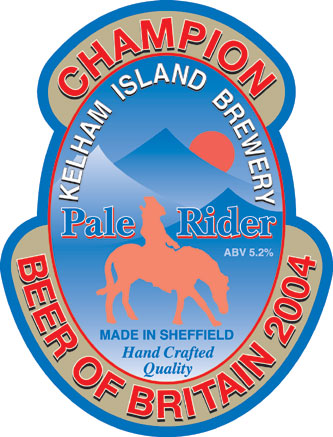
Inspired by the US, this pale ale was amongst some of the first that introduced many to American hops and the flavours they could impart on their beer. Bagging itself CAMRA’s Supreme Champion Beer of Britain award in 2004, its quality didn’t go unrecognised either. Since then its reputation has preceded it, with people assuming the brewery’s place in the brewing world being firmly cemented. It would appear even those with a long-standing legacy aren’t immune from the rising costs we all find ourselves surrounded by. 

While direct reasons weren’t cited in the announcement made by the brewery, Roger Protz spoke to Ed Wickett shortly after who confirmed rising costs and Covid were to blame. “We’ve had a tricky couple of years and they could have got worse. The brewery is getting old and some bits were falling off. It needed investment but we’ve been faced with surcharges for gas, fuel, malt, hops and delivery charges,” Ed told Roger. They’re not alone in closing their doors, with others including Beatnikz Republic in Manchester and Fallen Brewing in Scotland to name but two more, and rumour has it there are more to follow suit in the coming weeks. So where does this leave us and how can we help?

Simply put; drink beer and local beers at that. But, when we too are facing living costs spiralling out of control it’s not that easy. After lockdown closed down the on trade, a spike in running costs was another hurdle that brewery’s, pubs and bars did not need, and now their loyal customers are having their pockets hit harder than ever. Visiting a local might have once been a weekly occurrence, perhaps more for some, but those few regular pints might become the odd and infrequent one or two.

Likewise drinking at home has become commonplace, with many drinkers still finding solace and safety within the confines of their home or beer shed. Whilst seeking shelter from Covid is understandable, home drinking has to dwindle if our beloved places of comfort are to continue to navigate these troublesome times. But, for one last time, let us saddle up, hit the trail and raise a toast to Pale Rider and Kelham Island Brewery who will never be forgotten. 

Fuggles the Inebriate

The humorous novel, written by retired brewer Frank Priestley, is set in the ‘out of the way’ village of Widdleton-in-the-Bog somewhere in the middle of England. Today, the most prominent building in the village is the edifice known as the Old Hall – formerly the ancestral seat of the illustrious Fuggles dynasty.  The last remaining scion of that venerable family is Josiah Fuggles who, through mysterious circumstances has been reduced to living in a modest but comfortable cottage, on a small but adequate allowance.

Fuggles, an educated man, spends most of his time drinking with his friends in the many vernacular pubs of the village.  He never tires of flaunting the wealth of his wisdom and learning – his listeners frequently do.  Their quest is to extend and synchronise their patronage of the local hostelries in the hope of preventing the pub closures that have blighted so many other communities. 

In the course of the narrative, he experiences the pleasures and perils of streaking, snuff taking, craft ale, conceptual art, a beer festival, whisky drinking, town pubs, bicycle riding, gin drinking, long distance walking, sea fishing, a wedding, a brewery visit, pub games, a very bad winter, a brew pub, village cricket and a ‘gentlemen’s’ night.  During these adventures, he encounters a love-sick brewer, a ‘thin’ publican, a mortal enemy, a pig man, a yellow haired lady, a bee keeper, a meandering man, a beautiful barmaid, an angler, an unexpected half brother, a badger, a fox, a cat, a dog, a stoat and an imaginary owl.  Such is the variety of life in Widdleton-in-the-Bog.

The book is available to order on Amazon as a paperback or e-book.

Members’ Weekend report

CAMRA’s National Members’ Weekend, AGM & Conference is an annual event open to all members, this year it was held in Eastbourne from 8 to 10 April and as a member who has been actively involved in the campaign for many years now decided to make the trip down to attend.

The AGM element is a very small part taking up less than an hour on Saturday morning as it is just fulfilling legally required formalities. The Conference sees a good chunk of the time spent discussing and voting on motions proposing to change CAMRA’s campaigning policy and procedures but there is also more aimed at active volunteers including guest speakers (this year we had Liberal Democrat MP Daisy Cooper and writer Laura Hadland), award presentations and various workshops designed to share experiences and help you run your branch better. We also have reports from the national Chairman and CEO.

Personally when it came to the slot for fringe events on Saturday afternoon my choice wasn’t one of the workshops, I instead bought a ticket to a beer tasting event cantered around the new United Kingdom of Beer book, which was hosted by the author Adrian Tierney-Jones and featured six of the beers from the book.

The Members’ Weekend part of the event title is the more social part, which, lets be honest, was why most members go and after two years of Covid restrictions it was a get together for people across the UK and beyond who hadn’t been together for almost three years! The local branch run a members’ bar in the conference venue which is basically a mini beer and cider festival and all are provided with an information booklet that includes a map and guide to all the real ale pubs in the area and it is always an enjoyable change to have a wander around the pubs in a different town and recognise people from the event drinking in them! There were are also coach trips to local breweries organised.

Back at the conference an interesting little exercise that took place was a presentation and discussion of CAMRA’s five year plan for 2023-2027. Over some time a number of different volunteer committees had fed into this document which in simple terms breaks down what CAMRA is about and needs to achieve into a number of core objective headings with more details under those headings that can develop and evolve over the next five years. The headings are:

  • Secure the long term future of real ale/live beer, real cider and real perry by increasing their quality, availability and popularity
  • Promote and protect pubs and clubs as social centres and part of the UK’s cultural heritage
  • Increase recognition of the health benefits of moderate social drinking
  • Play a leading role in the provision of information, education and training to all those with an interest in beer, cider and perry of any type
  • To ensure, where possible, that producers and retailers of beer, cider and perry act in the best interests of the customer
  • Develop products and services that promote the Campaign as widely as possible, increase and diversify the membership and activist base and generate campaigning funds
  • Develop and maintain the necessary ethos, governance, structure and financial resources to deliver CAMRA’s objectives
  • Secure the financial future of the organisation and continued campaigning activity by maintaining and increasing membership numbers
  • Increase recruitment and retention and increase activism through improving brand perception, inclusivity and diversity performance
  • Increase the number of volunteer/active members and ensure stability and sustainability of branch network
  • Support volunteer network and enable it to effectively deliver events and campaign objectives

The discussion also mentioned there are some themes that can fit into a number of objectives in the detail such as the wider issue of environmental sustainability – for example we should be ensuring that as an organisation we include such values in how we do things but also highlighting environmental positives in things we campaign for – for example real ale is typically sold from casks that are returned to the brewery and reused and spent grain from the brewing process is often taken away by farmers for animal feed.

CAMRA’s role in providing information and education for members was embraced through the period of lockdowns and restrictions with the launch of much online content including the Learn & Discover platform at camra.org.uk with an extensive library of content; the Pubs, Pints & People podcast which is now several seasons in and the What’s Brewing online members’ newspaper. Of course now most Covid restrictions are lifted and life is able to resume in a more normal fashion we are also able to organise more sociable experiences such as brewery tours and beer festivals again too!

The next annual Members’ Weekend, AGM & Conference takes place 21-23 April 2023 and we are hosting it here in Sheffield, bringing 1,000+ beer tourists to the city who as well as attending the conference at the Octagon will be discovering many of the pubs and breweries around our area!

Inclusion, Diversity and Equality Review

The consultation seeks feedback and views on lots of areas of the campaign. This includes our events, communications, complaints process, and the experiences of people volunteering with us and attending our events.

The review is about understanding our membership so we can look at our existing equality and diversity policies and processes, identify what we are doing we well, and where there are gaps, weaknesses or improvements that should be made. You can read more about the review, and the review group leading at camra.org.uk/inclusivity-diversity-and-equality-review.

The consultation will be running until Monday 14 February, please take the opportunity to have your say.

The current pubco scene

A pub company is simply a company that owns pubs and there are literally hundreds of them, many with only a handful or even just one pub. We’ll concentrate here, though, on the bigger companies who, between them, own over half the country’s pubs.

Stonegate

Founded in 2010 with the purchase of 333 pubs from Mitchells & Butlers, Stonegate grew quite slowly over the next ten years, making a series of acquisitions including brands like Slug & Lettuce, Walkabout and Be At One, until its pub numbers totalled 765. All the pubs were managed houses. A seismic change came in 2020 when Ei Group was bought for £1.27bn, making Stonegate the largest pub company in the UK with 1,270 managed pubs and, as a result of the Ei purchase, 3,200 leased and tenanted businesses.

Ei itself had been founded, as Enterprise Inns, in 1991, initially with 333 pubs from Bass. The company built up its estate, gaining 2,200 pubs in batches by buying them from other companies or taking them over. In 2002, 1,864 pubs were bought from Whitbread and in 2004, 4,054 from Unique. By this time, it owned nearly 10,000 pubs and was in the FTSE 100 list of top companies. However, it was loaded with debt and the 2008 financial crash required a good deal of retrenchment. Ei also started building up its managed estate, including pubs on retail agreements under the Craft Union brand (we’ll look at this operating model in the next article). By the time of the sale, it was down to fewer than 4,000 pubs.

Punch Taverns

The first article included a brief history of Punch to illustrate the volatility around pubco development. In summary, it grew quickly to around 8,000 pubs, suffered under the crash, sold a lot of pubs including its managed division and was taken over in 2016. 1,900 pubs went to Heineken and 1,300 to Patron Capital, who retain the Punch brand. At takeover time, all pubs were leased or tenanted but it’s also now pushing retail agreements (which it calls Management Partnerships). Some pubs were sold but in June 2021 it announced the purchase of Youngs’ tenanted division, bringing the current total to 1,282.

Admiral Taverns

Admiral was founded in 2003 by two families and grew quickly to 2,300 pubs by 2007. Many of these were ‘bottom end’ houses disposed of by other pub companies. The financial crash had the usual consequences for over-extended businesses and numbers were down to 1,700 by 2011 and continued to fall. By 2017 it was in the hands of Cerberus Capital Management who sold up to a joint venture by Magners cider-makers C&C Group and estate investor Proprium Capital Partners, by which time there were 845 pubs. The acquisition trail was hit in 2019 with 137 pubs coming from Marston’s and 150 from Heineken. The big one arrived in July 2021 when Admiral bought 674 Hawthorn pubs from property firm New River taking the estate to over 1,500.

Admiral’s pubs are all tenanted or leased and tend to be wet-led community operations. It has a relatively good reputation in the trade though there’s certainly no aversion to flogging off pubs as ‘development opportunities’.

Star Pubs & Bars

In 1995, Scottish & Newcastle, one of the original ‘Big Six’ breweries, bought another of them, Courage, making the combined group Britain’s biggest brewer. By 2011, the pub arm, then known as S&N Pub Co, had 1,500 tenanted pubs and 600 in management. Come 2008, Scottish Courage was gobbled up by international brewer Heineken and the pub business rebranded as Star Pubs & Bars. Many pubs were sold but then, in 2017, as previously mentioned, 1,900 were snapped up from Punch. Again there were disposals and the estate currently stands at 2,500.

Star vigorously promote their retail agreement scheme, Just Add Talent. In 2020, it was fined £2m for breaches of the Pubs Code (which we’ll cover in a later article).

Greene King

In 1995, Greene King was a long-established family brewer with 900 pubs, nearly all in East Anglia and the South-East. It then embarked on a ferocious acquisition trail, swallowing up many breweries (the likes of Morlands, Belhaven, Morrells and Hardy & Hanson) and other pub companies. GK itself is now owned by a billionaire Hong Kong property developer. It has some 3,100 pubs, restaurants and hotels, of which 1,200 are tenanted or leased. Its strategy seems to be to move in the managed direction and the ‘Pub Ready’ retail agreements are pushed hard. GK was once renowned for not letting other people’s beers in its pubs but now have a more enlightened attitude.

Marston’s

The company was known as Wolverhampton & Dudley until 2007 when it rebranded as Marston’s, one of the many breweries it had taken over in recent years. At that time, 2,500 pubs were owned but the total is now down to 1,400. The tenanted estate, in particular, has been reduced through sales such as 200 to New River in 2013 and 137 to Admiral in 2019. In late 2020, the company took on the running of 156 Brains pubs in Wales. Also that year, Marston’s merged its brewing operations with Carlsberg but this does not directly affect the pub business.

Mitchells & Butlers

Formed originally out of the old Bass estate, M&B have 1,650 pubs and restaurants. The multitudinous brands include Ember Inns, Toby Carveries, Nicholson’s and All Bar One – as can be seen, the emphasis is on food. Pubs are mostly managed though around 50 are on a lease arrangement.

JD Wetherspoon

Since opening its first pub in 1979, ‘Spoons has expanded to 925 pubs and 50 hotels, all managed. Plans for 18 new pubs are in the pipeline,

Wellington

Owned by the billionaire Reuben Brothers, the company leases all its 850 pubs on a free of tie basis.