The consultation seeks feedback and views on lots of areas of the campaign. This includes our events, communications, complaints process, and the experiences of people volunteering with us and attending our events.
The review is about understanding our membership so we can look at our existing equality and diversity policies and processes, identify what we are doing we well, and where there are gaps, weaknesses or improvements that should be made. You can read more about the review, and the review group leading at camra.org.uk/inclusivity-diversity-and-equality-review.
The consultation will be running until Monday 14 February, please take the opportunity to have your say.
A pub company is simply a company that owns pubs and there are literally hundreds of them, many with only a handful or even just one pub. We’ll concentrate here, though, on the bigger companies who, between them, own over half the country’s pubs.
Stonegate
Founded in 2010 with the purchase of 333 pubs from Mitchells & Butlers, Stonegate grew quite slowly over the next ten years, making a series of acquisitions including brands like Slug & Lettuce, Walkabout and Be At One, until its pub numbers totalled 765. All the pubs were managed houses. A seismic change came in 2020 when Ei Group was bought for £1.27bn, making Stonegate the largest pub company in the UK with 1,270 managed pubs and, as a result of the Ei purchase, 3,200 leased and tenanted businesses.
Ei itself had been founded, as Enterprise Inns, in 1991, initially with 333 pubs from Bass. The company built up its estate, gaining 2,200 pubs in batches by buying them from other companies or taking them over. In 2002, 1,864 pubs were bought from Whitbread and in 2004, 4,054 from Unique. By this time, it owned nearly 10,000 pubs and was in the FTSE 100 list of top companies. However, it was loaded with debt and the 2008 financial crash required a good deal of retrenchment. Ei also started building up its managed estate, including pubs on retail agreements under the Craft Union brand (we’ll look at this operating model in the next article). By the time of the sale, it was down to fewer than 4,000 pubs.
Punch Taverns
The first article included a brief history of Punch to illustrate the volatility around pubco development. In summary, it grew quickly to around 8,000 pubs, suffered under the crash, sold a lot of pubs including its managed division and was taken over in 2016. 1,900 pubs went to Heineken and 1,300 to Patron Capital, who retain the Punch brand. At takeover time, all pubs were leased or tenanted but it’s also now pushing retail agreements (which it calls Management Partnerships). Some pubs were sold but in June 2021 it announced the purchase of Youngs’ tenanted division, bringing the current total to 1,282.
Admiral Taverns
Admiral was founded in 2003 by two families and grew quickly to 2,300 pubs by 2007. Many of these were ‘bottom end’ houses disposed of by other pub companies. The financial crash had the usual consequences for over-extended businesses and numbers were down to 1,700 by 2011 and continued to fall. By 2017 it was in the hands of Cerberus Capital Management who sold up to a joint venture by Magners cider-makers C&C Group and estate investor Proprium Capital Partners, by which time there were 845 pubs. The acquisition trail was hit in 2019 with 137 pubs coming from Marston’s and 150 from Heineken. The big one arrived in July 2021 when Admiral bought 674 Hawthorn pubs from property firm New River taking the estate to over 1,500.
Admiral’s pubs are all tenanted or leased and tend to be wet-led community operations. It has a relatively good reputation in the trade though there’s certainly no aversion to flogging off pubs as ‘development opportunities’.
Star Pubs & Bars
In 1995, Scottish & Newcastle, one of the original ‘Big Six’ breweries, bought another of them, Courage, making the combined group Britain’s biggest brewer. By 2011, the pub arm, then known as S&N Pub Co, had 1,500 tenanted pubs and 600 in management. Come 2008, Scottish Courage was gobbled up by international brewer Heineken and the pub business rebranded as Star Pubs & Bars. Many pubs were sold but then, in 2017, as previously mentioned, 1,900 were snapped up from Punch. Again there were disposals and the estate currently stands at 2,500.
Star vigorously promote their retail agreement scheme, Just Add Talent. In 2020, it was fined £2m for breaches of the Pubs Code (which we’ll cover in a later article).
Greene King
In 1995, Greene King was a long-established family brewer with 900 pubs, nearly all in East Anglia and the South-East. It then embarked on a ferocious acquisition trail, swallowing up many breweries (the likes of Morlands, Belhaven, Morrells and Hardy & Hanson) and other pub companies. GK itself is now owned by a billionaire Hong Kong property developer. It has some 3,100 pubs, restaurants and hotels, of which 1,200 are tenanted or leased. Its strategy seems to be to move in the managed direction and the ‘Pub Ready’ retail agreements are pushed hard. GK was once renowned for not letting other people’s beers in its pubs but now have a more enlightened attitude.
Marston’s
The company was known as Wolverhampton & Dudley until 2007 when it rebranded as Marston’s, one of the many breweries it had taken over in recent years. At that time, 2,500 pubs were owned but the total is now down to 1,400. The tenanted estate, in particular, has been reduced through sales such as 200 to New River in 2013 and 137 to Admiral in 2019. In late 2020, the company took on the running of 156 Brains pubs in Wales. Also that year, Marston’s merged its brewing operations with Carlsberg but this does not directly affect the pub business.
Mitchells & Butlers
Formed originally out of the old Bass estate, M&B have 1,650 pubs and restaurants. The multitudinous brands include Ember Inns, Toby Carveries, Nicholson’s and All Bar One – as can be seen, the emphasis is on food. Pubs are mostly managed though around 50 are on a lease arrangement.
JD Wetherspoon
Since opening its first pub in 1979, ‘Spoons has expanded to 925 pubs and 50 hotels, all managed. Plans for 18 new pubs are in the pipeline,
Wellington
Owned by the billionaire Reuben Brothers, the company leases all its 850 pubs on a free of tie basis.
A key member of Sheffield CAMRA and of the Sheffield beer festival for around 30 years. Having worked on the set up and take down of many festivals, Martin finally cajoled his brother into joining the cause and promoting real ale in Sheffield. They both then bent my ear until I joined up. This then began my journey and transition from tasteless frothy rubbish into real ale.
Martin was always the first to arrive and last to leave during festival set ups. Working tirelessly to give the attendees the perfect experience and therefore the best possible impression of what we are all about.
He was an absolute brute in the cellar set up and perfect gentleman at the bar, while sipping a dark ale or Old Rosie he presented an imposing figure in long sweeping coats, various hats, a glint in the eye and infectious smile. Picture a cross between Oscar Wild and Jeff Capes via a gothic Doctor Who. A treasure of a man with a rapier like wit, hollow legs and always ready with a story to cheer up the group.
Bring up Martins name to any member of Sheffield CAMRA, his local the Kelham Island Tavern or anyone he knew, I guarantee you will see an instant smile flash across their face, a raise of an eyebrow then a deep breath as they retell a tale of monsters, wizards, warrior maidens and heroes. Or more realistically great nights, brewery trips and days out around Yorkshire hunting out ale hot spots.
The real ale scene, nay the world is a worse place for having lost Martin. Whenever I come across a new cider or rabbit punned beer I will always wonder what you would have made of it and drink to you. The places you loved will stand for years and I will always look for you in the spots where we used to drink.
I loved the time we spent and the fun we had, sadly there will be no more. You leave a massive hole mate. Rest in peace and see you in the KIT, I’ll get the first round.
Noel Nield
I’d like to add to Noel’s words on behalf of myself and the beer festival team.
I first met Martin nearly 20 years ago when I started volunteering for the Sheffield beer festival. He was one of the “gang of three”, big lads, with his brother Mark and mate Noel. In those days we had no lifting equipment and Martin and Noel lifted the full barrels up to head height to fit on the top of the stillage. They’d work away cheerfully all day at was physically beyond the rest of us, with an incredible stream of banter between them. I was in awe of their teamwork. Martin cut an unlikely figure with goth looks and black nail varnish, and he also doubled as our bouncer when the festival was in session, a job he did with ease. Martin was one of the people who made me really welcome when I started doing festivals and we used to spend hours joshing about with his craic and ready humour.
Sundays saw him dressed in his best , looking resplendent in suit and overcoat with his family at the Kelham, looking like a character out of Dickens, again with a lively stream of banter. Once at a Halloween party I was confronted by a bright green man – yes it was Martin in one of his outrageous costumes. His last festival was 2019, and he was recovering from the initial onset of his brain tumour. Physically he could no longer help a lot, but he was determined to turn up for the festival, his ready wit and humour still to the fore. For him the festival was important, a social occasion to get together with the rest of us festival makers once a year and have a good time. We will miss him.
When I see someone out of the corner of my eye buying a pint of Black Mass, and hear a group of mates having a good laugh and joke at a packed festival, I’ll know he’s still with us in spirit.
Rest in peace big man, I feel proud to have known you.
We were only able to do a four RambAles this year, but at least we were able to do some this year unlike 2020, and enjoyed pleasingly good weather for all of them.
We started on a lovely sunny afternoon at the end of July when we met for a lunchtime drink at the Hammer & Pincers pub at Bents Green. Following a pint of Moonshine five of us set off up Ringinglow Road to a much busier Norfolk Arms and a very pleasant Titanic Plum Porter amongst other available waiter served drinks. We were joined by two more colleagues for the walk along the Houndkirk packhorse route to Fox House. There our party split with the majority staying for a drink there prior to catching a bus back to Sheffield. I carried on along the Moss Road route over Totley Moor towards Thornbridge’s Cricket Inn at Totley, who were indeed hosting a cricket match, before going home.
Anglers Rest, Bamford
Our small group of regulars assembled again at the end of August at the Anglers Rest in Bamford for a varied choice of drinks, before making our way to the Cheshire Cheese at Hope which had local Intrepid beers on. A short walk from there found us at the Old Hall Hotel for the Bank Holiday Hope Valley Beer Festival with a larger marquee and choice of beers and ciders and entertainment from our old Harlequin friends ‘Rocket 88’ who were doing only their second gig in 18 months.
Rocket 88 playing at the Hope Valley Beer & Cider Festival
We were amongst many who enjoyed beers from Blue Monkey, Little Critters and Intrepid amongst others.
Hope Valley Beer & Cider Festival at the Old Hall Hotel, Hope
Our September RambAle started at the Shepley Spitfire in Bradway but as it had no cask ales on, we made our way through the woods and field paths to the Royal Oak at Millthorpe which was serving refreshing pints of Tim Taylor’s Landlord. A slow walk back via Cartledge took us to the Angel Inn at Holmesfield who had beers from Hambleton Stud brewery. This pub is well known for offering gluten free food and drink. We were going to head back to Totley for a final drink but ended up going a different way for some chips instead.
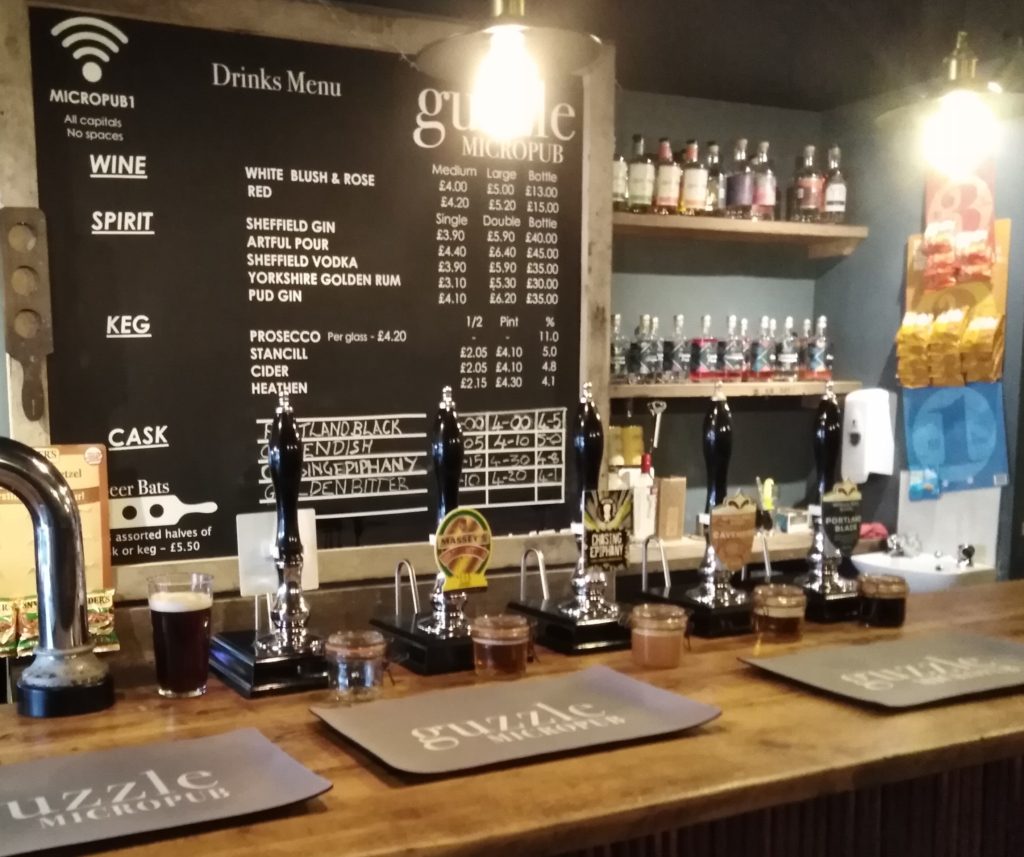
Guzzle Micropub, Woodseats
We had intended to start our October RambAle at the Guzzle micropub in Woodseats but had heard it wasn’t opening early enough, so switched the start across the road to the Big Tree who had a couple of cask ales on. Whilst we were gathering there, we noticed the shutters going up at the Guzzle so made our way back across to find they were experimenting with opening at 12 rather than 2pm. There was already a party in, so opening early obviously works. As does having a good range of well looked after cask and keg ales on and friendly and knowledgeable bar staff.
Mount Pleasant, Norton Woodseats
We then headed up through Graves Park where we found a regional Running Race taking place – so we took advantage of their catering facilities (a burger van) as we passed through. We found the Mount Pleasant pub down on Derbyshire Lane open and welcoming, although we initially went into the lounge which had been set out for an afternoon of gin tasting. Luckily next door’s bar had a choice of six cask ales from Abbeydale, Tetley, Stancill, Titanic and Whymer.
Cross Scythes, Norton Lees
A short walk from there took us down the road to Thornbridge’s Cross Scythes pub which had a choice of four of their excellent cask ales plus others on keg. A longer walk via Heeley Green took us past the Victoria and onto the Brothers Arms who must have had a dozen ales for us to try. Then a short walk across the road then took us to the equally busy Sheaf View and a choice of Neepsend and other beers. Our final stop on this RambAle was the White Lion on London Road for a final choice of drinks.
Brothers Arms, Heeley
It had only been a 3.5 mile walk but we’d fitted in seven pubs and (mostly) halves but the clocks had progressed through seven hours by the time we left for our buses home. An enjoyable day out for all.
We’re already discussing ideas for next year – we might finally get to the Redmire Dams and out to Great and Little Hucklows. Bakewell and Birchover have also been mentioned but may need an earlier start. A new route to the Wortley Beer Festival, if that is taking place, has also been suggested. More visits to pubs to the north of Sheffield or further into South Yorkshire and its surrounding countryside. Its also been suggested we start a second group who fancy doing longer/faster walks than the ones our current group are happy doing.
Please let us know if you are interested and any possible ideas for routes and pubs we could visit you may have and we’ll see what we can do in 2022.
This copiously illustrated and extensively researched 288-page book provides a reflection as to how British Beer has evolved over the last fifty years, and why this matters. It does not claim to be a beer guide or a history book. However, it provides a perfect picture of Modern British Beer (MBB).
A short prologue is followed by two introductory chapters: ‘The Broad Spectrum of Joy‘ and ‘Defining Modern British Beer.‘ The former provides the historical backdrop and paints a beguiling picture of the spectrum of currently available MBB – styles, flavours and experiences: from the perfect cask bitter to the wild-fermented, barrel-aged Saison. There are also references to many key players including Brendan Dobbin, (Yakima Grande Pale Ale, West Coast Brewery in Manchester) and Sean Franklin (the founder of Harrogate-based Rooster’s). As Matthew states: ‘the primary function of modern beer is to spark joy.’
The next chapter asserts that MBB is:
focused on ingredients, their agriculture and provenance
invested in sustainability, and the preservation of the environment
focused on regionality and is driven by, and supportive of, its local communities
inclusive and equitability-minded
delicious
He continues to state that ‘Racism, sexism, transphobia, homophobia and all other forms of marginalising language and actions belong in the dustbin of beer’s past, not its present, and certainly not its future.’
These are all sentiments with which I am sure we all fully agree.
Matthew also comments that, ‘in terms of modern British beer, no brewery has had more significant an impact on brewing in the United Kingdom over the past twenty years than BrewDog. Love them or hate them, this is a hill I have chosen to die on.’ BrewDog would not be my hill: many will recall their behaviour prior to the 2011 CAMRA GBBF, will note recent social media comment and also remember that in 2017, a quarter of their shares were sold to two companies based in the Cayman Islands. Personally, I would have taken Thornbridge, with their iconic and ground-breaking Jaipur, ‘the most influential of them all,’ as my talisman.
The introductory sections are followed by a series of short stories each focussed on a single beer from an independently owned, and run, brewery. The beers are chosen as a representative sample. As Matthew says, ‘whittling down the selection was the most challenging part of putting this book together.’ I have no doubt that every reader will suggest breweries which ‘should’ have been considered: my selections would include Arbor, Neepsend and Vocation. Perhaps, a supplementary book could be forthcoming?
The eighty six beers are split into seven regions, geographically, north to south. Hence, ‘Scotland,’ with eleven entries opens with ‘London and the South‘ (15), as the closing section. The brewery order is deliberately not alphabetical.
Each listing includes brewery location, alcohol by volume (abv) and style. The latter is based on styles as defined by the Beer Judge Certification Program (BJCP). As this book is published by CAMRA, it seems odd that the recently rewritten CAMRA beer styles are not mentioned.
Beer descriptions are evocative: ‘…. seduces with aromas of stewed plums and rhubarb crumble, drawing you in for that first, decadent sip’ (Titanic Plum Porter) and are mostly about right. Traquair House Ale, however, is included in a collective description of several beers as ‘brown and taste predominantly of malted barley, and not much else.‘ This is simply not true. First brewed in 1965, this 7.2% beer is a traditional Scotch ale (‘Wee Heavy).’ Agreed, there is fruity malt on the nose, but there is so much more. As Michael Jackson put it in his seminal, New World Guide to Beer, ‘A vintage port among beers.’
The beers included cover the full spectrum of MBB. Some are obvious choices while many are from relatively small local breweries, for example: Torrside’s Monsters, one of the last cask beers I drank before the first lockdown.
Many inspirational stories are included. For example, the uplifting tale of how Abbeydale, known for their hop-forward and funky sours, deliberately created a magnificent example of a ‘brown bitter,’ using John Smiths Bitter as their inspiration.
As ever, with a fact-filled tome, there are a small number of errors and areas which could do with more information: Attercliffe is east Sheffield, not north, Saltaire Brewery is in Shipley, not Saltaire, ‘23 years‘ is described as ‘three decades‘ and SI units are incorrectly written (please use 750 mL, not 750ml). It is stated that ‘BrewDog ceased production of cask ale in July 2011.’ Their 2019 restart is not mentioned.
Bruce Bentley, who, in July 1981, in partnership with Dave Wickett, purchased the Fat Cat for £33,750, also deserves a name-check. There are some typos: for example, Jakehead IPA (Wylam) is said to originate in 2021.
I also have the occasional disagreement: in the overview, mention is made of Matthew’s father, Frank, and the Tetley’s Bitter he served in the Beehive in the mid-1970s. Agreed, this was an excellent pint. However, I preferred Tetley’s from the nearby Red Deer: the only pub in the Sheffield One postal area which has continuously used a handpump since that time.
As Matthew states, ‘British beer has changed forever,’ ‘it’s about building friendships with like-minded folks from around the entire industry …. It’s this open attitude towards sharing ideas and forming bonds that has put British beer where it is today.’ These are sentiments with which I can only concur. This is a book well worth reading: it’s interesting, accessible, and enjoyable. You will not agree with every point, but you will appreciate the overall approach. Personally, I would enjoy meeting the author, over a few pints. Next time he’s in Sheffield, I hope he lets me know. As the book states, ‘Steel City as one of the most tremendous places for beer in the UK.’ This is yet another statement with which I cannot disagree.
Modern British Beer by Matthew Curtis / CAMRA Books (first published: 2021) / £15.99
This month sees the first printed edition of Beer Matters magazine in some time with a gap between the March 2020 issue and the September 2021 issue, during which we’ve been online only.
On 23 March 2020, prime minister Boris Johnson announced the first lockdown, however pubs and other such venues had already been ordered closed with “end of the world” parties held on Friday 20 with midnight that night seeing the doors locked until further notice.
With the lockdown in force to reduce the spread of coronavirus, we weren’t allowed out the house other than for local exercise, shopping for essentials and to commute to jobs that couldn’t be done from home. We also weren’t allowed to meet other people we didn’t live with except for certain designated support bubbles.
The full lockdown remained in force until early June, however other than being allow to operate as an off-licence/food takeaway pubs remained closed until 4 July. This of course had a very serious knock on impact on breweries – with pubs closed they had very few customers left to sell cask and keg to!
Many breweries pretty much had to furlough all staff and go into hibernation, however those that previously offered beer in bottles, cans, minikegs or bag-in-box upped production of small pack where they could and put more focus on selling direct to the consumer with many introducing or expanding online sales and home delivery with breweries such as Chantry, Bradfield, Drone Valley, Eyam and Abbeydale introducing their own delivery service whilst the likes of Triple Point, Stancill, Thornbridge and others offered the facility via couriers. A number of bottle shops including Hop Hideout and Dronfield Beer Stop also started their own home deliveries.
Abbeydale brewery had some luck – they took delivery of their own canning line early in lockdown and dramatically increased their production of beer in a can to satisfy demand and their online business was booming. We do need to see that in context against a huge fall in volume of cask and keg with overall brewery production still well down.
Pubs were allowed to reopen from 4 July but with various Covid-safe regulations including reduced capacity, social distancing, standing not allowed, enhanced cleaning regimes, taking details for NHS Test & Trace and more.
Further restrictions on the operation of pubs were introduced later in the year with a 10pm curfew from September which encouraged buying alcohol from supermarkets to drink at house parties and restrictions on group sizes. In October regional tiered restrictions came into force and in some tiers you could only buy an alcoholic drink with a “substantial meal”.
Pubs gradually dying a death from restrictions were finally put out of their misery with another lockdown implemented from 5 November, which ended on 2 December with a return to tiered restrictions.
We entered a third full lockdown from 6 January 2021, this time pubs were not allowed to operate as off licences but could offer home delivery, a restriction not imposed on other types of alcohol retailer!
Some pubs were able to open from 12 April, when outdoor table service was permitted for groups of up to 6 people. A number of pubs saw investment in beer gardens and other outdoor drinking areas as well as some introducing “pavement café” style arrangements. A venue of special note in Sheffield was the Dorothy Pax bar which went from being a small, cosy bar in a former railway arch to not only offering a few covered tables on the quayside but a huge area of outdoor seating upstairs on the roof with its own separate bar and staff serving customers at seat, which proved quite popular!
Indoor service was permitted from 17 May, however again this was mandatory table service and for restricted group size. The vast majority of pubs reopened at this point, however financially for pubs it was far from business as usual with reduced customer capacity coupled with the increased staff costs table service brought.
With step 4 of easing restrictions implemented from 19 July, pub life is much closer to normal, but not quite. Many pubs still aren’t allowing customers to linger around the bar after being served for the benefit of staff health and wellbeing, pubs are randomly having to close or reduce hours as staff get pinged by NHS Test & Trace due to being in contact with someone that has tested positive for coronavirus and of course city centre pubs have yet to recover the after work trade with many in office based jobs still working from home. There are also people of course that still don’t necessarily feel comfortable going out into social environments with the virus still in circulation.
Looking ahead the government announced that venues with large capacities such as nightclubs, large music venues and festivals will be required to check all customers are fully vaccinated before allowing them entry, at the time of writing no details had been announced of what exactly these rules will involve, for example which venues/events will be impacted or how they are expected to implement them.
So in summary, whilst we are the closest to “normal” we’ve been in about a year and a half, the world of beer, pubs and clubs is still struggling and needs our support as it attempts to get going again – and I think for many people who live alone they have been reminded of the important social role the community pub plays and why we mustn’t lose them!
Fifty years ago, when CAMRA was formed, the pub landscape looked very different. For a start, there were many more of them – some 75,000 against around 47,500 now. The majority of pubs (52,000 or so) were owned by breweries. The 89 small and regional breweries had 13,800 of them and the rest were in the hands of the ‘Big Six’ – Bass Charrington, Allied, Whitbread, Scottish & Newcastle, Watney/Grand Metropolitan and Courage/Imperial.
Most of the other 23,000 pubs were free houses (in name anyway – many tied their beer supplies to a big brewer in return for loans and discounts). Companies that just owned pubs were few and far between – the likes of Sir John Fitzgerald in the north-east and Heavitree in the south west (though they tied themselves to Bass).
Just about every pub-owning brewery rigorously imposed a supply tie on its own products. As late as the mid-1980s, I remember a Greene King Director recoiling in horror at my suggestion that they allow a few guest beers in their pubs. As a result, new breweries found outlets hard to come by and we customers were hardly spoilt for choice, as a glance at a Good Beer Guide of that era will reveal.
Then, in 1989, along came the Beer Orders. The story of this epochal legislation (for better or worse) is superbly told in Laura Hadland’s recent Fifty Years of CAMRA book but, in essence, the government acknowledged the stranglehold on the industry exercised by the Big Six and, among other things, capped their pub ownership at 2000.
By now, because of closures and sell-offs, the Big Six owned fewer pubs between them but the Orders still meant around 11,000 pubs coming onto the market. We, of course, dreamed of a new golden age of multi-handpumped free houses galore, but the reality was sadly different. Companies were quickly established, usually with close links to the Big Six, to hoover up these pubs in big batches then negotiate supply deals, invariably with the company who previously owned the place. Enterprise Inns, for instance, started off with the purchase of 368 pubs from Bass, and that’s where they bought the beer from.
In the years that followed, wheeling and dealing saw companies variously grow, collapse, merge, acquire, dispose – it was very difficult to keep up with who owned what. Some companies concentrated on managed pubs, some on tenancies, a few on a mixed model. Behemoths emerged – by 2004, Punch Taverns and Enterprise each owned more than 8000 pubs, though both had accumulated so much debt that they ran into trouble come the financial crash and subsequently retrenched. We’ll have a closer look at the current pub company scene in the next article.
A brief history of Punch Taverns illustrates the volatility surrounding pubcos from the 1990s onwards. Punch formed in 1997, purchasing a tranche of pubs from Bass. Two years later, they bought Inn Business (mostly former Whitbread pubs) and then the rump of the Allied estate. The managed pubs were spun off into a separate division called Spirit. In 2003, they acquired their 3100-strong rival Pubmaster plus a couple of smaller companies. Next, Scottish & Newcastle’s managed pubs were snapped up and added to Spirit. By 2011 the impact of the crash was being felt, calling for a ‘strategic review’. Spirit was demerged and, in 2015, sold to Greene King. Come 2016, a takeover bid totalling £403m (plus the taking on of a billion pounds of debt) was accepted; 1900 pubs went to Heineken with the remaining 1300 residing with Patron Capital, though the Punch brand has been retained.
In the meantime, the treatment of their tenants by many of the Pubcos had become a major issue and, after years of campaigning, the Government was persuaded, in 2014, to announce a statutory Pubs Code aimed at regulating their practices and ensuring fair treatment for tenants. We’ll return to the Code in a future article. In this context, though, it needs mentioning that the currently accepted definition of a pub company embraces breweries that own pubs – and nowadays most such companies have separate management structures for their pub and brewing operations.
Final comments. Pub companies are here to stay. There is nothing wrong with the basic model and, indeed, there are some excellent companies (mostly smaller ones) who treat their licensees well and clearly see their pubs as more than just property assets. It would, though, be difficult to argue that the ways in which some companies operate raise many issues around their custodianship of what aren’t just piles of bricks-and-mortar but, in most cases, precious and valued community assets. We’ll examine those issues in due course.
Commenting on the announcement by the Prime Minister on the further lifting of COVID-19 restrictions, subject to confirmation on 12th July, CAMRA’s National Chairman Nik Antona said:
“The easing of remaining restrictions in England will see the much-anticipated return of the authentic pub experience, with ordering and chatting at the bar replacing table service and the rule of six.
“This move will help to make sure that our beloved pubs, social clubs and taprooms can survive and thrive on the other side of the pandemic, and continue to play their vital role in our communities.
“Whilst the lifting of restrictions will be warmly welcomed by licensees, pub goers and the breweries that serve them – this isn’t ‘job done’.
“That is why CAMRA is calling on the Chancellor to back our campaign for a differential rate of duty on draught beer, which would level the playing field between the price of beer sold in social, community settings compared with supermarket alcohol consumed at home.
“We encourage everyone to support their local and enjoy a pint of fresh cask ale from a local brewery; however, the Government must also continue to provide support to our pubs to help them get back on their feet and thrive in the months and years ahead.”
Responding to the Health Secretary’s announcement that remaining COVID-19 restrictions will be lifted in England on 19th July, CAMRA Chief Executive Tom Stainer said:
“The lifting of these final restrictions is a huge step on the road to recovery for England’s pubs, social clubs and breweries. 19th July will be the opportunity for our pubs to be able to trade at full capacity, with table-service replaced by people ordering and chatting at the bar.
“Not only will this see the much-anticipated return of the traditional pub experience for customers, it will also help licencees make ends meet after a devastating 16 months.
“CAMRA will continue to campaign for the Government to continue to support pubs, including by changing the rate of duty charged on draught beer served in pubs to help them compete with supermarkets. Pubs are also in need of clarity from the Government as restrictions lift, namely on what is expected of businesses in continued contact tracing and checking COVID status, which we hope will be released in the coming days.
“We are calling on everyone to support their local pubs, social clubs and the great local breweries that serve them in the weeks and months ahead. As restrictions lift across the UK, we can help the Great British pub recover, thrive and cement their place at the heart of community life up and down the country.”
But it isn’t all over…
Whilst legal restrictions are lifted, government advice is to continue with caution. The younger bar staff are not fully vaccinated and the industry is being hit with staff shortages, a lot due to being asked to self isolate as a result of contact tracing. Many pubs are set to continue with some Covid safety measures for the short term. Pubs continue to need as much support as possible!
Commenting on the news that easing of restrictions in England will be delayed beyond June 21, CAMRA National Chairman Nik Antona said:
“The delay to the June 21 easing of restriction is awful news for publicans and means that the Government must immediately announce an additional financial support package today.
“Just last week, the British Institute of Innkeeping (BII) released data showing that one in ten pubs expect to fail if easing of restrictions was delayed – so roughly 4,000 pubs closed to their communities. This is grim news for hard-working publicans across England who have been subjected to unfair and unevidenced restrictions from Government throughout the pandemic.
“This is also bitterly disappointing for consumers, who are looking forward to a return to the authentic pub experience – with service at the bar and an end to restrictions on group sizes.
“Pubs matter to people and communities – it would be devastating for Government to let them fall at the very last hurdle. That is why the Government must announce top up grant funding, extend the furlough scheme and business rates holiday, and do something to fix the rent debt crisis immediately.”
CAMRA smashed a world record on Sunday 18 April during its 2021 Members’ Weekend, when more than 350 participants, using 266 Zoom accounts took part in a simultaneous beer tasting. The event, which focussed on beer from the Sheffield and District branch area, beats the record, as noted by the Guinness Book of Records of 18 venues achieved by the Brewhouse & Kitchen pubco in 2018.
In a normal year, attendees at the annual CAMRA AGM, Conference and Members’ Weekend (MW21) would visit local breweries and pubs. But the pandemic made 2021 different as it was impossible to keep to the original plan of a two-day event at the art-deco Sheffield City Hall.
As a result, both the AGM and Conference took place online along with a live tutored beer tasting.
Initially, there was the unenviable problem of finding a representative selection of six beers from the hundreds available. Within Sheffield, there are 26 brewing companies (23 breweries, three cuckoos), more per head of population than any other UK city. Also, within the branch area, in the Peak District National Park, are Eyam and Intrepid.
At a time when some breweries were mothballed, the occasion demanded award winners, geographical spread, mix of new and well-established breweries, diverse range of beer styles/strengths and commitment to supply 500 to a tight deadline.
Advertised in WB and online, the event was a sell-out. The CAMRA warehouse despatched, 10 days prior to the event protected by biodegradable maize starch peanuts, in tasting order:
Neepsend: Acadia, 3.9 per cent New England session pale 440 ml can
Kelham Island: Pale Rider, 5.2 per cent premium golden ale 440 ml can
Triple Point: Dyad #4, 5.2 per cent DDH New England IPA 440 ml can
Intrepid: Stanage, 4.5 per cent oatmeal stout 500 ml bottle
Bradfield: Belgian Blue, 4.9 per cent speciality ale – flavoured 500 ml bottle
Abbeydale: Black Mass, 6.66 per cent strong stout 440 ml can
European Beer Consumers Union beer judge and former Great British Beer Festival organiser, Christine Cryne introduced the event commenting on beer styles. MW21 co-organiser, Dave Pickersgill, then said a few words about Sheffield, reminding participants they had missed a visit to possibly the best beer city in the world. He noted Sheffield has more pubs on the CAMRA Pub Heritage lists than any other city in Yorkshire and hosts the only local to win the CAMRA National Pub of The Year title in successive years – the Kelham Island Tavern.
Christine then hosted the tasting. Five brewers – Ben Millner (Intrepid), Bruce Woodcock (Bradfield), Gavin Martin (Neepsend), George Brook (Triple Point) and Jim Rangeley (Abbeydale) – participated, commenting on their beer and responding to participants.
Companies House states the occupation of Ben as “brewer and speleological Interpreter”. He is the only UK brewer with this job title. This unique split of his working life obviously works, one participant describing the Intrepid beer as “one of the best stouts I’ve tasted from a bottle…. can’t believe the amount of body at such a low ABV.”
Throughout the event, the chat function was kept busy. Among many items discussed was the origin of Neepsend beer names, the Beaujolais Noveau aspect of Belgian Blue and the feasibility of the 2021 Abbeydale Funk Festival. It also confirmed Black Mass, the only beer in the Good Beer Guide whose ABV is quoted to two decimal places, is legally between 6.16 and 7.16 per cent. In addition, the true meaning of Dyad was discussed.
There was also complimentary comment about the brewers’ input: “Absolutely super event, wonderfully produced, great host and contributors and the sense of the CAMRA community, and great beer!” The brewers also had a good evening, as Gavin stated, via Twitter: “Was really good fun and hopefully we’ll be able to meet some of you in the flesh in Sheffield one day.”
The session was enjoyable, went extremely well and is obviously something which should happen again. However, can anyone beat 266 simultaneous Zoom accounts, or will Sheffield continue to retain its reputation as the best beer city in the world?