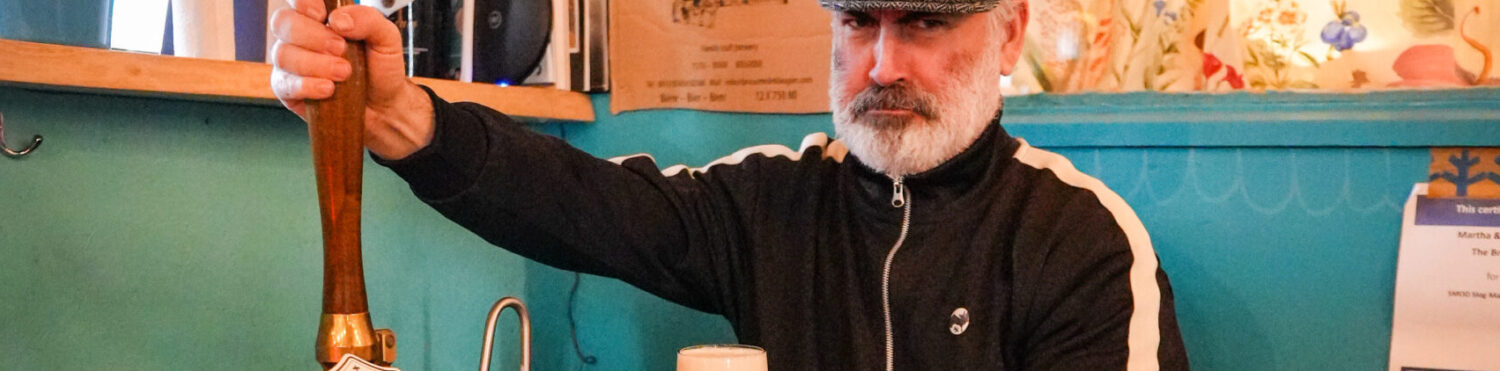
Kevin Thompson, our branch Social/Press Secretary, colleague, and friend, died on 25 August aged 64.
In his earlier life Kevin worked in retail management, including in the music sector, and organised events and press releases – skills he brought to bear on behalf of our branch in more recent years.
Kevin joined CAMRA in 2010 and after attending an AGM decided to get more involved in the branch, volunteering to take on more than one role. As press secretary he has been quoted several times in the Star, usually on Pub of the Month related news. This helped raise our profile and that of the pubs we cover – the committee are very grateful for his work.
He was also very active as our social secretary, spending many days scouting pubs on trips both in and out of town to practice routes for social meets he planned. These provided excellent opportunities for branch members to socialise outside of meetings and to explore some of the less well travelled parts of our branch and beyond. Kevin was always happy to lend his hand to chairing meetings, writing trip reports for Beer Matters, and standing in for award presentations.
At Steel City 49 a rare cask of Neepsend Brew Co’s Alcis was dedicated to Kevin, and his friends also arranged various fitting tributes across Sheffield focusing on his other joint loves of Sheffield Wednesday, and live music.
A tribute to Kevin was held on 6 November at Wadsley Bridge Working Men’s Club where many of Kevin’s friends met to celebrate his life, share stories and look at photos.
CAMRA’s Members Weekend presented a problem for those of us who volunteer for the Discovery Bars: How to show what we do without coming across as patronising.
For those who don’t know them, the Discovery Bars are part of CAMRA’s Learning & Discovery arm, the area of the campaign that sets about to educate people about beers, ciders and perries, pubs, pints, people, and the industry as a whole. There’s lots of different things that it does, but I only really deal with the Discovery Bars that go to beer festivals around the country; getting people to think more about what they’re drinking and in turn appreciate it more.
We usually do this with our partner breweries for the day, guiding festival goers through a theme. The themes are quite diverse but always fun and always involve free samples of beer. Comparing cask and keg versions of the same beer side by side is always an interesting one where we get to explain how the packaging differs and what that actually does to the beer as it comes to the drinker. Hop varieties are another great one, having hops on hand to get the drinkers opening them up to see the lupulin, to rub and sniff the cones and pellets to get the direct aroma from the oils, and then tasting beers made with those varieties to see how those oils come across in the final beer. And malts too always make for an interesting chat with people, getting them to chew some Maris Otter for its biscuity flavours and then some Chocolate malt for its taste of old ashtrays (I’m not a fan), before pouring them samples of beers made with those malts so they can see how the flavours of the malts can come through, and how they all affect the colour of the finished beer.
But the problem with CAMRA’s Members Weekend is that the attendees will most likely have done those things before. Several times. So how to showcase the effectiveness of the Discovery Bars and get people interested in hosting them at their local festivals in a way that’s more than just a slideshow full of photos of people enjoying themselves?
Well, the team excelled themselves with a new theme: Settling The Sparkler Debate.
Let’s be honest, people have views when it comes to the use of sparklers on their beer. And their views are usually very ingrained and never going to change. It’s either Sparkler Good or Sparkler Bad, there is no middle ground.
But what sort of sparkler? And what do they actually do to the beer? And how do they actually work? These are just some of the questions we thought we’d try and get people to think about and we needed a way to achieve that. We don’t teach people at the Discovery Bars, we don’t lecture them. We try to get them to think, we provide them with the information they need to educate themselves. It works better.
So how to achieve that?
It turned out to be quite simple, we attached a single cask of beer to a gravity tap and four hand pulls. It looked a bit bodged together, and being honest it was. We had no idea going into this if it would be popular or if we might do it again, so a bit of behind the scenes bodging was perfectly fine for this one occasion, and if it was popular, we could then invest in the more expensive kit to do it again.
This allowed us to present attendees with five samples from the same cask: gravity, hand pull with no sparkler, with a “flat” sparkler, a 1mm sparkler, and a vortex creamer. All five samples poured one after the other and set out in a line on the bar.
We were then able to talk people through the beers, getting them to focus on the mouthfeel of each, and on the bitterness and flavours that they picked up. As we went through the samples we talked about how the hand pulls worked, a simple beer engine that pushes the beer into the glass, quicker than just opening the gravity tap. How the flat sparkler has an internal cone and two large holes, forcing the beer out and to the sides of the glass. How the 1mm sparkler had lots of little holes (all 1mm in diameter, hence the name) and squirted the beer through at a higher pressure onto the bottom of the glass, and how the vortex creamer had even smaller holes and then a cone on the outside of the nozzle that caused the beer being poured into the glass to form a swirling vortex as it hit the bottom.
As we did this we got people to give us their thoughts on the difference between the beer they were sampling and the previous one. In general these were small increments, slightly less flavour and bitterness, slightly more body and smoothness. Then when we’d sampled the fifth one, we got them to try the first again, the gravity pour. Each increment between samples may have been small (which is why we chose those sparklers we were using), but the difference between the first and last samples was “like night and day” and “you’d not believe it was the same beer, let alone the same cask” according to those who came and chatted (and drank) with us.
By talking with people, and getting them to understand how sparklers work, and what each type of sparkler actually did to the beer, we got them to form their own opinions and come to their own conclusions. And the conclusion they came to wasn’t sparkler good or sparkler bad, but was instead whether they preferred their beers with more or less of a smooth body to it or more or less bitterness. The sparkler is just a tool to achieve that.
We then followed on our chats with people, going into how breweries can add extra hops to their beers so that when the sparkler strips out some of those hop flavours and bitterness, there’s still enough left to achieve what the brewer planned the end pint to taste like. About how it’s not just hop bitterness that the sparklers remove, but also malt astringency making them good for stouts. And also how they can remove the “tired” flavours of ageing beer, giving them a new lease of shelf life.
We didn’t know whether our little stand tucked away in the far corner of the Members Bar would be popular, but it was. We went through our entire cask in the first afternoon. Two and a half intense hours and we’d run out of beer. We had to “borrow” a second cask from the main bar itself just so that we’d be able to do it all again the following day. That one lasted three hours and we finished early. It seemed that the decision to present five different types of sparkled/unsparkled beers side by side was incredibly popular, something none of those who came to us had ever had the chance to try before. Amongst the chat about the sparklers we got to chat about the Discovery Bars and festivals, and there is a definite desire for them amongst the CAMRA branches, so expect to start seeing them around more.
Perhaps for me though the best comment of the weekend was from one member after we’d gone through the samples: “I have to admit, I came over here really sceptical but it’s been great and I’ve learned something.” And that’s all we can hope for, that people enjoy what we do, and that they go away a little bit more knowledgeable about what they’re drinking.
As for what people preferred, it’s really down to personal tastes.
From Big Brewing to Local Brewing: What Place Does Sheffield’s Beer Industry have in the City Today?
Dr Nick Groat and Prof Phil Withington from the University of Sheffield give an update on their project, Place, Craft and Alcohol in Historical Perspective, which is exploring the many histories and meanings of alcohol in the city with the help of CAMRA members.
We’re developing a picture of the changing place and importance of alcohol in Sheffield both historically and since the emergence of new trends in brewing and beer marketing often labelled with the term ‘craft’. A key feature of this work is discussions with brewers, distillers, retailers, and consumers about their own experiences of – and views on – the city’s alcohol economy, including their take on the ‘craft’ alcohol movement.
We’re in the process of building a collection of about 20 longform oral histories, and at SC48 last October we recorded the thoughts of 62 visitors and spoke to many more curious enthusiasts about what they thought ‘craft’ means today and what they would like to see change in the city to support the industry.
We also hosted two events – Craft in Conversation with broadcaster Pete Brown and Pints of Interest: Pubs as Social Landmarks with a panel of landlords and pub-goers – which provided plenty of opportunity to hear views on these matters. The conversations highlighted that while there is some consensus that ‘craft’ is now a controversial label in the context of the brewing industry, the term nevertheless represents an ethos that values attentive, experimental, skilful, and locally orientated brewing practices. Moreover, many people still used ‘craft’to describe brewers in Sheffield offering beers that they regarded as distinct from other major breweries. Others suggested ‘independent’ as an alternative label, emphasising the importance of beer producers that position themselves outside of large corporations. By sheer coincidence, YouGov published the results of a survey the week after SC48 which overwhelmingly showed how consumers felt “misled” by seemingly small, independent ‘craft’ brewers which were really owned by multinational brewing conglomerates such as Heineken, Anheuser-Busch InBev, and Asahi. The survey suggests that ‘independent’ is an equally contentious identifier and it will be interesting to see how much of an impact that new initiatives such as the Society of Independent Brewers and Associates’ (SIBA) “Indie Beer mark” will have on how these terms are used in the future. For now, it seems that ‘craft’ is one term among several which people use to identity high-quality and skilfully brewed beer outside the monopoly of the global corporations.
This issue, unsurprisingly, extends to where alcohol is bought and consumed. In our conversations to date, local independent establishments have been repeatedly noted as a valued asset in Sheffield (and more generally across the country), with several pubs in the city repeatedly mentioned as ‘good’ places to spend time buying and drinking exceptional beers and ‘craft’ alcohols. Indeed, there seems to be a growing, albeit dispersed sense that the proliferation of micropubs and bottle-shops, together with independent and quality breweries and eateries, plus the unique heritage of the city and region, are distinctive and attractive enough to be a driver of the city’s service and tourist economy and a key feature of Sheffield’s image nationally and internationally. This is not to say, of course, there isn’t also room for big chain-owned pubs selling well-kept ‘real ales’ at affordable prices – people felt that in a city as large and diverse as Sheffield the one was not exclusive of the other, with many people appreciating the basic reliability of craft-orientated chains. It was clear from talking to people that locality and independence in brewing, and the values often associated with craft, do not necessarily translate to where beer is drunk.
The other main component of our project has been mapping Sheffield’s pubs, breweries, and other alcohol establishments to better understand the place and impact of the industry on the city’s many neighbourhoods over time. To date we’ve recorded 1022 ‘historic’ pubs in Sheffield: it’s exciting to map such a large and important feature of the city’s heritage and to visualise its changing dimensions. We’re also mapping Sheffield’s contemporary ‘alcohol topography’ to see where and how it sits alongside the historical geography, paying especial attention to places which align themselves to a ‘craft’ ethos. We hope the maps will serve as a useful tool for Sheffield’s growing independent alcohol sector, linking it to the city’s rich and powerful heritage, and to this end we plan to use the dataset to produce a series of maps and trails targeted to specific areas of the city. The datasets and maps will be available digitally later this year.
Place, Craft, and Alcohol is a collaborative project by and for people interested in beer and Sheffield. We’re always on the lookout for people to speak to about the place of alcohol in the city and its neighbourhoods (past and the present) and what that place will or should be in the future.
If you’d like to talk to us about your experiences and memories of Sheffield’s intoxicating history and/or your views on alcohol’s role and place in the city today and in the future please contact n.groat@sheffield.ac.uk or scan the QR code below to get in touch.
The new Chancellor is presenting her budget on 30 October. With a brand-new government, and a large number of new MPs, we would like to see targeted support for pubs, social clubs, breweries and cider makers in the upcoming Budget.
We are calling for a further reduction in draught beer and cider duty, a reform of the Business Rates system in England, a VAT cut for hospitality businesses, a review of the definition of cider and a 50% juice minimum in cider, as well as the removal of unnecessary rules that prevent sales of takeaway pints. The more people who use our template to email their local MP, the higher the chances of ensuring our pubs, independent breweries and cider makers are at the heart of the new Government’s Budget.
A 20% discount for tax on pints in pubs would create thousands of new jobs and contribute £70 million to the economy, as consumers are encouraged to move from supermarket alcohol back to being able to support their local pubs and social clubs.
The Chancellor has also been urged to stick by the Labour manifesto promise on reforming Business Rates in England. The current system unfairly penalises pubs and makes it harder for all bricks-and-mortar businesses to compete with online shopping. CAMRA’s own figures show the shocking extent of churn in the pub trade, with over a thousand businesses closing their doors so far this year.
Now the Campaign is calling on all beer lovers and pub-goers to get involved and use their simple online tool to contact their MPs ahead of the Budget. The quick and easy to use e-lobby tool can be found on CAMRA’s website.
What used to be known as beer Twitter (do we refer to it as beer X now?) has often loved a good argument and whilst in my opinion X has become something of a negative cess pit good only for damaging your mental health, some good conversation does come along now and again!
This one is to be fair one beery people have had on a regular basis for as long as I’ve volunteered in CAMRA (about 25 years now probably) and the same points keep getting made. However the beer scene has actually changed in those years and I don’t think the cask ale scene is in any better or worse health, it is just different, in a positive way I’d argue!
The metrics that usually come into the discussion is the variety of beers on the bar, the proportion of national brands versus smaller local/regional brewers and interest from younger drinkers or diversity of drinkers choosing cask ale.
The absolute worse thing for putting drinkers off cask ale are quality issues – beer that has gone off and turned to vinegar will never give a good impression and if someone trying it for the first time has that experience and assumes that’s what it is normally like probably won’t give it a second chance. My personal experience is not having many such bad experiences in recent years and some of that ones I have had has been in a certain bar I won’t name that is simply making the mistake of putting a cask range on that is too big to turnover fast enough to maintain quality. I would suggest another common theme of pubs with poor quality beer are those owned by a chain where the manager has to sell specific national brands that aren’t popular with their customers. In contrast I’ve seen some excellent examples in our area of bars with only one handpump which has a popular local brand such as Abbeydale Moonshine or Bradfield Farmers Blonde at a reasonable price and it sells like mad to a broad mix of drinkers!
Back in my younger drinking days most fun places around town didn’t sell any beer worth drinking – you either went to a fun bar or a good beer pub, one or the other, there was no crossover. In the peak of the craft beer boom the number of venues with cask ale and/or good craft beer on keg increased, however that has started to move back the other way with faux craft brands owned by the likes of Heineken, AB Inbev, Molson Coors and Greene King muscling local beers off the bar. We still have a number of fun late night venues with cask to choose from such as the Washington and the Bessemer plus of course some more traditional places like Shakespeares Ale & Cider House that open fairly late. I’d suggest we still have an amazing choice of cask ale venues to choose from. The range of beers may have shrunk a little in some places to maintain quality but I think this reflects the economic climate and people going out drinking less, rather than cask ale being less popular.
So finally – are young people drinking cask ale? Well, the University of Sheffield real ale society is still going strong and their student union continues to run a very successful annual beer festival whilst in the pubs and bars they are like any other drinker – have the right ales on the bar in good condition and properly promoted – they will drink it.
Do you keep seeing talk of real ale and craft beer and wonder exactly what it means? Hopefully we can answer your questions in simple terms!
Most beer is brewed in the same way at a basic level – Malt added to water which is boiled, hops are added into the boil and the result is cooled then fermented with yeast into beer! (ingredients may vary and I know that’s an over simplification!)
Real Ale is a term originally coined by CAMRA activists in the early days. It can be applied to bottled beer that has a yeast sediment, however the most common use is for “cask conditioned” beer (or live beer to use a more modern term) where the brewery has racked fresh beer into casks with live yeast which allows secondary fermentation to take place in the cask in the pub cellar, meaning the beer is not only fresh but has a natural sparkle without needing to add gas on dispense to make it fizzy. However on the flip side, as it is a fresh live product it has a short shelf life and if on the bar too long can go off, oxidising and gaining vinegar characteristics!
Craft beer doesn’t really have an officially recognised definition and as a term is often abused by marketing people. It was intended to promote beer where the production is the opposite of industrial – smaller scale brewers using quality ingredients, manual processes and a love of the product where the recipe is dictated by the brewer rather than the accountant.
Of course there are success stories of craft brewers that have grown and the question is then whether they are still considered craft. Beavertown sold a good share of their brewery to Heineken who invested in a much bigger scale brewery and bigger distribution and there is a view the beer isn’t as flavorful as it used to be whilst Brewdog is now a multinational industrial scale brewer that supplies supermarkets and chain bars. On the other hand closer to home we have Thornbridge that has expanded significantly over the years with investment in bigger production facilities for their core brands, on site lab facilities, canning/bottling lines, a sales & marketing team and more – however the care for product, visions and values and an excitement to experiment (for example their barrel aging programmes and the installation of a Burton Union set) lives on, suggesting they still deserve to be called craft!
You may also see talk of cask versus keg for how draught beer is packaged. Typically real ale is in a cask as if facilitates secondary fermentation (although some single use keg products such as keykeg can also be used for real ale) and in CAMRA’s early days it was very much cask is good and keg is bad as the brewers that were replacing their traditional cask beer with keg products were filling their kegs with a poorer quality product made with cheaper ingredients with a process designed to make the beer long life rather then fresh with the lower production costs and lower wastage from expired beer proving financially attractive to both brewers and publicans.
These days things are less simple with craft brewers putting beer in kegs that are a good quality product (with decent ingredients, not pasteurized and often not filtered) and has much more flavour than the big industrial brands. The craft term isn’t tied to a specific format with such brewers often choosing cask or keg based on which they feel suits the style of beer best – for example a high strength stout that is likely to sell slower may be best in keg as it won’t go off so quick or a continental style lager may be enjoyed with some extra carbonation whilst a mild, malt bitter or gently hopped blonde might taste better on cask.
CAMRA does continue to champion the tradition of real ale, it is a fantastic part of our beer heritage we want people to continue to enjoy and are still passionate about that, however often now at CAMRA beer festivals other formats will be showcased alongside the cask where it is a good quality example of the genre (after all CAMRA was founded on the basis of wanting a choice of good quality beer) and campaigning priorities have moved on with issues facing consumers, publicans and brewers, particularly with the cost of living crisis!
Next is the subject of what we refer to as “real cider” or “real perry”. Similar to real ale it is the traditional, fresh, good quality product, however the key thing here is slightly different – it needs to be made from freshly pressed apple or pear juice that has been fermented rather than the more industrial product made from concentrate. Also any additional flavouring should be the real thing, not just a syrup chucked in.
Many of you will have noted the recent advertising for a ‘craft Brew Festival’ to be held in Neepsend in September. The ticket price is £35 upwards, depending on the session attended. Included in this fee is ‘five hours of unlimited craft beer.’
I believe that offering unlimited alcohol over a five hour period is irresponsible and will lead to attendees over indulging. It does not encourage responsible drinking.
It is also divisive: many of us, for many reasons, are restricted in our alcohol intake. For example, while recovering from radiotherapy, I recently attended Indie Beer Feast in Sheffield: almost five hours attendance saw me drink seven beers, a total of 2 and one third pints. I had an excellent time, meeting many friends, aiding my recovery. However, such a price tag would have meant non-attendance.
Why not have a pricing policy similar to the forthcoming Sheffield Steel City Beer and Cider Festival? Thursday 17 October will cost non-CAMRA members £17. This includes £10 beer tokens which are refundable if not used plus a glass (£3) which is also refundable on exit. If you don’t drink, up to eleven hours on site, including the entertainment and the river Don Steam Engine will cost you the princely sum of £4 (CAMRA members, £2). If you do sample some of the over 200 beers available, you will pay for exactly what you imbibe.
Sheffield Beer Week celebrated its 10th anniversary this March. Now that the dust has settled on another successful event, we talk to organiser Jules Gray to get her thoughts on how it has developed since its beginning in 2015.
What changes do you think you’ve seen over the last 10 years?
When we started, it’s the first one so I don’t necessarily think people understand what it is, or what you’re trying to achieve, which is understandable. It was great in that first year that we had a few venues like the Rutland and Shakespeare’s that really got on board straight away and it launched in a very short space of time. I think we organised it in two months.
How many venues were involved the first year.
Probably only about twenty venues and maybe about twenty events. But then once it happened, people saw the positivity from it, not only the people attending events but the economic and longer term benefits of it. The year after it basically doubled in size. At its maximum it was something like forty venues with over seventy events.
How do you think that the Sheffield beer scene has changed in the ten years.
Well, it’s changed in lots of different respects. There’s some of the longer standing Sheffield breweries that are still around, such as Abbeydale, and recently of course Kelham Island Brewery is under new ownership, but it’s still around.
So there’s been a changing of the guard as it were. I’ve seen breweries launch and sadly disappear, such as North Union who actually launched in Sheffield Beer Week. St Mars Of The Desert opened up around the end of 2018-2019 and it’s about recognising that a brewery might be in Sheffield but will be importing ingredients from all around the world and also doing collaborations, which is something that I’ve seen develop.
There’s been a move for traditional breweries to try experimental styles, such as mixed fermentation brewing, and also put in their beers not only in a firkin or keg, but putting it in cans and bottles. When I started Hop Hideout in 2013 I think I only had Bradfield and Kelham Island I could sell in bottles from local breweries.
Are there any standout breweries or beers over the 10 years?
Ohh, that’s difficult. And my memory is terrible these days. I mean, the Abbeydale & Thornbridge collab, ‘Stepping Stones’, was a big thing. I really like the Edward Carpenter beer that we did with Lost Industry. It was a beetroot sour, which was bright purple and had this earthy sourness. He was a Sheffield character from the late 1800’s who lived openly as a gay man in Sheffield and fought for gay rights and women’s suffrage, things like that.
There was the ‘Right To Roam’ IPA we did with St Mars Of The Desert, that was a good one as well. It was a collaboration with Nick Hayes, who’s a best-selling author and campaigner for the countryside, to celebrate the 90th anniversary of the Kinder Trespass.
I’m really proud of the beer ‘Ethel’ that we did with Triple Point this year to celebrate Ethel Haythornthwaite. She was a passionate environmentalist who helped establish the Peak District.
To be honest, when I look back and I talk to people about it, there’s loads of amazing things that have been part of Beer Week.
Indie Beer Feast is now an important part of Sheffield Beer Week. When was that introduced?
I think the first indie beer feast was in 2018, it was just one day at the Abbeydale Picture House. I’ve always wanted to do a beer festival. It attracts people to the city. What typically happens when you put beer festival on is people visit places whilst they’re here, so it benefits the local economy and local beer businesses.
And have you had any breweries that have been at Indie Beer Feast every year?
I don’t know to be honest. Abbeydale have been quite a lot, but I’m not sure they’ve been at every one. In general, it’s chopped and changed. I generally have some Sheffield breweries represented and then a nice pick from across the country. People like to see a bit of variety.
I like to champion under-represented, minority groups and stuff as well, lots of women-owned businesses and things. So Neptune Brewery have poured quite a lot at Indie Beer Feast.
When you first started it did you think from the outset it would run for years.
I didn’t think that at all. I knew that I really wanted to do it, and I thought it would be really beneficial for a lot of people and I had a feeling that people would support it and be positive about it. I’ve never said this will go on for x number of years, it’s quite organic in that respect.
I noticed that there was four or five cask lines at Indy Beer Feast. Isthat something that’s increased, because traditionally it always was mainly keg.
Yeah, it wasn’t ever set in stone you know. It was always down to the breweries, and it can be quite challenging with cask because of the venting and tapping and letting it settle. Obviously some of the newer breweries have typically focused on keg. For example, Kernel Brewery started in 2009 and its only recently they’ve started doing cask beer. But I I’ve always left it down to the brewery, it’s their choice.
You know, I think a lot of people are falling in love with cask beer again as it’s a traditional British way of brewing and packaging beer and I think it’s come full circle in a way. So some of those modern craft breweries are now producing more of it. I mean, some of those that were pouring were Sheffield breweries so it was easier for them but we had Torrside offering cask as well.
I do think that there will always be a place for cask ale.
Hop Hideout are moving to the new development at Leah’s Yard on Cambridge Street in Sheffield City Centre. Their Crowdfunder successfully raised nearly £10,000! Visit www.hophideout.co.uk to keep up to date with their new move and opening this summer. We’ll talk again to Jules to get the lowdown on how the move has gone once they’re settled in the new premises.
Sheffield has a tradition as a brewery city since the mid-late 18th century when there were around 30 in the city. It is also a music city, which sees the real ale bars busy most nights.
The ‘60s saw the advent of Sheffield as an emerging force in music, mainly through Joe Cocker. A gas fitter. He lived in Crookes. He took the scene by storm, singing “With a Little Help from My Friends.” This song landed him a 1969 Woodstock Festival spot, and his famous animated performance shot him to fame. Joe was a local legend often drinking Stones, Magnet or Whitbread in Crookes and Sheffield Lane Top pubs.
The ‘70s saw a more pubs and clubs vying to put performances on, among the best of these The Mucky Duck and The Jolly Buffer. The Mucky Duck hosting the first gig by British punk band The Clash. The late ‘70s and ‘80s saw the emergence of rock and electronic bands playing pubs and clubs around the City including The Limit Club.
There is much to celebrate from the City’s new bars that provide music. Many of them around Neepsend, Kelham, Commonside and Ecclesall all serve real ales from Blue Bee, Stancill, True North, Abbeydale, Vocation, and provide entertainment. Thornbridge are also popular and provide music on a regular basis. The Gardeners Rest at Neepsend has a regular Sunday session with the likes of M&J Blues (pictured) and Jake’s Rake, this goes well with the wide selection of 8 cask beers, and a few kegs and ciders
Just down the road on Percy Street sits Alder Bar, an old Victorian polish factory. The bar hosts a brewery and live music at the weekend. A real ale enthusiast bar, although the odd keg is served. Music ranges from bands to DJs.
The 3 giants of the local music scene however, are The Leadmill, a club that began in the ‘80s, partly due to Martin Bedford (local artist and music promoter), way before he founded the Honey Bees Blues Club which launched a good few local careers. The venue has hosted many bands including Big Country (pictured), Manic Street Preachers, The Killers, Suede and Muse. Although there is no cask ale available, Craft beer from breweries such as Triple Point, Abbeydale, Thornbridge and Heist is sold here on keg and in cans.
Shakespeares Ale & Cider House and The Greystones, sit at opposite ends of the City; Shakespeare’s being part of the Kelham Island catchment area. A very good range of cask beers is supplemented by unus International Americana ((Massy Ferguson pictured) and folk bands play. Cask, kegs and stouts including strong Imperial Stouts feature strongly. They regularly host a Tramlines Fringe every year, which sees the local and International artists. Meanwhile down at Victoria Quays on the edge of the City Centre is the Dorothy Pax hosting regular gigs.
On the South of the City sits The Greystones, atop the Greystones Road hill. A pub taken over by Thornbridge some time ago, they regenerated The Backroom. This hosts anything from Americana, Country, Folk, Blues and the odd rock band. These are mainly British, but again American bands come over to play such as Wild Ponies (pictured).
New kids on the block like Hillsborough Social Club have joined the fray, hosting Honey Bees Blues Club bands in the afternoon on the Sunday Sessions (Donovylan pictured), as well as faces from clubland and the local Indie/rock scene on Saturday evenings.
A great scene, at little or no cost to the drinker.
Founded in 1990, the Inn Sign Society raises awareness of the nation’s pub signs and compiles a record for the benefit of future generations. Many pub names have links with events from the past or personalities of national and local importance, and the Society provides a forum for members to research the history of inns and pub names.
It has an active web site and a quarterly full-colour journal to which members are encouraged to submit articles, pictures of pub signs and news from their areas.
As inns and pubs close at an alarming rate, much local heritage is in danger of being lost forever. Pubs are not just a place to enjoy a drink, they are often at the heart of the community and can reflect its history. Many members take a general interest in all signs, with some specialising in particular breweries, counties, aircraft or railways, to name but a few.
The Inn Sign Society is seeking to recruit more members and bring in new blood to help continue the good work done over the last 34 years. For more information, including on how to join, see the website at innsignsociety.com If the Inn Sign Society doesn’t research, capture and save our pub sign heritage, perhaps no-one else will.