Hopping Around: Estonia

It only seems like yesterday that I wrote my letter stepping down as editor of Beer Matters but here I am having spent the last few weeks in Estonia with Poppy, making a great start to our journey through Europe. In Estonia we have discovered a country with a burgeoning craft beer scene, from macro-breweries trying their hand at more niche beers to the new kids on the block creating some really interesting experimental styles. We flew into Riga in Latvia (the flights were much more reasonable than going directly to Estonia) and spent a couple of days there acclimatising to the more relaxed travelling way of life before getting the coach up to Pärnu in Estonia. A beach resort known as Estonia’s “summer capital”, Pärnu was quiet in late April but its streets are lined with restaurants, cafes and bars. Most of these served the big Estonian brand-name lagers such as A. Le Coq and Saku, but some had a selection of Belgian beers in bottles too. The main attraction for beer lovers in the town was undoubtedly a little bottle shop called Õllepood Nr.2 Gambrinus, which looks unassuming from the outside but within stocked well over 300 Estonian beers as well as a (yes, one) table where you could sit and sample them. We left the shop with a few breweries to look out for on the rest of our trip: I was really impressed with Pühaste who had a good range of all styles, while Poppy was a big fan of Sori Brewing and their milkshake DIPAs. Having made a full recovery, we headed off to the ferry to spend a few days exploring Saaremaa, Estonia’s largest island (about the size of Luxembourg apparently). We stayed in the island’s main town, Kuressaare, which allegedly has a population of 14,000 – they must have been hiding while we were there as the place was deserted! We had hoped to spend one of our days on the island visiting a local brewery, Pihtla, who specialise in a beer style called taluõlu (Estonian for “farmstead beer”), not dissimilar from the Belgian saison.
Sampling some local beers in my trusty Beer Central glass
Unfortunately, we discovered the brewery only opens to visitors during the summer months so we couldn’t go, but luckily we found a place just around the corner from our apartment called Saaremaa Veski that sold their beers. I tried their Pihtla Õlu (7.6%) and was pretty impressed. It had the yeasty flavour you might expect from a farmhouse-style ale but apparently the beer is bittered using juniper rather than hops, which gives it an interesting twist. It was also very obviously unfiltered and unfined – I think back home they would call this a real ale! We tried out a couple more of the bars in Kuressaare, but actually the place with the largest selection of local craft beer was the Coop supermarket – they had Pihtla and another Saaremaa brewery, Pöide, as well as beers from the neighbouring islands of Muhu and Vormsi. I can’t say any of them were particularly outstanding, but it was great for ticking off some new breweries. Next up was Estonia’s capital city, Tallinn. We arrived here knowing exactly what we were looking for on the beer front having done our research online, so the first port of call was the tourist information office. Poppy, always a fan of a free city map, picked one up and we marked on the best-rated beer bars so we could work out how to fit them in with our sightseeing. After visiting them all, our favourite was an underground bar called Põrgu, which translates into English as “Hell”! Despite the name, it was a really comfortable and friendly place with a huge range of beers and some excellent food too. Our beer highlights were again from Sori Brewing and Pühaste, but we also sampled beers from the likes of Lehe, Põhjala and Kolk during our three visits.
The Põhjala brewery and tap room
No beer trip to Tallinn would be complete without a visit to the Põhjala tap room, so one Saturday afternoon we headed to the trendy Kalamaja district where the brewery is located to try it out. We were already aware of Põhjala having seen their bottles around Sheffield, but there’s nothing quite like trying beer at its source. We were very impressed by the tap room, a large modern bar with a vibrant atmosphere and 20-odd beer fonts, 80% of them serving the brewery’s own beers. The tasting flights were pretty reasonably priced too, giving us chance to try as many as possible. The final destination on our Estonian beer tour was Tartu, a university city in the south of the country. It seemed common sense that where there were students there would be beer, and so it proved! The city is home to the country’s largest beer manufacturer, A. Le Coq, which offered an enjoyable brewery tour for €10 per person, although the tasting at the end was limited to one beer each, which seemed a little stingy. Tartu is also the location of Pühaste brewery, and while the brewery itself only opens for special events, their flagship bar in the city centre is open all year round and was well worth a visit. Our highlight though had to be the deTolly Õllebaar, hidden downstairs under a building that looked like a public toilet but was actually a cafe. The bar itself was small but stocked a good range of beers, all presided over by a friendly (and very tall) owner. As I write this we’re about to head into Latvia to see what we can find there. If you’d like to keep up to date with our adventures you can go to our blog, hoppingaround.co.uk – thanks to everyone who’s already been reading! As well as beer, Poppy’s also been writing up some of the other interesting places we’ve been and she’s been keeping a daily photo gallery, so there’s something for everyone. Dominic Nelson

Two Days in Dundee with CAMRA

A year since the much-discussed revitalisation vote and the formal approval of ‘good beer,’ the annual CAMRA Members weekend took place recently. Held in Cairns Hall, Dundee, this was the first AGM since the new beginning.
Following the Friday social evening, the event commenced with Jackie Parker chairing her first, and last, AGM. Nick Antonia will be taking over for 2020. Later in the day, the recently appointed Chief Executive, Tom Stainer, provided an upbeat presentation, using football analogies and praising ‘Team CAMRA’.  It was good to hear the Sheffield Pub Heritage Book held up as an excellent example of local campaigning.
As for debates: the most contentious were two concerning the definition of cider. Included were a vote which involved the tellers, mentions of pasteurisation, and more. No doubt, these definitions will be revised for 2020. There was also a return of the cask breather debate, described by one speaker as ‘the topic what is to CAMRA what Brexit is to the Conservative Party.’
There remain elements in CAMRA who still take the attitude that ‘all keg is crap’ – agreed, much keg is such – think Carling ….. however, much packaged beer is high quality and often real ale. Nationally, some branches are well ahead of the game while others still seem to be stuck in a 1980’s time-warp. For example, the CAMRA Steel City Beer Festival in Sheffield, the best beer city in the world, has had a ‘keg bar’ since 2016. Manchester Beer and Cider Festival, Nottingham Beer Festival and Derby Winter Beer Festival have followed. ‘Gin bars’ have also been seen.
On the ground, high quality beer, not necessarily cask-conditioned is embraced. This is illustrated by the high level of discussion attracted by a number of (usually, but not always) small breweries who are doing ‘something different,’ even if this does not always involve ‘cask.’ Examples include Dundee-based 71 Brewing and Sheffield-based Abbeydale, Lost Industry and St.Mars of the Desert (SMOD). In addition, a number of highly regarded breweries have recently returned to cask: for example, Brewdog and Cloudwater. The latter continue to cite quality concerns and will only allow their cask to go to specific outlets. Locally these include both the Rutland and Shakespeare’s.
Abbeydale, the largest brewery in Sheffield, continue to provide an excellent cask selection (an award winner at CAMRA GBBF 2018) while simultaneously developing their ‘funk dungeon’ project (barrel aged sours) and producing a new beer on an almost weekly basis. Recent expansion will see the installation of a canning line. Summer 2018 Barnsley Pub of the Season, Biere de Maison (Elsecar) has no hand-pumps and no traditional cask-conditioned beer. However, it has a vast range of packaged beer, plus a range of ‘keg’ offerings.
It will all happen again in York next year and, for the 50th. anniversary of CAMRA in 2021, Sheffield City Hall is booked.
Dave Pickersgill
As well as the formal business of the AGM and the policy making process of the conference that CAMRA members are invited to attend and participate in, the “Members Weekend” is also about socialising with other people from near and far that enjoy real ale, cider & perry.
The conference venue as always featured a Members Bar – a small beer festival exclusive to CAMRA members showcasing local cask beers plus a selection of traditional ciders to enjoy on the lunch break and in the evening, this proved a great place to meet up before going out and exploring Dundee. A map showing all the pubs with good beer was included in the Members Weekend Handbook that came in your conference bag.
Some of the more traditional pubs had clearly made an effort to cater for the extra demand for real ale, with the Pillars bar – which only has one handpump on the bar – setting up a mini bar in the corner with two extra beers and customers invited to pull their own pint and pay the bar man! There was also evidence of the modern craft beer scene being present in Dundee and CAMRA members were also made welcome in these venues such as the St.Andrews Brewery bar – a smart modern venue with a large number of interesting beers on tap as well as food; 71 Brewery also had a bar as did Innis & Gunn.
Dundee also of course features the usual chains such as Wetherspoons and Brewdog.
Organised trips to breweries were arranged for those that planned ahead and book, however of course in between the beers you could opt to have a look around the non-boozy attractions of Dundee including the new V&A gallery and the various little nods to the fact the publishers of the classic Beano and Dandy comics is based in the City!
Andy Cullen
——————————————————–
DEBATING IN DUNDEE

Abigail Newton, known for steering the organisation’s Volunteer Committee, was elected CAMRA’s vice-chairman. She will be joining new national chairman Nik Antona in steering the direction of the campaign, with Jackie Parker and Ian Packham officially stepping down as chairman and vice-chairman, respectively, at the close of Conference.

In her address to members, Jackie reflected on CAMRA’s achievements under her tenure as chairman over the past year, including appointing a new chief executive and deputy chief executive, producing an equality and diversity policy and developing CAMRA’s Information, Education and Training programme. She also paid tribute to the Games and Collectables Committee, which has donated more than £1.3 million since 1991.

Jackie told members: “Let’s not forget that the name of our organisation is CAMRA: the Campaign for Real Ale, and let’s continue to do just that – campaign for pubs, real ale, cider and perry. It’s what we do best!

Joining the national executive are four new members: Gary Timmins, Catherine Tonry, Hubert Gieschen and Jonathan Kemp. Nick Boley and Ian Garner were re-elected for a second term.

This was also the first CAMRA Members’ Weekend for Chief Executive Tom Stainer since beginning his new role in January 2019. Giving his first Campaigns Report, Tom looked towards the future of the organisation, saying: “Just as the beer landscape has changed, so has CAMRA, and so must it continue. Nowhere is this better reflected than in our campaigning.”

We should not be afraid of welcoming bold new thinking and new ideas. Your ideas are welcomed and they are encouraged. If you think CAMRA needs to change, it will only change with people like you involved.”

Members also debated a number of motions over the weekend, on topics including campaigning against large pub-owning companies converting pubs from tenanted to managed, campaigning for the introduction of Minimum Unit Pricing for England, and reducing the amount of single-use plastics used within CAMRA – all of which were carried.

Bruges

In the company of the two best available Belgian beer books, the Good Beer Guide Belgium and Around Bruges in 80 Beers, two of us recently used a BeerJunkets Bruges Beer Festival package to visit Belgium for a long-weekend. We first visited Bruges in 2009, finding an earlier edition of Around Bruges an essential companion. Ten years later brought this, my third visit. The latest edition includes many changes from the version utilised a decade ago. At that time, Bruges had the single brewery, Halve Maan. There are now an additional two, both offering visits, shop and bar. Fort Lapin, over a mile from the Belfort, is normally only open to the public on Saturdays. On my early-morning visit, I was given a personal guided tour by the brewer and co-owner, Kristoff Vandenbussche. A range of high-quality bottle conditioned beers are available, all bottled on-site. There is also a small cosy on-site sampling room. Hoplapin, a 6% hibiscus-infused hoppy blonde, proved an excellent way to start the day. By contrast, Bourgogne des Flandres Brewery, opened in 2016, part of the long-established Timmermans (Martins) empire, is very tourist-orientated. There is both a large shop and café, lots of staff, upmarket food options (for example, Black Tiger Scampi at €16.60) and a large range of beer, the latter including a tasting tray of 12 cl of six different beers at €14. Adjacent to a canal and close to the Belfort, the brewery tour includes technological assistance and many links to historical references. Their main brew is the base for the 5% Bourgogne des Flandres red ale. This base is later blended with a Timmermans lambic. They also brew experimental beers, some of which were available in both the café and at Bruges Beer Festival: at the latter, one Primeur was Nikita, a 9.5% imperial porter. The 2019 festival utilised three adjacent venues: two large marquees (in the Burg and the Markt) and part of the Belfort building. Opening from 12:00 until 22:00 on the Saturday and 11:00 until 20:00 on the Sunday, over 70 brewery bars provided well over 500 beers. These ranged from the well-known to more than 70 which were described as either ‘niew’ or ‘primeur’. Among many others, Dominator’s Potion II, a 12% whisky-barrelled stout from D’Oude Maalderij was appreciated. The rumour for 2020 is that the festival will be moving across town to t’Zand. On the Sunday, the sun came out, so we made use of the train to Ostend and then the coast tram, the kussttram. The 67 km route runs from Knokke in the north to De Panne, on the border with France. A day ticket (€7) took us to Middelkerke, De Haan, Blankenberge and the new Jus de Mer Brewery. Recommendations include: Herman (Blankenberge), Zeeduif (De Haan) and Iceberg (Middelkerke). The latter had both Val-Dieu Tripel (9.0%) and background music which included an excellent Flemish cover of ‘Ride a White Swan’ (remember T.Rex). We also visited several bars in Bruges, including, an old favourite, t’Brugs Beertje. Here, a new house beer, Hazy Daisy (8.0%) brewed by Belgian micro, Siphon was available. This is named after Daisy Claeys, the long-time owner, who retired at the end of 2016. It was created in 2018 to celebrate the 35th anniversary of this internationally-known institution. Other Bruges bars visited included De Garre (10.5% house tripel from Van Steenberge), Rose Red (lots of red roses and possibly the best lambic selection in the city, also De Dolle Dulle Teve Tripel at 10.0%) and Zandloper, the first bar off the train: Sint-Bernardus Abt12 (10.5%). In short, Belgium never disappoints – just don’t forget the essential reference material! Dave Pickersgill ​Pollard, C. and McGinn, S. (3rd edition, 2013) Around Bruges in 80 Beers. Cogan & Mater Strange, J. and Webb, T. (8th edition, 2018) CAMRA’s Good Beer Guide Belgium. CAMRA Books.

Derbyshire (and just over the border)

After an early morning shopping trip to Crystal Peaks Shopping Centre, the plan was to catch the 09:36 non-stop Stagecoach service 72 from there back to Sheffield Interchange ready for 10:24 train service to Derby. However, the bus made such good time that I was able to get the earlier 10:00 departure to Derby, allowing time for a quick, unplanned visit to the Babington Arms (GBG 2019), an excellent Wetherspoon establishment, and a half of Heritage Doctor Jekyll & Mr. Hyde (4.4%) was enjoyed before the bus to Heanor.
Crooked Cask, Heanor
The first pub visited here at opening time was the Crooked Cask micro pub in the town centre, which had four tables on entering, a couple of steps leading up to the bar area which contained some stools and a small room beyond the bar with more seating. Of the four beers available on hand pump I chose Grasshopper Cricket (4.8%). Almost across the road is the Redemption Ale House. A one-roomed micro pub with eight or nine tables, a wood burning stove and seven hand pumps. My choice was a half of Little Star Brewery Shipstones Nut Brown Ale (4.0%).
Crown Inn, Heanor
Back through the marketplace and past the bus stop was the Crown Inn, a traditional pub with seating around a horseshoe-shaped bar. Six hand pumps dispense three cask ales and one cider and I had Dancing Duck Duck Berry (4.1%). Two Falstaff beers were also available. I was greeted in this pub by the barking of an oversized poodle which not only yapped at me but also at passers-by on the pavement. Not the best of welcomes, although the beer was fine!
Burnt Pig, Ilkeston
It was then time for the hourly number 21 bus service to Ilkeston.  The first call here was to the Burnt Pig Ale ‘Ouse (GBG 2019), a bustling and friendly micro pub with the bar located in the cosy front room. Two further rooms stretched beyond this making it larger than it looked from the outside. Large cheeses and pies were being sold from the well-stocked fridge. The five pumps dispense a range of beers and styles and I selected Coastal Relentless Sea (4.2%) and Castle Rock SIPA V1 (4.2%). Not too far away is the Spanish Bar. A spacious open bar area greets you leading through to another seated area and beyond that there is a covered conservatory and then a garden. Five of the seven hand pumps were in operation and I had a half of Oakham Bishop’s Farewell (4.6%).
Horse & Jockey, Stapleford
Onward by bus now to the Horse & Jockey in Stapleford (GBG 2019 entry). Although located just over the border in Nottinghamshire, it is accessible on a Derbyshire Wayfarer on the My15 Trent Barton service. This is a well-established split level pub and is easily identifiable as it is painted white.  From the 13 hand pumps I had two from Three Castles Brewery, Tiddly Dyke (4.8%) and Barbury Castle (3.9%) plus Turning Point Wavelength (4.5%). A chance encounter here with Malcolm from Long Eaton offered the opportunity to visit the York Chambers (GBG 2019) in that town, which is only a short bus ride from Stapleford using the My15. Situated in the Market Place in an old bank it had about five tables with six beers served straight from the cask in a room behind the bar and no lager. I selected Amber Chocolate Orange Stout (4.0%).
Admiral Sir John Borlase Warren, Stapleford
It was then back on to the My15 to Stapleford for the Admiral Sir John Borlase Warren. By now this was a very busy Wetherspoon’s and I tried two beers from Newby Wyke: WisKy rye ale (5.2%) and Distant Grounds Extra IPA (5.5%). Just round the corner from here is a micropub called the Millipede. Its eight tables were also very busy, partly due to the imminent Nottingham CAMRA Branch Meeting in the Horse & Jockey. Here I sampled Old Sawley Two Rivers IPA (4.8%).
Millipede, Stapleford
Using the My15 bus again I went back through Long Eaton to Long Eaton station and the nearby Sawley Junction micro bar. This was nicely busy with all six tables occupied and people standing at the bar. I sampled Brewster Goatee (4.2%) and Scribblers Rubecca (4.8%).  A train from Long Eaton to Derby allowed a few minutes to visit the nearby Brunswick Inn (GBG 2019). My selection was Irving Intrepid (4.9%), a red rye ale, before catching the next train back to Sheffield and the bus home. I had never drunk in Heanor, Ilkeston, Stapleford nor Long Eaton before and there are more pubs to visit in these places with all being accessible by virtue of the excellent value Derbyshire Wayfarer ticket. Cheers, Andy Morton

Glasgow

Having spent Christmas at different ends of the country, myself and Dom decided a few nights away before New Year would be the perfect opportunity to visit a city we had both heard great things about, but never properly visited. Although admittedly a little far for a day trip, our pre-booked returns from Crewe to Glasgow were £30, and the hotel not much more so it was a perfectly affordable couple of days away.

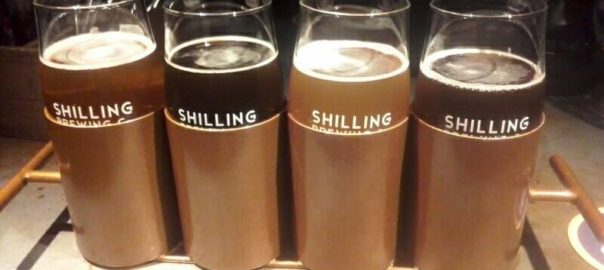
Less than a five minute walk from the station, Shilling Brewing Company provided a warm welcome to a rather nippy Glasgow. The brewpub sits in an imposing building on the corner of West George Street. Alongside an excellent range of guest beers, four of the brewery’s beers were on the pumps, all brewed a couple of meters away. The full series could be purchased in a stylish flight deck and included Brew Tang Clan (5% coffee porter), Unicorn IPA (5.2% IPA) and Glasgow Red (4.4% red ale).

Throughout the evening we also visited a number of pubs and bars down Argyle Street on our walk into the city centre, sampling Magic Rock Dairyfreak (5.2% ice cream porter) in the Taphouse, Drygate Chimera (5.9% India pale lager) and ending in the CAMRA award-winning Bon Accord drinking Black Iris Snake Eyes (3.8% pale) and a couple of single malts. A highlight of the evening was being served Leffe on ice in a champagne bucket at a local Indian restaurant.

The following morning spent at the Kelvingrove Art Gallery and Museum listening to the free Organ Concert and learning a little more about Scottish History, before setting off for the West End. The first stop was at BrewDog directly opposite the Museum, where my drink of choice was admittedly something mulled in an attempt to combat the chill.

Lunch was enjoyed at the Kimchi Cult, a tripadvisor recommendation that certainly didn’t disappoint, and after that a five minute walk up Byres Road led us to the Curlers Rest where we enjoyed a pint of 2018’s Champion Beer of Britain, Siren Broken Dream.

Following this we headed to an unassuming little lane which all the locals kept telling us was a must visit on our trip. Ashton Lane had whisky bars, Belgian beer bars an Irish pub and everything in-between. Our first stop was the Innis & Gunn Beer Kitchen where we settled in for a couple of hours, with Dom trying most of their tap beers and a couple of bottles (Blood Red Sky, a 6.8% rum-barrel aged red ale, and Don’s Choice, a 6.2% coconut and rhubarb black IPA, stand out as highlights), and me repeatedly ordering Magic Rock Stiggy Pop (7.3%), a brilliant example of the NEIPA style.

Popping over the road our next stop was Brel, famed for its impressive beer menu incorporating everything from Belgian to Scottish beers, and its beautiful beer garden. Favourites sampled here were the classics including Leffe, St Bernardus, Boon, and a wee Drambuie too! A notice in the beer garden did make me smile noting no hill climbing or head dives – a subtle nod to the 45% angle that the tables were perched upon. By this time we decided to have a break from beer and try some more whiskies in the wonderfully-named Ubiquitous Chip – we were in Scotland after all.

A full Scottish breakfast and surprisingly clear heads rounded off a much-enjoyed weekend in Glasgow, a trip we will definitely be making again.

Poppy

Calder Valley

I arrived in Leeds with the intention of having breakfast in the Wetherspoons at Leeds Station before getting an onward train. However, as the pub was heaving I decided to forego breakfast and take the train to Todmorden and have a pizza at the Wetherspoons adjacent to the station.
This was much quieter even though it was now gone midday. Unfortunately pizzas were off the menu today and as the beer selection was somewhat mundane I opted for a sandwich and pasty from a nearby bakers. My first drink in Todmorden was at The Pub (Good Beer Guide 2019) near the indoor market.  Quite a small affair with four tables and six hand pumps, and I selected a half of Northern Whisper Soft Mick.
The Pub, Todmorden
Not far away was the wonderfully named Polished Knob.  On entering you are greeted with an abundance of colour from the walls, furniture and stage – in fact, everywhere you looked. Many rugby league shirts adorned the walls. There were six hand pumps but only three were in action and I chose Three Valleys EPA. Next up was the Alehouse.  More modern in appearance, this micro pub has four tables of varying shapes and sizes and there was some patio seating outside at the front. There were six beers on hand pump and one cider. I chose beers from Doghouse and Rossendale breweries
Polished Knob, Todmorden
A short train ride on the line back towards Leeds is Hebden Bridge. It was a few minutes’ walk from the station into the town centre and the first pub that I visited was Nightjar, which is the tap for Nightjar Brewery. Three of their beers were available on hand pump and I chose Picture House at 3.9%. From here it is a short walk to the Old Gate Bar & Restaurant (GBG 2019). This is a larger establishment combining gastro dining with nine hand-pulled ales and one cider. I chose Oakham ABV and Kirkstall Brewery De Abdij & The Mill which was a very rich oatmeal stout at 6%. I could have stayed for another in here but there was still a lot to do. Next, a walk up the hill to the Fox & Goose (GBG 2019 entry), a community-run pub with an old-world feel and several different seating areas including a garden perched above the road. I chose halves of Bingley Korito and Serious Russet.  Back down the hill now to Drink? (GBG 2019) where Northern Whisper Yammerhouse was sampled.  Two beers were available on the small bar to the rear but this is also a bottle shop with an extensive range of both cans and bottles.
Fox & Goose, Hebden Bridge
Heading back towards the station I called in Vocation & Co, another brewery tap offering four cask beers and 16 keg. All the beers were served from taps behind the bar. From the cask list I chose Vocation Vermont Table IPA at 2.5%.  This was quite a modern looking bar and was getting quite busy now. The train beckoned but there was just time for a quick half of Nightjar Klondike back in the Nightjar tap. Another short train ride to Sowerby Bridge and the Turks Head. More of a local feel to this pub which had six hand pumps with four in operation and I chose Newby Wyke Orsino. A short walk away is the Hogs Head Brew House (GBG 2019) which offered six of their own beers and two guests. From their own range I had 6 to 8 Weeks bitter, White Hog pale ale and Smash Mosaic, all at 4%.  This seemed to be a very popular destination for people and was a hive of activity.
Turks Head, Sowerby Bridge
Back to Leeds now and the Scarbrough Hotel (GBG 2019), just down the steps from the station. There were nine hand pumps and I had Black Sheep Choc & Orange Stout and Siren Suspended In Mosaic.  On arrival back in Sheffield there was just time for a swift half of Roosters Parts & Labour American Pale Ale in the Sheffield Tap (GBG 2019).  There were other pubs I could have visited but those chosen certainly made for a Grand Day Out! Cheers, Andy Morton

PUBlic Transport: the tram-train

The long-awaited tram-train connecting Sheffield with Rotherham finally comes into operation on Thursday 25 October 2018, so it seemed like the logical choice for this month’s PUBlic transport article. Running between Sheffield Cathedral and the Parkgate shopping centre in Rotherham, the tram-train is the first of its kind in the UK. Conveniently for us, it also opens up a new route for exploring some of the real ale pubs that Rotherham has to offer!
Starting off in the city centre, we have a number of pubs featured in the recent Cathedral Quarter article: the Church House, Dove and Rainbow and Bankers Draft are among the selection of pubs offering real ale close to both Cathedral and Castle Square tram stops.
Wentworth House Hotel, Carbrook
As we head out of town on the existing tram line towards Meadowhall, the first real ale stop we come across is the Carlton (563 Attercliffe Road, S9 3RA). Roughly equidistant from both Woodbourn Road and Attercliffe tram stops, this is a lively traditional pub with two changing guest beers, mainly from local and regional breweries. Just a couple of stops further along, alighting at Valley Centertainment will bring you to two pubs offering cask beer. The Wentworth House Hotel (26 Milford Street, S9 2LD) is a former Ward’s pub which was renovated and reopened in 2015, serving up to three real ales from local breweries. Just over the road is the Eighteen Ten (3 Arena Court, S9 2LF), a Marston’s food-led pub offering Pedigree and the occasional guest beer. At Meadowhall South/Tinsley you can find the Steel Foundry, a Wetherspoon pub located in the Meadowhall centre offering the typical range of cask ales and reasonably-priced food. After this stop, the tram-train deviates from the usual tram route and begins the “train” part of its journey.
Bridge Inn, Rotherham
The train line brings us to Rotherham Central, which has a nice selection of real ale pubs nearby, including the Angel, the Rhinoceros (Wetherspoon’s) and the Bridge Inn, the original home of the Rotherham branch of CAMRA. This pub offers five hand-pulled beers, with regulars from Old Mill Brewery and Timothy Taylor’s along with a couple of changing guests. Our last port of call on the journey is a newly-constructed terminus at the Parkgate shopping centre. The Little Haven micropub is the pick of the real ale outlets here. Rotherham’s fourth micropub, which opened in June this year, offers four cask beers with Chantry and Exit 33 often featuring. We are running a branch social to Rotherham on Sunday 18 November to explore some of the pubs on the tram-train route and further afield. We will be meeting at the Devonshire Cat at midday, then taking the tram to Valley Centertainment for the Wentworth House Hotel. From there we will take the tram-train to Rotherham Parkgate and the Little Haven micropub. We will then go by bus to the Something Brew Inn at Rawmarsh, the Wath Tap at Wath-upon-Dearne and the Arcade Alehouse in Barnsley before getting the train back to Sheffield. It would be great if you could join us!

Oktoberfest

A visit to Munich’s annual Oktoberfest is on the bucket list of many beer lovers around the world and this year we were lucky enough to be able to make the pilgrimage. This is the world’s largest beer festival, with more than six million people attending every year and around 13.5 million pints of beer being consumed over the 16 days it is open. Munich’s biggest breweries each create their own special festival beer called Märzen, which at around 6% ABV is somewhat stronger than the usual lager-style beers Bavaria is known for. We set off early on Saturday morning to Manchester Airport for our first flight of the day to Düsseldorf (direct flights to Munich are extortionately expensive during Oktoberfest), where we enjoyed a couple of hours with a nice wheat beer before heading on to Munich. Once in the city, we quickly dropped our belongings off at our hotel and caught one of Munich’s very efficient local trains for the 20-minute ride to the festival grounds. Alighting at Hackerbrüсke station, the short walk to the Theresienwiese gave us a good idea of what was to come, as we passed revellers in various stages of horizontalness having presumably been drinking since early morning. It was quite a spectacle with locals and visitors alike sporting lederhosen, dirndls and other local garb. Once we arrived once we arrived the sheer scale of the festival struck us – even though we had heard and read how big it was, it’s impossible to comprehend without seeing it for yourself. At Oktoberfest there are no bars and no drinking outdoors, so in order to get some beer you have to make your way into one of the 14 large (some of them seating up to 9,000 people at a time) and 21 small tents in order to get a seat and be attended to. With so many tents to choose from, we’d naively assumed that we would have little problem finding five seats. How wrong we were though, as every tent we passed had queues trailing out of the doors, a one-in-one-out system firmly in place. After a short confabulation, we resolved to abandon the festival grounds for the evening. The new plan was to head into the city centre and come back first thing on Sunday morning. We headed to the Hofbräu beer house, but on finding that to also be full we settled for some of the smaller bars nearby and sampled local beers from breweries such as Ayinger and Tegernsee, traditional Bavarian wheat beers and dark lagers the order of the day. The local food too is exactly what you would expect, with sausages, pretzels and schnitzels abounding. There’s a reason these are so popular though – they’re delicious! Sunday morning came around and we arose bright and early to make sure we arrived at Oktoberfest in time for the opening at 9 am. We were by no means the first people there, but our plan to get in line early enough to secure seats was successful and within 20 minutes we had taken root in the Löwenbrau tent. The tent was wonderfully decorated in traditional Bavarian style, with long wooden benches and a bandstand in the middle. Less traditional was the 15-foot high animatronic lion statue which sporadically raised a stein to its roaring mouth. Soon enough, our waitress for the day took our first order and within minutes she returned, impressively carrying nine one-litre steins filled to the brim without spilling a drop. It makes you wonder how much training it must take before the festival, and it really is a sight to behold! The beer itself was very good too – not cask beer of course, but like all proper German beer it was clean and crisp and extremely refreshing, with a nice malty sweetness. The festival organisers have done a great job of keeping the atmosphere of the festival intact; during the day only brass bands are allowed to play (some tents do have electronic music later in the evening) and the doormen are very quick to spot and deal with any unruly behaviour. Standing and dancing on the benches is allowed and even encouraged, but taking that second step up onto the table will see you out the door before you can say auf wiedersehen. After spending a few hours in the Löwenbrau tent, we decided to head just next door to Hacker-Pschorr. There were none of the brewery’s distinctive swing-top bottles to be seen today; the beer came instead from a huge hose hanging from the ceiling. Again, this was a really enjoyable, slightly hoppier beer than the last – the perfect tonic for an increasingly warm day. We found a friendly German couple with some spare seats on their table and tried our best to converse in the local language – a couple of beers always helps in that regard! Eventually though it was time to head back to our hotel and get some rest before the journey home began on Monday morning. The famous purity of German beer meant there were no sore heads and we all agreed that we would definitely return in the future. Our one tip for anyone visiting would definitely be to get there early, especially on the busier days. Dominic Nelson

Amber Valley

Coords not found for https://whatpub.com/pubs/AMV/1539/prospect-street-micropub-alfreton The first available train to Alfreton on a weekday using a Derbyshire Wayfarer is the 9:06 from Sheffield. Alighting 25 minutes later at Alfreton Station it is a short bus ride into the town centre and then on to Ripley. There are 4 pubs in the Market Square including the Red Lion (CAMRA Good Beer Guide 2018), where a Wetherspoon’s breakfast was partaken together with half a Lymestone Whimsical Waterstone (4.5%).
The next stop was the Old Cock Inn for a Brampton Pentrich Revolution Best Bitter (3.8%) from the choice of four ales and three hand-pulled ciders. Nearby is the Thorn Tree with six hand pumps and traditional cider on gravity. I had Falstaff Judson (4.2%). Also not far away is the Pear Tree, which looked like a former Greene King pub in the process of changing hands. Only two of the five hand pumps were in use and I had Greene King St. Edmunds Ale (4.2%).
Old Cock Inn, Ripley
A short bus ride on the 147 took me to the Holly Bush at Marehay. This used to be the home of Little Bush Brewery but from the choice of five ales I chose a half of Draught Bass. Back into Ripley now and Ripley’s Little Ale House which opened at 1pm. This is a fairly small micro pub on a pedestrianised street with six tables, five hand pumps and a fair few gins. I had halves of Langton Sovereign (4.2%) and Heritage Oatmeal Stout (4%). A little walk down Butterley Hill brought me to the Talbot (GBG 2018) with nine hand pumps and seven real ciders available. I chose Pentrich Downfall Architect Mosaic IPA (6%) and one from the Brew York X-Panda Session IPA series. From near here I caught the Rainbow 1 service to Codnor for the Poet & Castle. This is one of the Project William partnership pubs between Everards and Lincoln Green. There are 10 hand pumps containing five Lincoln Green beers and five guests. My selections were Mad Dog Third Eye Blind (3.8%) and Plain Ales Innspiration (4%).
Ripley’s Little Ale House
Another short Rainbow 1 bus ride further away from Ripley is the Tip Inn micro pub in Loscoe. There are two indoor seating areas here and a garden and from the six hand pumps I had Grasshopper Knee High (3.8%) and Abstract Jungle Pale (4.9%). The Rapid One service took me back to Ripley in order to catch the 9.1 service to Swanwick and The Steampacket Inn (GBG 2018 entry) for some Blue Monkey Raspbeerry (4.6%). Another 9.1 service took me back to Alfreton Bus Station. It is only a short walk to the Handlebar (Landlocked Brewery tap) and some of their own Experimental Lambic Sour (3.9%) and Island of the Singular C (4.7%). Midway back towards the rail station is the Prospect micropub tucked away in a residential street. From the selection I had Scribblers Rubecca (4.8%) and Amber Ales Session Pale (3.6%).
Tip Inn, Loscoe
The train back to Sheffield was on time so there was just time for a last half in the Sheffield Tap. Roosters Finkle & Einhorn (4.9%) was a fitting way to end an enjoyable day, even though it was by far the most expensive of the trip at £2.25 a half. Andy Morton

South Yorkshire

A South Yorkshire Day Connect ticket costs £6.60 from the driver for one day’s bus and tram travel throughout the area. Getting to Rotherham mid-morning allowed plenty of time for the short journey to Broom, arriving there just after 11am.
The Stag (CAMRA’s Good Beer Guide 2018) adjacent to the roundabout of the same name, opens at 10am and has four hand pumps.  A roomy pub with several drinking areas served by the central bar and plenty of outdoor seating made for a pleasant start to the day.  Halves of Black Sheep/My Generation Beer Co.’s My Generation Session Pale Ale and Bath Ales Summer’s Hare were enjoyed.
The Stag, Broom
Just a few yards away is the Dragon’s Tap, with six tables inside and a few outside at the front. A bright and airy micropub with a selection of 6 hand pulled ales (and 3 traditional ciders), from which I chose Chantry Citra Pale. Chantry ales appeared fairly regularly in the pubs I visited today. Back into Rotherham and another short bus ride past the Parkgate shopping complex to the Little Haven, another micropub serving 3 hand-pulled beers, one cider and containing five tables indoors. I selected Drone Valley No. 43. It was such a balanced and refreshing drink on this hot summer’s day that I had a second half. I then decided to walk up Rawmarsh Hill to the Something Brew Inn, which had seating inside and out. A bus ride of a couple of stops would have been more sensible. Anyway, a pleasant half of Chantry Two Magpies Porter was consumed from the range of six real ales available. Continuing away from Rawmarsh a bus took me to Wath-upon-Dearne and the Wath Tap (GBG 2018 entry and Rotherham CAMRA Pub of the Year 2018), which was slightly larger and also had pavement seating at the front. North Riding Pecan Pie Porter and Rat Splinter Black IPA were sampled from the six available beers. Traditional cider was also served.
Tap & Brew, Hoyland Common
A further bus ride in to Barnsley this time and the Arcade Alehouse (GBG 2018 entry and Barnsley CAMRA Pub of the Year 2018) in the town centre.  Nightjar Haka Pale was enjoyed before then catching the number 66 to Hoyland for the Knave and Kestrel, probably the smallest micropub visited today.  Elland Nettle Thrasher and Stancill Blonde were sampled before catching another 66 back towards Hoyland Common and the Tap & Brew for some Small World Secret and Raw Jester Pale and some complimentary peas in the pod to accompany the beer. From here it was but a short walk to catch the number 2 service back to Sheffield, which gave plenty of time for a half of one of the Brew York X Panda Session IPA series in the Head of Steam and a final Adnams Anti-Hipstermin in the Bankers Draft before the bus home. I had hoped to visit some of the newly opened pubs around the Barnsley, Mapplewell and Darton areas, but these will have to wait for another day. Andy Morton