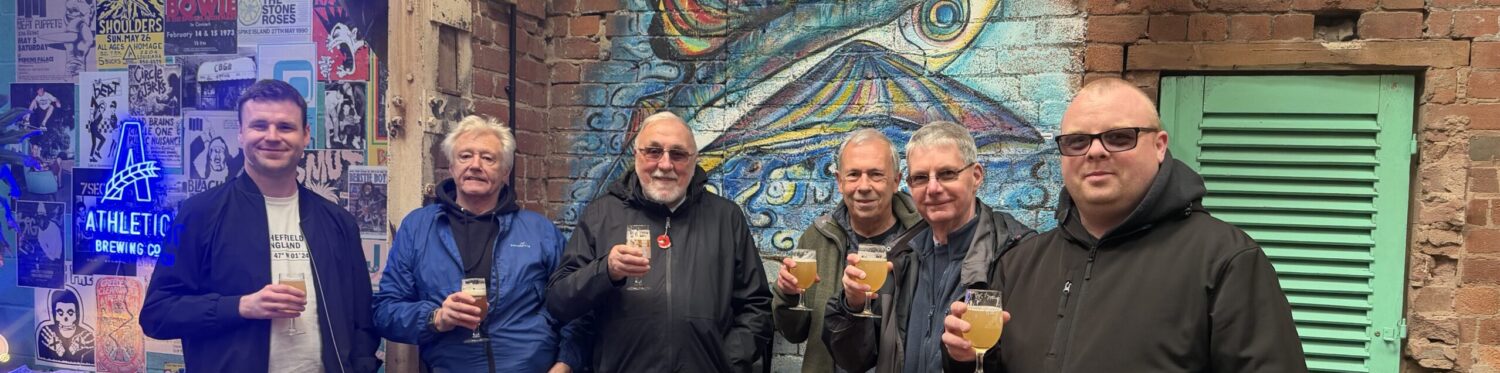
The annual beer census is a survey we do every year to take the pulse of Sheffield’s real ale scene in terms of how many different beers are available at any one time, which breweries are currently popular and what the average price is.
The same survey is also conducted in Derby, Nottingham, Norwich, York and other towns and cities with the results not only being data that is useful from an academic point of view but also allegedly proves where is the Beer Capital of England in terms of choice!
We would like to invite you to join us on the survey day, a pub crawl with a purpose! Each official survey crawl will have a leader with the paperwork, simply meet them at the start point and enjoy visiting some pubs in Sheffield you may not normally get to – if we can get a good group on each crawl it is a social event as well as a task!
There are three sets of crawls – suburban crawls starting at midday that work their way into the City Centre by bus, City Centre crawls starting at midday and then an evening crawl taking in Kelham Island and the Upper Don Valley.
The choice of meeting points:
Suburban routes, lunchtime start. Citywide all day bus & tram travel ticket suggested, cost £4.50
Devonshire Arms, Dore (buses 70 or M17) at 12:00
Wagon & Horses, Chapeltown (buses 29, 75, 79A, 87 or 265) at 11:00
Cross Scythes, Norton Lees (bus 19 or 20A) at 12:00
Walkley Cottage, Walkley (bus 31, 52 or 95) at 12:00
Banner Cross Hotel, Banner Cross (bus 70, 81, 82, 83, 88 or 272) at 12:00
Three Merry Lads, Lodge Moor (bus 51) at 12:00
Royal Oak, Deepcar (bus 57 or SL) at 12:00
City Centre routes, 12:00 start
Sheffield Tap, Sheaf Street (then split into up to 3 parties)
Evening routes, 19:00 start
Red Deer, Pitt Street (then split into up to 3 parties)
As part of Heritage Open days 2015, we are leading a Pub Heritage Walk on Sunday 13th September 2015. This short walking tour will take in some of the entries in the CAMRA ‘Yorkshire’s Real Heritage Pubs’ book. Also included are a number of ‘try also’ pubs which include aspects of architectural merit.We will commence at ‘Fagans’ and proceed to the ‘Dog and Partridge’ via a short stop outside the ‘Grapes.’ After a short refreshment break, we will proceed past the ‘Red Deer’ and ‘Bloo88,’ before completing the walk at ‘The Bath Hotel.’ Places are limited and may be booked via Eventbrite http://tinyurl.com/ps4ezog . Participants who wish to sample the beer served at the various en route stops are recommended to use public transport. Your guide will be Dave Pickersgill: author of the e-book, ‘History of the Worksop and Retford Brewery’ and ‘Pub Heritage Officer’ for Sheffield CAMRA.
Sheffield and District CAMRA has piloted a national CAMRA scheme which encourages branches to nominate pubs in their area as Assets of Community Value (ACV). The scheme is now open to all CAMRA branches. Each branch can use this assistance to nominate up to ten pubs/month. Once a pub is ACV listed, planning permission is required for any change of use or demolition
We have nominated eleven pubs, ten in Sheffield and one in the Derbyshire Dales. The pubs are a mix of heritage, suburban, city centre and rural. Currently only one Sheffield pub, the Castle (Bolsterstone) has ACV status. In our wider ‘district,’ the Angel (Spinkhill) and the Anglers Rest (Bamford) also have ACV status
CAMRA, nationally, completed the LA paperwork, checked ownership, obtained ground plans and paid the £6 fee. After checking the details and adding more information, we then submitted the completed documentation to the appropriate Local Authority. We now await their decisions. Once the Local Authority has ruled on these applications, we will review our position and may submit more pubs for ACV status.
More information is available at:
CAMRA: http://www.camra.org.uk/list-your-local
Sheffield City Council: https://www.sheffield.gov.uk/in-your-area/report_request/community-assets.html
Derbyshire Dales: http://www.derbyshiredales.gov.uk/community-a-living/community-rights/community-right-to-bid
Thanks for assistance:
Paul Crofts, Andy Cullen, John Dowd, Mike Hensman, Paul Holmshaw, Kate Major and from CAMRA HQ, Faye Grima
– Dave Pickersgill
Update – the Plough at Crosspool has now gained ACV status following a local campaign.
Sheffield CAMRA is taking part in a national CAMRA pilot scheme which is encouraging local branches to nominate pubs as Assets of Community Value (ACV). The branch has identified eleven local pubs : a mix of heritage, suburban, city centre and rural. With assistance from CAMRA HQ, the paperwork will be completed and submitted to the relevant Local Authority. We then await their decisions.
Pubs that are ACV-listed require planning permission to be demolished or for any other change of use. Currently only one Sheffield pub, the Castle (Bolsterstone) has ACV status. In addition, The Plough (Crosspool) has recently applied.
Sheffield CAMRA’s new Pubs Officers, Paul Crofts and Mark Boardley on the challenge of keeping track of Sheffield & District pubs.
As you may know, Sheffield CAMRA has been looking for members to get more involved in its activities, and in particular for new committee members. In response to this both myself (Paul) and Mark independently offered to take on the role of Pubs Officer. (Disappointingly no one made any reference to buses – “wait ages for one and then two turn up at once” etc. We suspect that the chairman, as a Supertram employee, has placed an embargo on any transport -based jocularity!) This function has been neglected for the last couple of years and needs a fair bit of work bringing things up to date so it was decided that two heads would be better than one, and we would share the work.
Our initial plan is to get the Whatpub website up to date. If you’re not familiar with Whatpub, we’d recommend having a look next time you’re on t’internet. It has lots of information on pubs across the country and is a great way of finding places to visit. You can do a basic search by entering a keyword such as an area or pub name, and then up to 36 different filters can be applied to narrow the list down to pubs that suit your requirements, whether that’s for food; parking; disabled access; dog-friendly pubs; proximity to public transport, etc.
Sheffield & District has 586 pubs and a good proportion haven’t been surveyed for over 3 years, so obviously this might take a while. And this is where CAMRA members can help. When you’ re visiting pubs in the area, any information you pick up that you think may be relevant can be emailed to us at the addresses below and we will act on it immediately. Mark is handling the East of Sheffield, and I’ll handle the West, though you can email either of us and we’ll sort it out. As well as details on the beer choice and pub facilities, you can also send us photos. The pub frontage is the first thing we need, but a few internal photos can also be included.
We have already started on the updates, but obviously we can act a lot faster if you help us find the major errors and out-of-date information on the site. There are over 1400 members in the Sheffield branch so if each person sent us an update on just 1 pub it would give us more than enough to start on. (Yes, we know. It would also give us quite a bit of duplication. Our maths isn’t that bad. Mark will do 45%, I’ll do 45%, we’ll pass 25% to the committee and the remaining 7% we’ll leave till next year!) We’ll need to verify the information sent in, but it will be a massive help in knowing where to start.
So, in summary – Get to the Pub! And if your other half asks what your doing, tell ’em Paul and Mark said it was all right. Cheers!
Paul Crofts – pubsofficer@sheffieldcamra.org.uk
Mark Boardley – pubscampaigns@sheffieldcamra.org.uk
CAMRA Supports Beer Day Britain – Your Country Needs You!
June 15th is Beer Day Britain – the UK’s first national beer day – and your country needs your help and enthusiasm to demonstrate why Britain’s beer and pubs should be recognized as national treasures.
June 15th is also the date that Magna Carta was sealed in 1215. This year there will be major national and international events to mark the 800th anniversary. The connection between Magna Carta and Beer Day Britain is that ale is mentioned in Article 35 of the great charter.
‘Let there be throughout our kingdom a single measure for wine and a single measure for ale and a single measure for corn, namely “the London quarter“‘
Ale was so important in England in 1215 that it was included in one of the most significant legal documents in history. And in 2015 beer is still vital – not just to the British economy but to the social health of the nation.
The intention of Beer Day Britain is:
To encourage people to drink beer whether that is at the pub, a barbeque, party, picnic, or brewery tap room.
To raise the profile of beer as Britain’s national drink.
To make people proud of Britain’s beer and pubs today and of Britain’s heritage as the brewing powerhouse and its role in spreading beer around the world.
To have a fantastic time drinking and enthusing about our favourite drink.
At 12.15pm on June 15th we are planning a nationwide communal cheers to beer, when everyone is encouraged to go to the pub to raise a pint of real ale as part of the national ‘cheers’. Will you join in and encourage your friends and colleagues to do the same? The aim is to trend on Twitter using the hashtag #CheersBDB.
We cannot make Beer Day Britain a success without CAMRA members getting involved, so lets make sure social media lights up with mentions of #beerdaybritain in the weeks leading up to June 15th. In addition to participating in the 12.15pm national cheers, perhaps you could encourage your local brewery to brew a celebratory ale or throw a party in the brewery, or for your favourite pub to host a special beer themed event.
Please follow @BeerDayBritain on Twitter and ‘like‘ it on FaceBook.
You can also download an information pack, logo and beer mat artwork on the website (www.beerdaybritain.co.uk) so you can tell everyone you know that you are a ‘Proud Supporter of Beer Day Britain’.
Here’s to Beer Day Britain 2015!
A few of us from Sheffield & District branch spent the weekend in Nottingham for the national CAMRA Members Weekend. As well as enjoying some good beer and wonderful pubs and bars with CAMRA members from across the UK, we also attended the AGM conference. A good proportion of this is spent debating and voting on motions, which is how the campaign’s policy and direction is formed.
There were very few motions this year that split the membership or caused excitement, however a few things did come out of it:
– a new point of sale labelling scheme is to be developed to help drinkers recognise beer that is real ale but not served from a handpump (for example bottle conditioned beers and naturally carbonated key keg beers)
– Branches will be offered more assistance in campaigning against local authorities imposing late night levies
– CAMRA will continue to recognise cider as ‘real’ with added flavourings such as fruits, herbs and vegetables as long as they are natural, fresh additives and the cider is still 90% fermented fresh apple juice.
The success of the cider motion did however dismay a lot of the more passionate cider campaigners so this position may well change again next year!
Real Ale, also known as cask conditioned beer (although is also available from bottles or key-kegs as well as casks!), is traditionally the British way of doing the best, freshest craft beer.
Real Ale is beer that goes through secondary fermentation in the container (cask, bottle etc.) and dispensed without gas being added to the beer. Real Ale in good condition should have a natural sparkle from the secondary fermentation process.
Back in the 1970s real ale was under threat of being discontinued by the few big breweries and replaced by rather poor quality keg beer that was designed to be consistently inoffensive, have a longer shelf-life, be cheaper to make and rely less on the cellarmanship skills of the publicans to deliver the beer how the brewer intended. CAMRA was formed to maintain the drinkers’ choice of quality beer.
CAMRA also formed a group called ‘Apple’ that promotes real traditional cider and perry that is made from nothing more than fermented juice from freshly pressed fruit. This is quite hard to find in pubs compared to real ale although there are a small number of brands such as Westons that can be found nationally in pub chains. Many of the popular and mass produced cider brands are made in an industrial style from concentrate and served fizzy.
Over the years CAMRA has expanded into a successful consumer campaign group for beer drinkers and pub-goers with a membership now around the 170,000 mark. The campaigning priorities now are less to do with availability of good beer (we’ve never had it so good!) and more to do with pubs and the issues that are causing many to close.
Issues now affecting pubs include planning legislation, taxation, the way pub companies with tenanted estates are run, competition from cheap supermarkets and off licences that encourage ‘pre loading’ and more. Check out the national CAMRA website www.camra.org.uk for the latest news on national campaigns.
Although of course, that said, we do celebrate our love of real ale and the heritage behind it still and our volunteers organise beer festivals around the UK showcasing the choice of great real ales available.
If you care about pubs and beer (or cider) do join us, there is a form in the back of Beer Matters or you can join online, and don’t forget we are a very social organisation as well as a campaigning one!
At the branch AGM we elected a new Chairman and appointed the committee members for the year ahead.
The new Chairman is Andrew Cullen, editor of Beer Matters, and we also welcome some new committee members in the shape of Branch Secretary Sadie Skipworth who has recently moved to Sheffield from Norwich, Beer Festival Organiser Louise Singleton and Pubs Officer Mark Boardley.
Some old faces remaining on the committee, other than Andrew, are Mike Humphrey, Dave Pickersgill and Alan Gibbons. Their roles will be confirmed at the committee meeting taking place on the day this magazine arrives from the printers. There are still some vacancies on the committee so volunteers are still welcome!
Commenting on the changes and the plans for the years ahead, new branch Chairman Andrew Cullen said “Thanks to those who supported me returning to this role after 2 years doing other things in the branch, I’ve been talking to various people recently including a variety of CAMRA members, brewers and publicans and I feel we need to breathe some fresh air into the branch. There are some things we are already doing well: Beer Matters and the website are both looking good and our beer and cider festival proved an incredible success at Kelham Island Industrial Museum last year. We now need to make our programme of socials good again, make the branch meetings a bit more enjoyable and purposeful, and raise our profile around the pubs of Sheffield & District.”
He also commented on his wider campaigning views “I think we should also be communicating CAMRA’s national campaigning priorities louder locally. Although we are called the Campaign for Real Ale and our heritage is all about ensuring drinkers have the choice of quality real ale on the bar that really isn’t a concern right now. There is plenty of real ale coming out of an ever growing number of breweries and the wider beer scene beyond real ale is starting to embrace quality and craft. Any arguments about changing CAMRA’s policy and definitions of beer is somewhat time-wasting, I feel. Where our efforts are needed, are saving pubs. We have seen threats from the way some pub companies do business, from property developers, from convenience store chains, from the tax man and from planning rules that are causing potentially viable, good pubs to close their doors for good.”
As it was both National Science Week and Sheffield Beer Week, it was appropriate to have a beer-themed Science event at the venue of the Sheffield CAMRA Beer Festival. Hence, on Wednesday 18th.March, over 30 Science/Beer buffs arrived at the Millowners Arms to be greeted by a pint of Pale Rider from Kelham Island Brewery (KIB).
This was followed by a short talk on Sheffield Brewery history from ex-Sheffield CAMRA Chairman, John Dowd. Then utilising various samples, Nigel Turnbull, Head Brewer at KIB explained the brewing process.
Participants then adjourned to the classroom where Bob Kibble, Member of the Institute of Physics and the Chair of Doncaster CAMRA took them through their paces with some beer-inspired Science: make your own hydrometer and the exponential decay of the froth on your pint.
After a quick buffet, the evening finished with an ‘Ask the Experts’ session in which John and Nigel were joined by Dave Pickersgill from Sheffield CAMRA. A repeat is planned for Science Week 2016.