Dave has been a CAMRA member since the 1970s and has worked at almost 40 Sheffield CAMRA festivals, plus a fair number of others. He is Brewery Liaison Officer (BLO) for Abbeydale, Blue Bee, Bradfield and Loxley. He was also the Chair of the Local Organising Committee for the 2023 national CAMRA Members’ Weekend, AGM & Conference.
A member of the National Pub Heritage Group, he leads on planning and pub heritage issues. He also edited the Sheffield's Real Heritage Pubs book, for which downloads vastly exceeded expectations. The hard copy was available in October 2018 and again in 2021. On both occasions, it was a sell-out. The 5th edition (2023) is available as both a hard copy and a free download.
The South Yorkshire Local Heritage List identifies heritage assets that are valued as contributing to the distinctiveness and history of South Yorkshire but that are not protected by statutory national designations, such as Listing or Scheduling. Inclusion on the Local Heritage List can allow the more local significance of a building, place or site to be taken into account in planning decisions that affect it or its setting. It does not provide the same level of protection as national designation, but will be of assistance when planning applications are submitted.
Sheffield and District CAMRA has ensured that pubs mentioned in the recently published book, Sheffield’s Real Heritage Pubs which are not nationally listed or in a Conservation Area, have been put forward for the Local Heritage List. However, this leaves many pubs which are not listed – possibly your local?
From the website, you can view the existing list, see the assessment criteria and nominate candidates. Please make sure your favourite heritage buildings are nominated!
In September, as part of Heritage Open Days and Sheffield Walking Festival, we led two pub heritage walks. These were the first such events since 13 March 2020, the evening which saw my last pub visit for almost six months: a final beer in the Wellington.
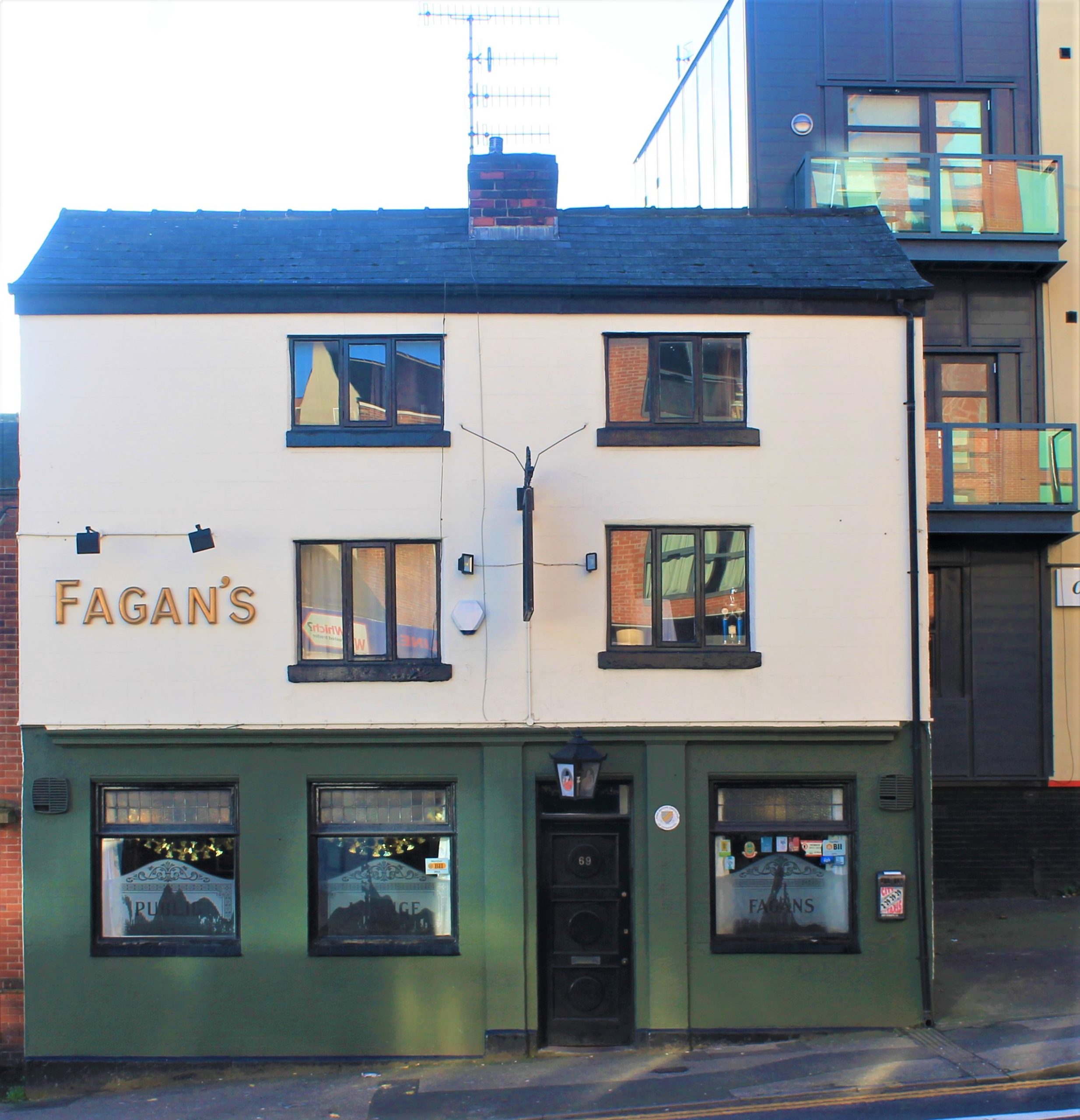
The first walk commenced in the lounge at Fagan’s, in a room which, 200 years ago was a tenement adjacent to the Rawsons-owned, Barrel pub. The name change came in 1985 when long serving landlord, Joe Fagan retired and current occupants, Barbara and Tom Boulding took over the reins. We then progressed along Bailey Lane to both the Dog & Partridge and the Grapes. The latter is the best remaining example of a Rawsons pub while the Dog has a small intimate snug which, in the 1974, almost became a gents toilet. Then it was the sights of West Street before finishing in the CAMRA National Inventory-listed, Bath Hotel: a pub which is (almost) unchanged since the 1931 Ind Coope renovation.
Bath Hotel plans
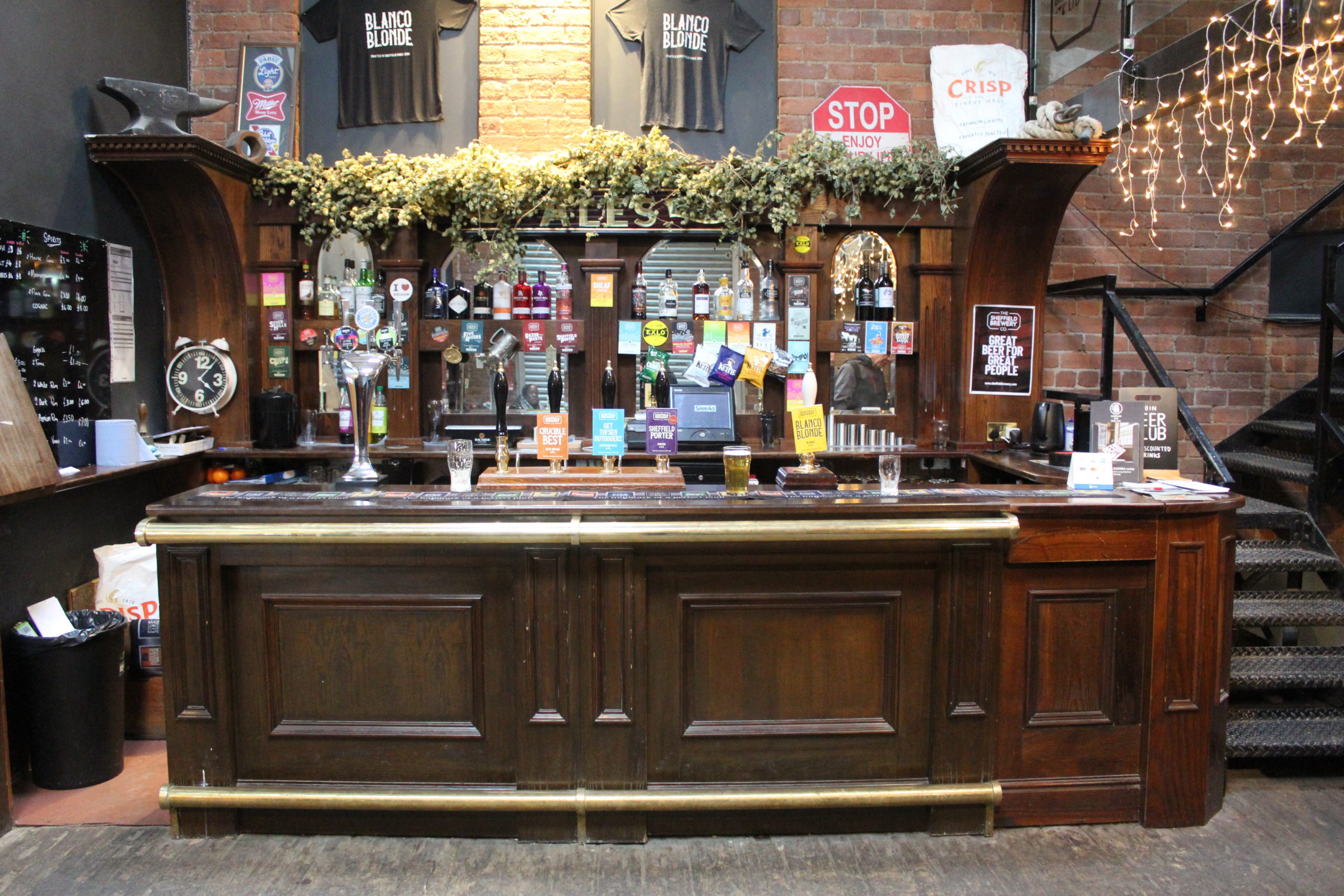
Two days later, we commenced in the Fat Cat, the pub that, when opened in 1981, doubled the number of different cask beers available in Sheffield. Then to Shalesmoor, passing both ex- and current pubs and breweries before finishing at the original home of ‘Blanco,’ Sheffield Brewery Company with both a brewery tour and a welcome drink. The latter was from the bar which was originally at the now-demolished Sheffield University Ranmoor Hall. They also have an interesting selection of branded bricks as part of the recent outside development.
Thanks to the 37 participants and all who assisted. Future walks are planned for Sheffield Beer Week in March and again, next September.
The 4th edition of the Sheffield Real Heritage Pubs Book is now in print. 1000 copies of the 112-page A5 book (£6.99) are available both via mail and in an increasing number of local outlets.
Paul Ainsworth, the Chair of the National CAMRA Pub Heritage group says; ‘For almost forty years, CAMRA has developed its national inventory (NI) of historic pub interiors. This publication portrays the rich tapestry of Sheffield’s pubs: from the nationally important to those where what remains, even if fragmented, should be cherished.’
A recent series of book-signing events for four of our sponsors provided lots of positive feedback, as have responses from mail-order buyers. For example, Andy Brown, from Poole in Dorset commented: ‘I’ve received my book today …. it looks superb …. well done on the publication,’ while ex-CAMRA Good Beer Guide Editor, Jeff Evans commented, ‘Good to see this new edition celebrating the finest pubs in a great beer city.’
Local stockists include both beer-outlets and bookshops:
Abbeydale Brewery (mail order), Beer Central, Blind Monkey, Bradfield Brewery Shop, Chantry Inn, Coach and Horses (Barnburgh, Doncaster), Crow Inn, Dog and Partridge, Draughtsman (Doncaster), Fat Cat, Friendship (Stocksbridge), Samuels’ Kitchen (Stocksbridge), Maison du Biere (Elsecar), Princess Royal, White Lion
Beer Inn Print (mail order), Biblioteka (Kommune), Kelham Island Books & Music, Kelham Island Museum, Millennium Gallery, New Chapter Books, Rhyme and Reason, the Sheffield Shop, Watson Park Museum
Thanks again to all who assisted with this publication: many individuals, the National CAMRA Pub Heritage Group, Sheffield Archives and the sponsors for their help. Also to Andy Shaw for the design and Mick Slaughter for many of the photos.
Last month, we reported how the Royal Oak (Mosborough), was demolished. The owners, Bar 24 Ltd., have now applied for retrospective planning permission. Their assertion is that toxic waste was dumped in the car park, and the situation became so bad that the only option was to demolish the pub. The building dated from 1843, becoming a beerhouse in 1870.
Clive Betts, the local MP disagrees, ‘we should never have been in this position. An application should have gone in before the pub was demolished, and it’s disgraceful how the applicants have behaved. The application has to be treated as if the building is still there. There must be no advantage to the developer because they broke the rules and demolished the pub before they got permission.’
Sheffield and District CAMRA agree with Clive. In October, environmental experts assessed the situation and didn’t find anything to justify demolition. This suggests that the spillage has been used as a pretext for taking short cuts to potentially secure profitable redevelopment of the site. We also believe objections to the anticipated planning application should initially focus on the importance of retaining pub use on the site and the lack of any justification for the demolition. The Carlton Tavern (London) sets a clear precedent.
Sheffield and District CAMRA will comment on this planning application. We encourage you to do the same. Sheffield City Council planning, reference 21/03651/FUL.
The developers are proposing to replace the pub with a retail park.
The 4th edition of the Sheffield’s Real Heritage Pubs Book arrived from the printers in late September (1000 copies, A5, 112 pages, £6.99 rrp). Compared to the third edition, this edition includes ninety new images, plus many text changes.
Paul Ainsworth, the Chair of the National CAMRA Pub Heritage group says; ‘For almost forty years, CAMRA has developed its national inventory (NI) of historic pub interiors. These highlight the crème de la crème which have either escaped much alteration or contain features of exceptional interest. We are aware that below the NI are a host of interiors which still offer a great deal worth seeing. The pioneering work carried out in Sheffield to locate and record these pubs has been an inspiring exercise. This publication portrays the rich tapestry of Sheffield’s pubs: from the nationally important to those where what remains, even if fragmented, should be cherished. A bonus, of course, is that many of these pubs sell great real ale.’
At the time of writing, the following local outlets have agreed to sell copies directly:
Abbeydale Brewery
Bath Hotel
Beer Central, Moor Market
Beer Inn Print (mail order)
Biblioteka, Kommune
Bradfield Brewery Shop
Crow Inn
Dog and Partridge
Fat Cat
Friendship, Stocksbridge
Kelham Island Books and Music, Shalesmoor
Maison du Biere, Elsecar Heritage Centre
New Chapter Books
Rhyme and Reason
the Sheffield Shop
White Lion
Copies will also be available at four book signing events which are part of the Sheffield Beer Festival on tour event.
Last October, the Sheffield Wheat Experiment invited two hundred locals to plant wheat in their allotments, gardens, pots, public spaces or schools. Earlier this summer, the wheat was harvested, allowed to dry and then at a communal event held at Bloc Studios in late August, threshed. 130 kg of grain resulted: 2 kg went to local brewery, Grizzly Grains.
Grizzy Grains Brewery – Dave Pickersgill
This brewery commenced in 2020, brewing at the owner’s home in Walkley, Sheffield. In March, this year, they moved to a 4.5 Bbl. plant in an industrial unit close to Bramall Lane. Their original brewing kit, now the seventy-two litre mini-kit, was obtained from Crosspool Ale Makers. When Crosspool became a cuckoo, their newer plant was purchased by Grizzly Grains, owner and brewer, Sam Bennett. The brewery name came from his young daughter. Originally, Operations Manager at Heeley City farm, Sam now splits his time between the brewery and the farms honey operation, the unit acting as headquarters for both.
The boil commences – Rachael McNiven
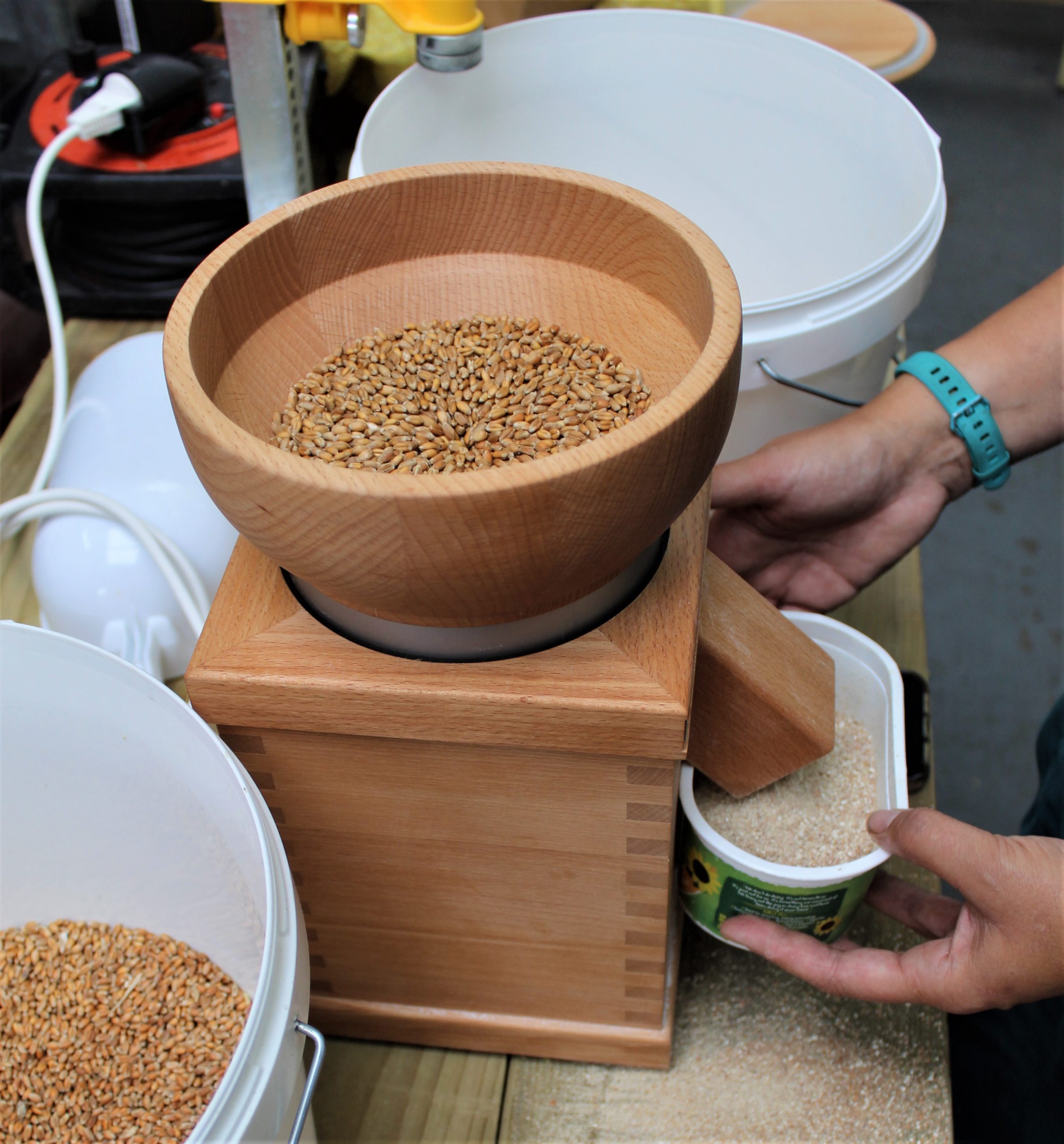
Two days before mashing, the grain was torrified (or as my spell-checker insisted: ‘terrified’). Using the large oven at the nearby Regather Co-operative, the wheat kernels were subjected to high-temperature heat treatment. This breaks down the cellular structure of the grain and pre-gelatinises the starches in the wheat so that they are easily broken down at mash temperatures. In beer, protein aids head retention by bringing foam quality and stability. Torrified wheat contains a higher percentage of protein than malted barley. Ideally, for good foam retention, 5/10% of the mash should be wheat.
On the 9 September, the mash for the Sheffield Wheat Experiment beer used spelt, crystal malt, rice husks and malted barley with the Sheffield-grown wheat forming the final 10%. Hops were a mix of East Kent and Northdown. The result was seventy-two litres : 210, 330 ml bottles of a Belgian style amber.
As for the rest of the grain: 1 kg will be seed for sewing in the Autumn and the remainder will become flour. For information about the Sheffield Wheat Experiment: thesheffieldwheatexperiment.co.uk
This copiously illustrated and extensively researched 288-page book provides a reflection as to how British Beer has evolved over the last fifty years, and why this matters. It does not claim to be a beer guide or a history book. However, it provides a perfect picture of Modern British Beer (MBB).
A short prologue is followed by two introductory chapters: ‘The Broad Spectrum of Joy‘ and ‘Defining Modern British Beer.‘ The former provides the historical backdrop and paints a beguiling picture of the spectrum of currently available MBB – styles, flavours and experiences: from the perfect cask bitter to the wild-fermented, barrel-aged Saison. There are also references to many key players including Brendan Dobbin, (Yakima Grande Pale Ale, West Coast Brewery in Manchester) and Sean Franklin (the founder of Harrogate-based Rooster’s). As Matthew states: ‘the primary function of modern beer is to spark joy.’
The next chapter asserts that MBB is:
focused on ingredients, their agriculture and provenance
invested in sustainability, and the preservation of the environment
focused on regionality and is driven by, and supportive of, its local communities
inclusive and equitability-minded
delicious
He continues to state that ‘Racism, sexism, transphobia, homophobia and all other forms of marginalising language and actions belong in the dustbin of beer’s past, not its present, and certainly not its future.’
These are all sentiments with which I am sure we all fully agree.
Matthew also comments that, ‘in terms of modern British beer, no brewery has had more significant an impact on brewing in the United Kingdom over the past twenty years than BrewDog. Love them or hate them, this is a hill I have chosen to die on.’ BrewDog would not be my hill: many will recall their behaviour prior to the 2011 CAMRA GBBF, will note recent social media comment and also remember that in 2017, a quarter of their shares were sold to two companies based in the Cayman Islands. Personally, I would have taken Thornbridge, with their iconic and ground-breaking Jaipur, ‘the most influential of them all,’ as my talisman.
The introductory sections are followed by a series of short stories each focussed on a single beer from an independently owned, and run, brewery. The beers are chosen as a representative sample. As Matthew says, ‘whittling down the selection was the most challenging part of putting this book together.’ I have no doubt that every reader will suggest breweries which ‘should’ have been considered: my selections would include Arbor, Neepsend and Vocation. Perhaps, a supplementary book could be forthcoming?
The eighty six beers are split into seven regions, geographically, north to south. Hence, ‘Scotland,’ with eleven entries opens with ‘London and the South‘ (15), as the closing section. The brewery order is deliberately not alphabetical.
Each listing includes brewery location, alcohol by volume (abv) and style. The latter is based on styles as defined by the Beer Judge Certification Program (BJCP). As this book is published by CAMRA, it seems odd that the recently rewritten CAMRA beer styles are not mentioned.
Beer descriptions are evocative: ‘…. seduces with aromas of stewed plums and rhubarb crumble, drawing you in for that first, decadent sip’ (Titanic Plum Porter) and are mostly about right. Traquair House Ale, however, is included in a collective description of several beers as ‘brown and taste predominantly of malted barley, and not much else.‘ This is simply not true. First brewed in 1965, this 7.2% beer is a traditional Scotch ale (‘Wee Heavy).’ Agreed, there is fruity malt on the nose, but there is so much more. As Michael Jackson put it in his seminal, New World Guide to Beer, ‘A vintage port among beers.’
The beers included cover the full spectrum of MBB. Some are obvious choices while many are from relatively small local breweries, for example: Torrside’s Monsters, one of the last cask beers I drank before the first lockdown.
Many inspirational stories are included. For example, the uplifting tale of how Abbeydale, known for their hop-forward and funky sours, deliberately created a magnificent example of a ‘brown bitter,’ using John Smiths Bitter as their inspiration.
As ever, with a fact-filled tome, there are a small number of errors and areas which could do with more information: Attercliffe is east Sheffield, not north, Saltaire Brewery is in Shipley, not Saltaire, ‘23 years‘ is described as ‘three decades‘ and SI units are incorrectly written (please use 750 mL, not 750ml). It is stated that ‘BrewDog ceased production of cask ale in July 2011.’ Their 2019 restart is not mentioned.
Bruce Bentley, who, in July 1981, in partnership with Dave Wickett, purchased the Fat Cat for £33,750, also deserves a name-check. There are some typos: for example, Jakehead IPA (Wylam) is said to originate in 2021.
I also have the occasional disagreement: in the overview, mention is made of Matthew’s father, Frank, and the Tetley’s Bitter he served in the Beehive in the mid-1970s. Agreed, this was an excellent pint. However, I preferred Tetley’s from the nearby Red Deer: the only pub in the Sheffield One postal area which has continuously used a handpump since that time.
As Matthew states, ‘British beer has changed forever,’ ‘it’s about building friendships with like-minded folks from around the entire industry …. It’s this open attitude towards sharing ideas and forming bonds that has put British beer where it is today.’ These are sentiments with which I can only concur. This is a book well worth reading: it’s interesting, accessible, and enjoyable. You will not agree with every point, but you will appreciate the overall approach. Personally, I would enjoy meeting the author, over a few pints. Next time he’s in Sheffield, I hope he lets me know. As the book states, ‘Steel City as one of the most tremendous places for beer in the UK.’ This is yet another statement with which I cannot disagree.
Modern British Beer by Matthew Curtis / CAMRA Books (first published: 2021) / £15.99
The first face-to-face CAMRA Sheffield & District meeting since spring 2020 recently occurred.
A week before their formal opening, newly re-located Heist Brew Co. (107 Neepsend Lane, S3 8AT) allowed us a preview of their new brewery and tap room.
This development incorporates their state-of-the-art brewery, in addition to a very large tap room, complete with benches, shuffle board and a skateboard. Beer-wise, plenty of KeyKeg, including a couple of 11% imperial stouts and various sours and IPAs.
Our next branch meeting on 7 September is, by contrast, at a very traditional pub, the Chantry at Handsworth (S13 9BZ), one of only four pubs in the UK that are claimants as built on consecrated land. There is also a cemetery on the grounds of the pub.
The fourth edition of the Sheffield’s Real Heritage Pubs is scheduled to go to print in mid-September (1000 copies, A5, 116 pages). For details of pre-orders and retail possibilities, please contact pubheritage@sheffield.camra.org.uk. The second edition was available as both a printed version and a free download. The third edition is currently available as a free download at sheffield.camra.org.uk/rhp. Full details of local availability will be available in the next edition of Beer Matters.
Sheffield’s Real Heritage Pubs 2021 Fourth Edition
For almost half a century, CAMRA has worked to identify, support and protect the UK’s most historic pubs through its national inventory: pubs that are wholly or mostly unchanged or retain important historic rooms or features from over fifty years ago.
Since then, hundreds of pubs have been restored or created in buildings previously used for something else. There have also been new-build pubs that are worthy of admiration and recognition. The Outstanding Conversions and Restorations (OCR) Project identifies and promotes such interiors of outstanding architectural and/or design quality, pubs which are great places to enjoy a drink in splendid surroundings.
The website ocrpubs.camra.org.uk highlights almost two hundred pubs from across the UK that are magnificent conversions or glorious restorations. There are also stunning new builds and a handful of pubs in museums.
As Project Manager, Gerry Hahlo, puts it; ‘all these pubs are the work of dedicated individuals, and pub companies who know the value of excellent design and have created great spaces in which people want to drink and socialise. Some show off their architectural merit by sympathetically converting historic buildings such as banks and cinemas while others recreate painstaking replicas of the glories of yesteryear.’
One example is a former Tetley house, the ex-Firwood Cottage (Sheffield S6 2WA): the Blind Monkey opened in Spring 2018 after a period of closure and deterioration. Dating back to 1846, the building was originally a small village shop that sold bottled beer. It later became a pub. Over the years, it was opened out from smaller rooms into an open-plan design. Taken on by Speakeasy Company, the owners of the nearby Don Valley Brewery, the derelict shell was gutted, and the interior was taken back to the multi-roomed 1890s: most materials used are reclaimed items dating back to the Edwardian and Victorian periods.
Gordon Jones, Director, describes the project as, ‘a labour of love. We wanted to showcase both our architectural and design skills. We rebuilt; we divided the once-open snug area by glass partitions to display whiskies. The fireplace and chimney were opened-up and a reclaimed parquet flooring was renovated and laid down in the main areas of the pub, complemented by original tiling near the bar areas. We also used reclaimed light fittings sourced from as far as Mumbai to as near as Manchester.’
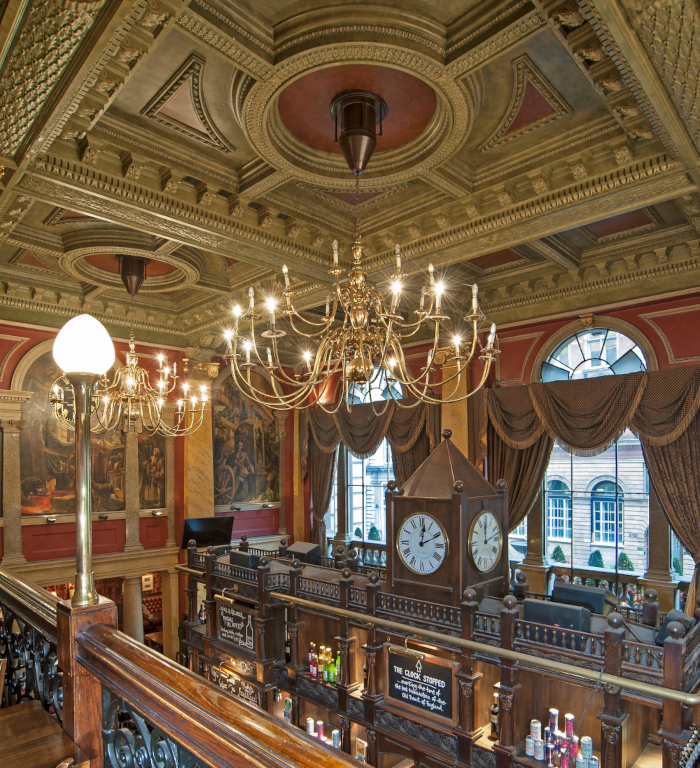
The Blind Monkey is an outstanding restoration. Our image, the Old Bank of England (EC4A 2LT) is an outstanding conservation (Thanks to Mick Slaughter for the photograph). There will be many more: hence, we welcome your suggestions: please contact info@ocrpubs.camra.org.uk saying why the pub should be included. But also, please, enjoy these wonderful pubs!