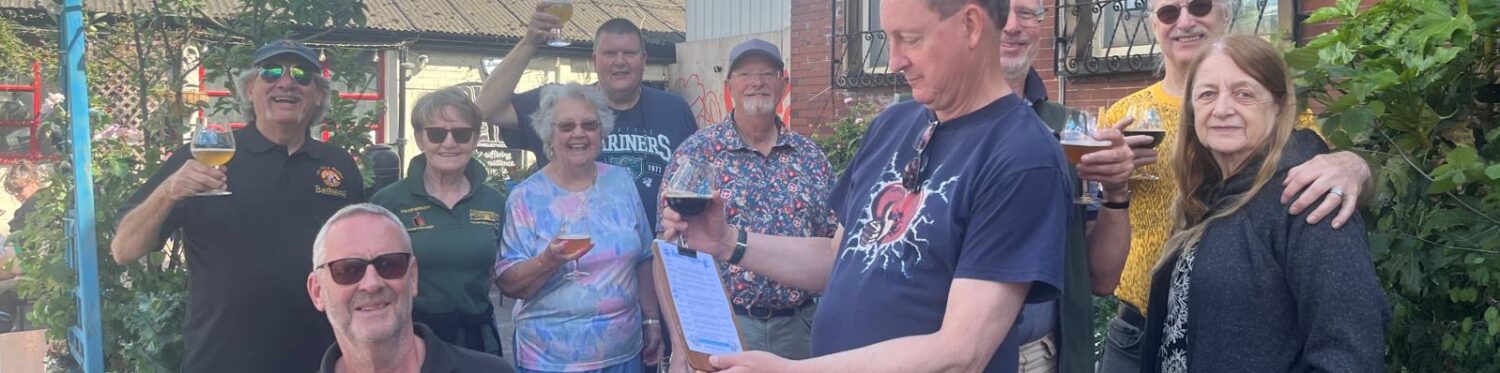
This year the Sheffield & District branch of CAMRA is 51 years old, Beer Matters magazine is 50 years old (as long as you count its predecessor, the Parish Pump newsletter) and we’ve run 49 annual beer festivals (the festival had two years off for Covid!) although the branch has been involved in more than 49 festivals due to putting on beer festival bars at student union and music festival events in the past!
Over the years we’ve also presented a Pub of the Year award and we have them listed on our website going back as far as 1982.
The third booklet in our pub heritage walk series is now available. This concentrates on Neepsend, the ‘new Kelham Island.’ Included are copious images, a map, detail on the various pubs featured and lots of information on the area and its history, including a timeline.
The formal launch will be at the forthcoming Sheffield Steel City Beer Festival (15-18 October 2025). The first booklet which was produced for the 2023 CAMRA Members’ Weekend, AGM and Conference is sold out and there are relatively few copies left of the second booklet: Little Chicago. The pub heritage walk series will continue with Kelham Island in 2026 and Riverside in 2027.
In common with the preceding two booklets, it is: 32 pages, A5, full colour throughout, £2.99 rrp and had a print-run of 1000 copies. It is currently available from several local stockists, including: Abbeydale Brewery, Beer Central, Biblioteka, Bradfield Brewery, The Crow, Draughtsman (Doncaster Railway Station), Famous Sheffield Shop, Forest, Gardeners Rest, Hop Hideout, Kelham Island Books and Records, Millennium Galleries, Pangolin, Rhyme and Reason and St.Mars of the Desert.
Led by Dave Pickersgill, this short walking tour will explore Neepsend, an area which is currently ‘on the up’ (it’s next door to Kelham Island, the 35th ‘Coolest Place on the planet.’). We will encompass both aspects of industrial, and social, heritage and of the ‘Beer Capital’ status owned by the City of Sheffield. Highlights include the ex-Samuel Osborn Works (now Church – Temple of Fun), Naomi’s Corner, Ball Bridge, the JC Albyn complex and William Stones Cannon Brewery. There will be one en route stop and a finish in the Beer Garden in the co-operatively owned Gardeners Rest.
The walk will be published in September 2025 as the third in a growing series of ‘Sheffield Pub Heritage’ 32-page, A5 booklets. The first (University Arms to Fagan’s, 2003) is sold out. The second (‘Little Chicago’) was published in 2024.
A guided walk with a difference – Led by local author, John Stocks and editor of ‘Sheffield’s Real Heritage pubs,’ Dave Pickersgill, you will explore Sheffield’s Little Chicago Quarter. The walk will explore streets that feature in John’s book ‘Sheffield 1925: Gang Wars and Wembley Glory,’ and also explore the beer, social and Industrial heritage of the area. The comfortable walk, with one minor ascent, is just over a mile. It will last for approximately 90 minutes before concluding at the Kelham Island Tavern for a post-walk drink and discussion.
Many of you will recall that the Royal closed last year. A planning application has now been lodged with Sheffield City Council to convert the pub into residential accommodation (ref. 25/00501/FUL). We have formally objected: the permanent loss of this culturally significant and historic pub would have a profound and detrimental impact on the local community and beyond.
The Royal Hotel has served as a vital community hub since 1813, providing a space for social interaction, local traditions and live music. Most notably, it is one of the key venues for the Sheffield Christmas Carols – a centuries-old folk tradition that draws visitors from across the country and further afield. Losing the pub would diminish this deeply rooted cultural event, which has been widely recognised as a unique and important part of British heritage.
The Royal attracts visitors not only from Sheffield but from further afield. The area has a growing, affluent customer base who regularly visit the surrounding countryside for recreation. Dungworth is criss-crossed with walking trails and sits on the edge of the Peak District National Park – the pub is a welcome sight for walkers seeking rest and refreshment. Locally, the past two years have seen nearly 20 new houses either built or granted planning permission.
There is strong evidence to suggest that, with the right management, the Royal could thrive. Many similar rural pubs in the Sheffield area are successfully attracting a mix of local patrons and visitors. The Royal’s setting – with its historical significance and sweeping views across the Loxley Valley – offers a clear opportunity for revitalisation.
A key requirement for change-of-use applications involving pubs is a demonstrable effort to market the premises as a going concern. In this case, there is little evidence that the Royal has been properly offered for sale as a functioning pub. In contrast, a local fundraising initiative has already pledged a six-figure sum to support the future of the Royal, and a local brewery has expressed interest in purchasing the pub. Viable options clearly exist to avoid the unnecessary loss of a valued local facility – one that supports community cohesion, social interaction, and the local economy.
Given the strong interest in preserving the Royal, granting permission for its conversion at this stage would be premature. We believe the proposed development is inconsistent with both local and national policies on the conversion of pubs. With overwhelming community support and positive indicators from the Public House Viability Test, we urge the council to reject the application and support efforts to secure the future of the Royal Hotel as a sustainable business and vital community asset.
Sunday 16 March 2025 – walk – start 11:00, finish at Kelham Island Tavern ~12:30
Following the success of previous guided walks, events during Sheffield Beer Week 2025 will include a guided historical walk in Sheffield’s Little Chicago Quarter. We will explore both the pub heritage aspects of the area plus the streets which feature in the book, ‘Sheffield 1925: Gang Wars and Wembley Glory.’ Thenarrative will explain how Sheffield briefly became the most turbulent city in Britain due to an escalating gang war involving the Park Brigade, Mooney Gang, the Gas Tank Gang and many others.
The short walk will also explore the beer, social and Industrial heritage of the area, examining the myths and reality of a tumultuous year in Sheffield history. Along the way, mention will be made of the 1884 ‘Sheffield Drinks Map,’ George Orwell, the establishment of a coaching inn and the Sheffield pub with the most local CAMRA awards.
The walk will be led by local historian and writer, John Stocks and ‘Sheffield’s Real Heritage Pubs’ editor, Dave Pickersgill. The comfortable walk of just over one mile, with one minor ascent, will last for approximately 90 minutes, including one en route stop, followed by post-walk drink and discussion.
Includes:
* Guided historical walk
* copy of the new Pub Heritage walk booklet which features Little Chicago (A5, 32 pages, rrp £2.99)
* the opportunity to purchase a copy of ‘Sheffield 1925: Gang Wars and Wembley Glory’ (second edition) at the reduced price of £10 (cash only)
DATE: Sunday 16 March 2025
Meet: 11:00 outside the Sheffield Combined Court Centre, West Bar, S3 8BH
Finish: 12:30 Kelham Island Tavern, 62 Russell Street, S3 8RW
Cost: £4.95
Tickets available at: Eventbrite
Number of places available: 20
Pub Heritage Talk: Little Chicago
Thursday 13 March 2025 – 20:00 – Harlequin
This event is a history/pub heritage talk which will concentrate on the Little Chicago area of Sheffield, taking you from the early part of C19th up to the current day. We will explore both the pub heritage aspects of the area plus the streets which feature in the book, ‘Sheffield 1925: Gang Wars and Wembley Glory.’ The narrative will explain how Sheffield briefly became the most turbulent city in Britain due to an escalating gang war involving the Park Brigade, Mooney Gang, the Gas Tank Gang and many others.
The talk will be led by local historian and writer, John Stocks and ‘Sheffield’s Real Heritage Pubs’ editor, Dave Pickersgill. The talk will last for approximately 60 minutes, followed by post-talk drink and discussion.
Includes:
* historical talk (one hour, including questions)
* copy of the new Pub Heritage walk booklet which features Little Chicago (A5, 32 pages, rrp £2.99)
* the opportunity to purchase a copy of ‘Sheffield 1925: Gang Wars and Wembley Glory’ (second edition) at the reduced price of £10.00 (cash only)
This large pub, named after the nearly stainless steel manufacturing firm of Samuel Fox and Co. Ltd. opened in April 1963. At the time of closure (Spring 2019), the interior was very little changed with two bars, off sales and a rear passageway with some seating, The upstairs functions room remained virtually untouched. The entrance led into a passage with doors to the tap room on the left and lounge bar on the right. There were two hatches to the servery in the passage that were the original off sales.
The public bar on the left retained the original bar counter front that has a number of mirrored panels and a wooden surround but, like, lounge bar on the right the original light oak wood had a very dark stain. There was a hallway at the rear with one table and a few chairs in a tiny area on the far left. The gents retained the original urinals but had modern wall tiling. Upstairs had the intact original function room had a dado of Japanese quartered oak. It retained the servery with its curved panelled bar counter and bar back of oak still with the original stain.
In June 2020, the pub was purchased from Trust Inns by a local property company, Fish Developments. In September 2022, planning permission was granted in order to demolish the building and erect eleven dwelling houses with associated parking.
Following the success of the 2023 pub heritage guided walk booklet, CAMRA Sheffield & District have produced a second booklet focused on Little Chicago. Publication will coincide with the forthcoming 48th Sheffield Steel City Beer Festival: Kelham Island Museum, 16-19 October.
This new booklet (A5, 32 pages, full colour throughout, £2.99 RRP) takes you up the hill from West Bar to Scotland Street before heading towards Kelham Island. In addition to information about the three excellent pubs en route (the Crow, the Kelham Island Tavern, and Shakespeares), copious historical detail is included. This includes references to George Orwell, the temperance movement, and the Sheffield gang wars.
Festival events concerned with the booklet include both a guided historical walk and an illustrated talk.
The short walk will explore both the pub heritage aspects of the area and the streets featured in the book, Sheffield 1925: Gang Wars and Wembley Glory, with a narrative explaining how Sheffield briefly became the most turbulent city in Britain due to an escalating gang war involving the Gas Tank Gang, the Mooney Gang, the Park Brigade, and many others. The walk will also explore the beer, social, and industrial heritage of the area, examining the myths and reality of a tumultuous period in Sheffield history.
The talk will concentrate on the area covered in the booklet, taking you from the 19th century up to the current day. Along the way, mention will be made of the 1884 Sheffield Drinks Map, the establishment of a coaching inn, and the Sheffield pub with the most local CAMRA awards. A similar talk will take place at the Crow on Thursday 10 October at 20:00.
The talks and walks will be led by local historian and writer John Stocks and Sheffield’s Real Heritage Pubs editor Dave Pickersgill. This booklet is the second in this growing series. The 2025 edition will focus on Neepsend, with the following year looking at Kelham Island.
Sponsored by Abbeydale Brewery and the Crow, the booklet is available from a growing number of local outlets, including: the Biblioteka, Crow, Draughtsman (Doncaster), the Famous Sheffield Shop, Hop Hideout, Kelham Island Books and Records, Kelham Island Tavern, Millennium Galleries and Saint Mars of the Desert tap room. For retail inquiries and postal copies, please contact: pubheritage@sheffield.camra.org.uk.
Dave Pickersgill and I represented CAMRA Sheffield & District at Sheffield Town Hall (Silver Room) for one of many Heritage Days in September. We were joined by Paul Crofts and his wife, Tina. Our goal, like other heritage projects, is to campaign for the preservation of historic buildings and their features for future generations.
Stalls included a wide range of organizations such as the Sheffield Castle Project, The General Cemetery, and The Home of Football, along with relative newcomers like the University of Sheffield’s The Wave building.
A gathering of around 60 people heard a speech from the Right Worshipful Lord Mayor of Sheffield, Jayne Dunn, who launched the month-long programme of events. The launch was toasted with Prosecco or orange juice.
Heritage pub guided walk outside the Fat Cat – photo by Pete Mudd
Our contribution to the Heritage Open Days programme is Dave Pickersgill’s ever-popular guided pub walks, where he shares insights into pub history and points out key heritage features.
The Big Gun (13-17 Wicker, S3 8HS), a pub with interior features of Special Heritage Interest, closed in September 2023. In May, several months after building work commenced, a retrospective planning application (24/01523/FUL) was submitted to Sheffield City Council (SCC). Work completed includes the creation of a new shop front, the replacement of windows and the fitting of roller shutters.
In July, SCC produced their verdict: ‘Grant Conditionally’ – hence, the current owners have retrospective planning permission for the building work they have done (and stated that they intend to do). Some Victorian fittings are lost forever.
In the SCC documentation, the Planning Officer Report mentions, that change of use from a pub has not been applied for and refers to the building as a pub throughout. In addition, the decision states: ‘Planning permission will be required for the change of use of the pub (Sui Generis) and ancillary residential accommodation and storage use to commercial use (Class E) and residential accommodation (C3/C4).’
To summarise, there is no planning permission for ‘change of use:’ the Big Gun has been a pub for over 200 years, and will remain so. We await developments, with interest.
As part of Heritage Open Days 2024, we are leading a pub heritage walk. On Sunday 15 September at 2pm, we’ll be in Kelham Island. The walk will include Victorian tilework, terrazzo flooring, art deco glasswork, a mention of long-gone Sheffield breweries and much more…..