On 11-12 May, we’ll be hosting our first Beer Festival here at Heeley City Farm. Eight local breweries (and one local distillery) have donated ale (and gin) for the public to purchase to raise funds for the upkeep of the farm. Thanks to the kind donations from: Abbeydale Brewery, Welbeck Abbey Brewery, Neepsend Brew Co, Stancill Brewery, The Sheffield Brewery Company, Little Critters Brewing Company, The Ecclesall Ale Club, Thornbridge Brewery and Locksley Distilling Company.
Credit: Live Slow Photography
Join us from 5:30-9pm on the Friday, and 2-9pm (or until the beer runs out) on the Saturday. Both sessions are free entry. There will be live music on the Saturday afternoon between 2-5pm from Rob Lowdon, Paul Pearson & Friends, Morrigan’s Fire and Treebeard, followed by the Mads n da Bads DJs playing into the evening. So come and have a pint or two and enjoy the sights and sounds of the City Farm. For more detail on the work we do please visit our website at www.heeleyfarm.org.uk. We are located on Richards Road, Sheffield, S2 3DT.
Olly Connolly
Watch this space: Toolmakers Brewery Bar is now fully licenced and we have some exciting things awaiting in the pipeline so keep your eyes peeled for what’s to come.
Not to worry though, we still have a booking system in place for any private functions that hire the bar space. Whether this be private parties, wedding receptions, religious celebrations or even live bands looking for a competitively priced, welcoming and rustic venue located in the heart of Sheffield’s real ale trail.
Located at 6-8 Botsford Street, S3 9PF, we are only a hop, skip and jump away from Sheffield’s diverse city centre so easily accessible for everyone.
Marion
I started Emmanuales in 2014 with big dreams. I wanted to own a microbrewery, to join the great beer reformation. Whilst brewing on my kitchen stovetop with friends on warm summer evenings, I would explain the grand vision: to be a brewery with a difference; a brewery that brewed beers of biblical proportions in every aspect, where every beer is something special; to employ people who are as passionate and as dedicated to it as we were, who were more than employees but a family on a mission to spread the Good News one beer at a time, whilst never forcing religion down people’s throats – just beer.
Having partnered with The Sheffield Brewery Company, where I am now the Head Brewer (and most other things!), I hoped the role would allow me opportunity to develop and grow the Emmanuales brand to a wider audience on a larger scale, finding a niche within the highly competitive and creative craft beer market. While the founders of the brewery have been supportive in allowing me to continue to brew Emmanuales under their roof, trying to effectively balance and operate two business models with separate visions has proven extremely challenging and unsustainable.
Rather than being able to develop the products and ideas I’ve had for the brand, I quickly came to the realisation that I only had the personal and brewhouse capacity to focus on upscaling the Emmanuales core range – albeit irregularly – at a scale that I felt would satisfy both the cask, keg and small pack market. Although the long term dream was to run Emmanuales as an autonomous brewing business, without significant financial backing, going solo and entering the craft beer market would carry huge risks.
After long deliberation, seeking wise counsel from trusted individuals, and many dark hours soul searching, I have drawn the conclusion that it is within the interests of the Emmanuales brand, The Sheffield Brewery Company business, and my own personal and family’s well-being to call last orders on Emmanuales.
Although I still wholeheartedly believe in Emmanuales as a brand, an ideology, and the beers I’ve produced – which have been enjoyed by many over the several years I’ve been brewing them – the significant financial, time and personal investment required to grow the brand needs a laser-like focus which I simply do not have the capacity to give. Death is not the end, merely a new beginning. One day, Emmanuales will be resurrected. There will be a Second Coming, different and more glorious than the first. But for now, we’re laying it in the tomb and offering it up!
Of course, it wouldn’t be the perfect ending to this gospel without releasing one final beer. The Last Supper (10%) is a worthy, divine, Holy Trinity of Hops, Double IPA, hopped with Loral, Citra, Amarillo, Falconer’s Flight, Simcoe, Mosaic, Palisade, and Brewer’s Gold. It’s a small batch beer, like we used to produce in the early days, and will be available soon in limited quantities from a few outlets in and around Sheffield.
I’d like to thank all my good friends who have helped and encouraged me on the journey so far, and all the customers who have supported the brand over the years we’ve been going.
And finally, I want to thank you – our craft beer devotees.
Without you, this never would have become a reality. You came to the events, you purchased the beer, and you believed in it. It made you smile. You chatted with your mates over it. You enjoyed a film whilst drinking it. It spurted out over your kitchen floor. For one small moment in your life, it brought you joy – the kind of joy and deep breathing out after a hard day at work that nothing else in God’s green creation can except a cool beer.
Thank you, and see you on the other side.
Nick Law
Stancill Brewery has given a makeover to one of its most popular beers after receiving a high number of requests from to produce a vegan-friendly beer.
Launched in April, the unfined version of Stancill Blonde is served hazy, but according to head brewer Dean Pleasant, the removal of the finings has had an unexpected effect on the beer, enhancing the subtle flavours within the light, refreshing 3.9% ale.
Hayle McPhie, manager at The Closed shop said: “There has been a noticeable shift in the tastes of beer drinkers and we have seen a noticeable increase in the numbers of drinkers requesting vegan friendly alternatives. The unfined version of Stancill Blonde has proved to be very popular amongst the pub’s vegan drinkers.”
Dean Pleasant, head brewer at Stancill Brewery explains: “Finings are used to provide clarity within beer. Many drinkers are often deterred from drinking hazy or cloudy beer as this can sometimes be a sign that the beer hasn’t been looked after correctly. However, finings can also impact on the taste of beer. Removing the finings from Stancill Blonde has helped to bring out some of the subtle flavours in the beer.”
Currently available on cask at The Closed Shop, the unfined version of Stancill Blonde can also be ordered by special request from the brewery.
Meanwhile, hot on the heels of Stancill’s ESB beer launched last month, the latest offering in Stancill’s Full of Dank range is an amber ale, packed with fruity flavours ready to welcome the warmer summer weather.
Brewed using a combination of German-produced Hüll Melon and New Zealand Wai-iti hop varieties, the result is an easy-drinking, refreshing beer with hints of strawberries, melon, peaches and ripe apricots.
Set to be released in early May, the yet-to-be-named 4% beer will be available in cask, key keg and cans. The Full of Dank range, which includes Charlie Brown and ESB, is also vegan friendly.
< Note: April 2020: when this message was originally posted in 2018, it was possible to download the NE PHG from the National Pub Heritage Website. However, in August 2018, this website went down and was subsequently replaced by the new one – https://pubheritage.camra.org.uk/ – the new site has more functionality than the previous site, but unfortunately, the provision for Regional Guides is not yet in place. Hence, at present it is not possible to download Regional PH Guides. >
This publication, the CAMRA guide about Heritage Pubs in the North East of England, is now available as a free download. Edited by Paul Ainsworth, this ground-breaking publication aims to create an up-to-date snapshot of the North East Pub Heritage picture.
For example, the Stags Head in South Shields, a Victorian pub of 1897, has an unusual feature of a two-storey arrangement of two bars one above the other – clearly a response to the narrow site. On the ground floor the entrance lobby on the left has floor to ceiling tiling and the inner door has stained glass. In the two-part public bar, the counter and bar-back are original, as is the fire-surround although the hearth and tiles seem modern; above is a stag’s head. The wide elliptical arch spanning the servery is also most unusual.
Included are 40 images and detailed comment on the 44 North East pubs listed on the CAMRA Pub Heritage website. The guide is freely available from the CAMRA Pub Heritage website: pubheritage.camra.org.uk/rhp/NorthEast.
Dave Pickersgill
A positive part of CAMRA’s campaigning is to celebrate the best pubs you can enjoy a quality pint of real ale and that is what our awards are there for. Here in Sheffield & District branch we run a Pub of the Month award throughout the year, supplemented by the District Pub of the Season award for our Derbyshire pubs. We also choose the best pubs in the area to be awarded a place in the national Good Beer Guide, a book published annually.
At the end of the year, all those pubs that have won an award or a Good Beer Guide listing are entered into our Pub of the Year competition. This sees all our branch members invited to vote for which pubs they think are the best by ranking their top 10 out of the 42 pubs in the competition.
The voting process produces a shortlist of 10, a mixture of Sheffield and Derbyshire pubs, which a team of judges each independently visit and scores them against CAMRA’s national judging criteria, which is primarily about beer quality but also takes into account style, décor, furnishing and cleanliness; service, welcome & offering; community focus and atmosphere; alignment with CAMRA principles; and overall impression.
We give two pub of the year awards, one for a pub in Sheffield that then goes forward into the Yorkshire competition and one for ‘District’ that goes forward into the North Derbyshire competition, both of which are preliminary rounds of the national competition.
We have two additional annual awards which select a venue to be entered into national competitions – Cider Pub of the Year and Club of the Year. The former sees our cider champion Sarah Mills produce a list of pubs in the area that offer and promote a range of real cider and perry (real being a natural product made from little more than fresh apple or pear juice that has been fermented) to drink in an enjoyable environment and a vote is taken by members attending a branch meeting.
The Club of the Year is for venues that are generally members only and not necessarily open to the general public to the same level as a pub such as social clubs, students’ unions, sports clubs etc. A shortlist of clubs in our area that serve and promote a range of real ales is produced by our Clubs Officer, Andy Shaw, and a vote is taken by members at a branch meeting.
Sheffield & District CAMRA’s Annual General Meeting for 2018 took place on 3 April at Shakespeares on Gibraltar Street. Around 20 members were in attendance, despite resurfacing works on West Bar roundabout making it a little trickier than usual to get to the pub (not to mention causing several disruptions during the meeting!).
Following the customary apologies for absence, declarations of interest, appointment of tellers and confirmation of the minutes from last year’s AGM, departing chairman Mick Saxton gave a report of the branch business from the past twelve months. This started by singing the praises of last year’s Steel City Beer & Cider Festival, which saw more than 6,000 visitors over the four days and attracted a record number of new campaign members joining at the membership stall.
Next up was recognition of the huge success of the recent Sheffield’s Real Heritage Pubs e-book, which at the time of writing has been downloaded more than 58,000 times. Its success has paved the way for other CAMRA pub heritage books to be released in the same format, with editor Dave Pickersgill leading a national task group on this front. An updated edition of the book is currently being prepared and is set to be released at this year’s Steel City Festival.
Mick also mentioned the improvements made to Beer Matters magazine in the last twelve months, with a move to a new local printer bringing with it enhanced paper quality and more reliable deliveries. Demand for the magazine is increasing across the city, with more pubs than ever now receiving copies every month.
In June 2017, we undertook our annual Beer Census, visiting as many pubs as possible on one day in order to get a snapshot of the range of real ales available around Sheffield. Although we were not able to make it to quite as many pubs as in previous years due to a decrease in surveyors, we did still visit 136 pubs and found 590 handpumps with 360 unique real ales. The average cost of a pint was £3.12 and the most popular ale was Abbeydale’s Moonshine.
After the chairman’s report came an update on branch finances from treasurer Paul Crofts. The balance sheets showed that the festival had made a good surplus, which was enough to cover other branch expenses. We were also able to send funds back to the central CAMRA campaign office. The accounts will be audited externally before being approved.
The next action was to appoint the branch committee for 2018/19. With a number of committee members leaving their roles, some restructuring will take place with existing members taking on new responsibilities. More details will be given following the next committee meeting at the end of April. The departing committee members were thanked for their efforts over the last year.
After a short beer break, it was time to announce the results of the Pub of the Year, District Pub of the Year, Club of the Year and Cider Pub of the Year awards. The winners were the Kelham Island Tavern, the Red Lion at Litton, Interval Bar at the University of Sheffield Students’ Union and the Clubhouse on London Road respectively. Congratulations were extended to all the winners and runners-up.
The last point on the agenda for the evening was to vote on a number of motions for debate. Firstly, an updated branch constitution in line with the CAMRA model constitution (submitted by Dave Pickersgill) was accepted by the members present by a 17-3 vote. Next was a motion moving that the rules for the Pub of the Month competition be updated so that a pub which is no longer eligible can be removed from the running without the consent of the nominator. Again, this motion was passed (15 votes in favour, 0 against).
The final two motions instructed the new committee to investigate two issues. The first involved looking at possible changes to the format of the Pub of the Year competition to give pubs outside the more popular parts of the city an equal chance of winning. The second instructed the committee to review the format of branch meetings. These motions were both passed unanimously.
We would like to say thank you to all members who attended the AGM. More details about the new committee for 2018/19 will be included in next month’s Beer Matters.
Dominic Nelson
From the outside, the Eyre Arms is a handsome creeper-covered building with a walled garden to the side. You enter this 17th-century country pub via a front door which leads to a small entrance hall. On your left is a smoke room with a quarter-circle wooden bar: wooden tongue and groove of high quality. Behind the bar are fitted shelves. This small room has fitted wooden benches around two walls and a fire place which looks pre-war. A door on the rear wall leads to the cellar (to the left), the gents and, to the right, is a small snug.
From the entrance, on your right is a rectangular lounge which leads back into what was originally a sitting room. The central bar is opposite a massive coat of arms displayed on the wall above the fireplace. A wooden door leads left into the small snug, with views to the rear of the building. A further door leads to a corridor, the gents and the public bar. On the wall, a framed list of past licences goes back to 1753. The entrance form the hall to the lounge displays a fixed sign above the original words of ‘Smoke Room.’
A 1952 plan (Gerald Maynard & Co. D5328/21/3(i), Derbyshire Record Office, Matlock) shows the front entrance into a hall. On the left is a Tap Room (now the smoke room), while to the right are steps (up) and a Smoke Room. Ahead is a passage which runs the length of the two forward rooms with a bar counter ahead. The cellar is to the left of the bar, with a sitting room to the right. Further right are a Larder and Living Room.
The current layout and the 1952 plan suggest a mid-1950s refit which merged the two right rooms into a single lounge with the bar moving forward to its current central position and the snug taking the place of the bar counter and bar area.
We believe there have been no major changes since the mid-1950s. Apparently local craftsmen were used to do the work: stonemason for the fireplaces and carpenter for the bar front and wood panelling. Relatives of these craftsmen are still pub regulars.
The pub sign shows the Eyre family coat of arms. The arms on the wall of the lounge belong to Rowland Eyre, a Royalist officer in the Civil War. The Eyres raised a regiment in Derbyshire and fought at the Battle of Marston Moor in 1644. The centrepiece is a solitary leg. Apparently, at the Battle of Hastings (1066), William the Conqueror was knocked from his horse. He was assisted by a soldier called Truelove who loosened the Kings’ helmet as his nose-plate was crushing his face. William then said “thou hast given me the air that I breathe – henceforth you will be known as Air (Eyr)”. Later in the battle, the King discovered that Truelove (Eyr) had to have a leg amputated. William told him that when he was recovered, he would give him some land. The soldier replied, ‘I shall call it Hope, for you have given me hope to live.’ There are two problems with this story: the Norman soldiers did not wear helmets of this type, and Truelove was an Anglo-Saxon name, not Norman.
The building was originally a farmstead, built in 1632. By 1753, ‘Eyre Arms as a Public House at Hassop.’ In 1814, the name changed to ‘Newburg Arms Inn’ and in 1902, it returned to the Eyre Arms. The pub has recently been proposed as a new entry on the CAMRA National Inventory of Pub Interiors.
Dave Pickersgill
The UK is now home to over 120 community-owned and community-run pubs and three of these are in the Sheffield CAMRA Branch area. Two – the Anglers Rest, Bamford and the Gardeners Rest, Neepsend – have attracted much publicity, but the third – the Miners Arms in Chapeltown – is less well known.
Six members of the Miners Arms’ owning consortium
The pub occupies what were once three 18th-century cottages, converted to a pub in 1885. For many years it was tied to Tennents brewery but later passed to the Tom Cobleigh group and most of the attractive fittings date from that time. When that company sold up in 2003, the Blackburn brewer Thwaites took over, though the pub never prospered under their stewardship. Next door was another pub, the Thorncliffe Arms, owned by Enterprise Inns. Over the next ten years, both had their ups and downs, with the customary story of under-investment, regular changes of licensee and periods of closure.
The Thorncliffe shut in 2013, was bought by developers and subsequently demolished. Then, Thwaites put the Miners on the market. Faced with the possibility of losing both their pubs, the community leapt into action. Thirteen locals formed a community interest company with the aim of buying the pub. Thwaites didn’t make it easy, giving them less than a month to raise the money and threatening to strip the building if they missed the deadline – but they managed it with twelve hours to spare and took over in October 2014.
Tenants Caroline and Julian with chef Sammie
Since then, the kitchen and bar areas have been re-floored and a new central heating boiler installed, along with other improvements like external lighting and kitchen upgrades. On a day-to-day basis, the pub is run by tenants Caroline and Julian. The interior has long been opened out but retains distinct areas – a small bar, a large dining room and a games room. On the two pumps, Bradfield Farmers Blonde is the regular ale, with a changing guest, often from another local brewery, on the other.
Eighteen months ago, food arrived courtesy of Sam’s Kitchen. Sammie is a classically-trained chef and it shows. I’ve eaten there a couple of times and can vouch for the excellence of the grub. Dishes are a mix of pub favourites and more unusual offerings and prices are very reasonable. Food is served 5-9 Wed-Sat and Sunday lunchtimes. There’s generally a theme night the last Friday of the month – Thai, Italian and Mexican have all featured.
Diners enjoy a themed evening at the Miners Arms
As you’d expect with a community-owned pub, this is very much a hub for local people as evidenced by the various events which take place – most recently a monthly coffee morning raising money for charity. Its location in Warren Lane on the edge of town means passing trade is minimal but it really does deserve to be better known. Why not give it a try – you’ll be assured of a warm welcome.
Paul Ainsworth
The Florist has been run by Alex and Steve Wainwright since October 2013. A lot has changed since opening; we like to keep things fresh and we often add new products and events. We keep our prices low – pints from £2.30, spirits from £1. We do not have a happy hour as we offer low prices every day.
We sell one ale for now. This comes from Bradfield Brewery and changes every month (Irish Dexter for March, Plum Bitter in April) and at the end of each year customers can vote for their favourite one. We sell much more ale now than in previous years and are considering adding more pumps.
Our weekly events are: Monday – Snooker & Pool night, Wednesday – Quiz & Bingo night, Friday – Live Music every month or two, Saturday – Disco & Karaoke, Sunday – free jukebox evening (5pm – 10pm). Tuesday might become an open mic night soon.
We also do theme nights, charity nights, and offer a free venue for parties. The pub recently had a full refurbishment (painting, new carpets and flooring, decor, toilets) and we are renovating the beer garden this spring.
Alex Wainwright
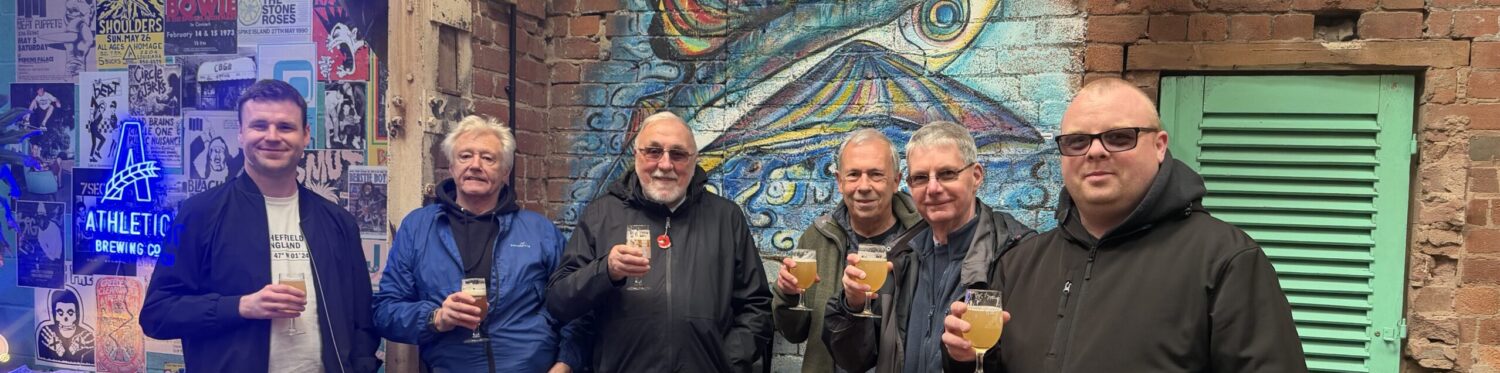




 In June 2017, we undertook our annual Beer Census, visiting as many pubs as possible on one day in order to get a snapshot of the range of real ales available around Sheffield. Although we were not able to make it to quite as many pubs as in previous years due to a decrease in surveyors, we did still visit 136 pubs and found 590 handpumps with 360 unique real ales. The average cost of a pint was £3.12 and the most popular ale was Abbeydale’s Moonshine.
After the chairman’s report came an update on branch finances from treasurer Paul Crofts. The balance sheets showed that the festival had made a good surplus, which was enough to cover other branch expenses. We were also able to send funds back to the central CAMRA campaign office. The accounts will be audited externally before being approved.
The next action was to appoint the branch committee for 2018/19. With a number of committee members leaving their roles, some restructuring will take place with existing members taking on new responsibilities. More details will be given following the next committee meeting at the end of April. The departing committee members were thanked for their efforts over the last year.
After a short beer break, it was time to announce the results of the Pub of the Year, District Pub of the Year, Club of the Year and Cider Pub of the Year awards. The winners were the Kelham Island Tavern, the Red Lion at Litton, Interval Bar at the University of Sheffield Students’ Union and the Clubhouse on London Road respectively. Congratulations were extended to all the winners and runners-up.
The last point on the agenda for the evening was to vote on a number of motions for debate. Firstly, an updated branch constitution in line with the CAMRA model constitution (submitted by Dave Pickersgill) was accepted by the members present by a 17-3 vote. Next was a motion moving that the rules for the Pub of the Month competition be updated so that a pub which is no longer eligible can be removed from the running without the consent of the nominator. Again, this motion was passed (15 votes in favour, 0 against).
The final two motions instructed the new committee to investigate two issues. The first involved looking at possible changes to the format of the Pub of the Year competition to give pubs outside the more popular parts of the city an equal chance of winning. The second instructed the committee to review the format of branch meetings. These motions were both passed unanimously.
We would like to say thank you to all members who attended the AGM. More details about the new committee for 2018/19 will be included in next month’s Beer Matters.
Dominic Nelson
In June 2017, we undertook our annual Beer Census, visiting as many pubs as possible on one day in order to get a snapshot of the range of real ales available around Sheffield. Although we were not able to make it to quite as many pubs as in previous years due to a decrease in surveyors, we did still visit 136 pubs and found 590 handpumps with 360 unique real ales. The average cost of a pint was £3.12 and the most popular ale was Abbeydale’s Moonshine.
After the chairman’s report came an update on branch finances from treasurer Paul Crofts. The balance sheets showed that the festival had made a good surplus, which was enough to cover other branch expenses. We were also able to send funds back to the central CAMRA campaign office. The accounts will be audited externally before being approved.
The next action was to appoint the branch committee for 2018/19. With a number of committee members leaving their roles, some restructuring will take place with existing members taking on new responsibilities. More details will be given following the next committee meeting at the end of April. The departing committee members were thanked for their efforts over the last year.
After a short beer break, it was time to announce the results of the Pub of the Year, District Pub of the Year, Club of the Year and Cider Pub of the Year awards. The winners were the Kelham Island Tavern, the Red Lion at Litton, Interval Bar at the University of Sheffield Students’ Union and the Clubhouse on London Road respectively. Congratulations were extended to all the winners and runners-up.
The last point on the agenda for the evening was to vote on a number of motions for debate. Firstly, an updated branch constitution in line with the CAMRA model constitution (submitted by Dave Pickersgill) was accepted by the members present by a 17-3 vote. Next was a motion moving that the rules for the Pub of the Month competition be updated so that a pub which is no longer eligible can be removed from the running without the consent of the nominator. Again, this motion was passed (15 votes in favour, 0 against).
The final two motions instructed the new committee to investigate two issues. The first involved looking at possible changes to the format of the Pub of the Year competition to give pubs outside the more popular parts of the city an equal chance of winning. The second instructed the committee to review the format of branch meetings. These motions were both passed unanimously.
We would like to say thank you to all members who attended the AGM. More details about the new committee for 2018/19 will be included in next month’s Beer Matters.
Dominic Nelson 
 A 1952 plan (Gerald Maynard & Co. D5328/21/3(i), Derbyshire Record Office, Matlock) shows the front entrance into a hall. On the left is a Tap Room (now the smoke room), while to the right are steps (up) and a Smoke Room. Ahead is a passage which runs the length of the two forward rooms with a bar counter ahead. The cellar is to the left of the bar, with a sitting room to the right. Further right are a Larder and Living Room.
The current layout and the 1952 plan suggest a mid-1950s refit which merged the two right rooms into a single lounge with the bar moving forward to its current central position and the snug taking the place of the bar counter and bar area.
We believe there have been no major changes since the mid-1950s. Apparently local craftsmen were used to do the work: stonemason for the fireplaces and carpenter for the bar front and wood panelling. Relatives of these craftsmen are still pub regulars.
A 1952 plan (Gerald Maynard & Co. D5328/21/3(i), Derbyshire Record Office, Matlock) shows the front entrance into a hall. On the left is a Tap Room (now the smoke room), while to the right are steps (up) and a Smoke Room. Ahead is a passage which runs the length of the two forward rooms with a bar counter ahead. The cellar is to the left of the bar, with a sitting room to the right. Further right are a Larder and Living Room.
The current layout and the 1952 plan suggest a mid-1950s refit which merged the two right rooms into a single lounge with the bar moving forward to its current central position and the snug taking the place of the bar counter and bar area.
We believe there have been no major changes since the mid-1950s. Apparently local craftsmen were used to do the work: stonemason for the fireplaces and carpenter for the bar front and wood panelling. Relatives of these craftsmen are still pub regulars.
 The pub sign shows the Eyre family coat of arms. The arms on the wall of the lounge belong to Rowland Eyre, a Royalist officer in the Civil War. The Eyres raised a regiment in Derbyshire and fought at the Battle of Marston Moor in 1644. The centrepiece is a solitary leg. Apparently, at the Battle of Hastings (1066), William the Conqueror was knocked from his horse. He was assisted by a soldier called Truelove who loosened the Kings’ helmet as his nose-plate was crushing his face. William then said “thou hast given me the air that I breathe – henceforth you will be known as Air (Eyr)”. Later in the battle, the King discovered that Truelove (Eyr) had to have a leg amputated. William told him that when he was recovered, he would give him some land. The soldier replied, ‘I shall call it Hope, for you have given me hope to live.’ There are two problems with this story: the Norman soldiers did not wear helmets of this type, and Truelove was an Anglo-Saxon name, not Norman.
The building was originally a farmstead, built in 1632. By 1753, ‘Eyre Arms as a Public House at Hassop.’ In 1814, the name changed to ‘Newburg Arms Inn’ and in 1902, it returned to the Eyre Arms. The pub has recently been proposed as a new entry on the CAMRA National Inventory of Pub Interiors.
Dave Pickersgill
The pub sign shows the Eyre family coat of arms. The arms on the wall of the lounge belong to Rowland Eyre, a Royalist officer in the Civil War. The Eyres raised a regiment in Derbyshire and fought at the Battle of Marston Moor in 1644. The centrepiece is a solitary leg. Apparently, at the Battle of Hastings (1066), William the Conqueror was knocked from his horse. He was assisted by a soldier called Truelove who loosened the Kings’ helmet as his nose-plate was crushing his face. William then said “thou hast given me the air that I breathe – henceforth you will be known as Air (Eyr)”. Later in the battle, the King discovered that Truelove (Eyr) had to have a leg amputated. William told him that when he was recovered, he would give him some land. The soldier replied, ‘I shall call it Hope, for you have given me hope to live.’ There are two problems with this story: the Norman soldiers did not wear helmets of this type, and Truelove was an Anglo-Saxon name, not Norman.
The building was originally a farmstead, built in 1632. By 1753, ‘Eyre Arms as a Public House at Hassop.’ In 1814, the name changed to ‘Newburg Arms Inn’ and in 1902, it returned to the Eyre Arms. The pub has recently been proposed as a new entry on the CAMRA National Inventory of Pub Interiors.
Dave Pickersgill 


 We sell one ale for now. This comes from Bradfield Brewery and changes every month (Irish Dexter for March, Plum Bitter in April) and at the end of each year customers can vote for their favourite one. We sell much more ale now than in previous years and are considering adding more pumps.
 Our weekly events are: Monday – Snooker & Pool night, Wednesday – Quiz & Bingo night, Friday – Live Music every month or two, Saturday – Disco & Karaoke, Sunday – free jukebox evening (5pm – 10pm). Tuesday might become an open mic night soon.
 We also do theme nights, charity nights, and offer a free venue for parties. The pub recently had a full refurbishment (painting, new carpets and flooring, decor, toilets) and we are renovating the beer garden this spring.
Alex Wainwright
We also do theme nights, charity nights, and offer a free venue for parties. The pub recently had a full refurbishment (painting, new carpets and flooring, decor, toilets) and we are renovating the beer garden this spring.
Alex Wainwright