In 2021, the Royal Oak was demolished without planning permission. The owners, Bar 24 Ltd, have recently achieved retrospective planning permission for this demolition and the redevelopment of the site. Their assertion is that toxic waste was dumped in the car park, and the situation became so bad that the only option was to demolish a building dating from 1843.
At the time, the local MP, Clive Betts, disagreed, ‘the issue of the toxic waste and chemical spills on the site is in my view a red herring. There has been a problem with toxic chemicals but the explanation from the owners that they contacted the Environment Agency about demolition does not in any way obviate the need to apply for planning permission to demolish: the two are separate issues.‘
CAMRA Sheffield & District agree with Clive. It seems that the dumped waste was used as a pretext for taking short cuts to potentially secure profitable redevelopment of the site.
The Carlton Tavern (London) sets a precedent for such unauthorised demolition. The Carlton closed in April 2015: then two days before Historic England was due to recommend the pub be granted Grade II listed status, the owners demolished the building, without planning permission. They expected a £5000 fine. However, Westminster Council had a different opinion. They ordered the owners: CTLX, to rebuild the Carlton brick by brick. In 2021, having been totally rebuilt, it re-opened.
CAMRA Sheffield & District believe that Sheffield City Council (SCC) should have taken a similar approach to that adopted by Westminster. However, following the ‘grant conditionally‘ decision of SCC Planning and Highways Committee, this is not the case.
Hence, we have written to SCC to request the reasons behind their decision:
‘A formal Enforcement Notice was not served in this case given that the owner/applicant cooperated with officers and committed to submitting a retrospective planning application for the redevelopment of the site. This is a legitimate option which was available to them. The National Planning Policy Framework advises that enforcement action is discretionary and that Local Planning Authorities must act proportionately in responding to breaches of control.
Whilst the actions of the developer are regrettable in this case, there is no comparison with the Carlton Tavern which was just about to become a designated heritage asset. In that case the developer knew that the building was about to become statutorily listed and carried on with the demolition regardless. The former Royal Oak is not in this category and the applicant had already engaged in pre-application discussions with the Council about redeveloping the site.’
If 40 years ago, you had asked a beer-buff to talk about breweries in Sheffield, you would have heard mention of Stones, Tennants (by then Whitbread) and Wards. However, it is unlikely that the Hope Brewery would have been mentioned.
Opened in 1939, the Hope Brewery (Clay Wheels Lane, S6 1NB) was the home of Carter, Milner & Bird Ltd. The company was founded in 1892, and registered, at Mowbray Street, in 1899, by Christopher Carter, Eleazar Milner & George Bird. In 1939, due to redevelopment of the area, the original Hope Brewery was closed and a new model brewery was built.
The company merged with Henry Tomlinson Ltd in 1942 after the destruction of Tomlinson’s Brewery, and the name was changed to Hope & Anchor.
The company saw spectacular growth in the 1940s and 50s, fuelled by several acquisitions:
1948 Wellington Brewery bought from Isle of Man Brewery, Castletown
1954 Wilkinson’s Pine Street Brewery, Newcastle
1955 Truswell’s Brewery Sheffield with over 50 pubs
1957 Openshaw Brewery Manchester with 125 pubs
1958 Welcome Brewery Oldham with three pubs
By 1960 the company had around 250 tied outlets and the telegram address Jubilee Sheffield.
In addition, novel marketing was used. Local artist, Kenneth Steel, known for paintings and advertising, many of which were reproduced as designs for station billboard posters, produced advertising material. This included paintings of pubs on beer-mats, trays and posters.
Hope & Anchor are also featured in the 1950 short film, The Inn that Crossed the Sea. This film was made at the height of the post-war export drive. Beer consumption in the UK was in decline and overseas markets were wanted. It tells the story of exhibiting their beers to worldwide buyers at the 1949 Canadian International Trade Fair in Toronto.
As part of the exhibition, the brewery used 15 tons of material to create a replica of the Old Rose & Crown (Hoylandswaine). They exhibited: Golden Mead Ale, Jubilee Stout, Old English Beer, and from partners, Castletown, Oyster Stout. Local liquor laws meant that beer had to be poured down the drain. However, the 50,000 visitors/day resulted in both lots of publicity and good sales. Their Jubilee Stout was airlifted to Toronto.
A 1952 reciprocal agreement with Canadian Breweries (CBL), led by President EP (Eddie) Taylor saw Jubilee Stout on sale in Canada and the initial entry of Carling Lager to the UK.
In March 1960, Northern Breweries Ltd was formed to merge: Hammond’s United Breweries Ltd, Hope & Anchor Breweries Ltd. and John Jeffrey & Co. Ltd. The name was later changed to Northern Breweries of Great Britain Ltd and in October 1962 to United Breweries Ltd. In 1962 they merged with Charrington & Co. Ltd of Mile End London and name changed to Charrington United Breweries Ltd. In 1967 CUB merged with Bass, Mitchells & Butlers to become Bass Charrington Ltd.
The Hope Brewery became a specialist brewery for bottled beers before it was closed in 1994. For a short period it brewed, one of the few bottled-conditioned beers available at the time, Worthington White Shield (abv 5.6%, original gravity: 1050.5).
Sheffield Archives have updated their very useful research guide: ‘Sources for the Study of the History of Sheffield’s Public Houses.’ This invaluable A4, 22 page booklet, includes many information sources and useful suggestions as to how to gain access. Free download: https://tinyurl.com/2p88t5v9
Andrew McCloy tells the stories of some unusual former pubs and beerhouses
High up on the Peak District moorland west of Sheffield, beyond Lodge Moor, are the three small Redmires reservoirs. They were constructed between the 1830s-50s to provide drinking water for the growing city. What looks like a memorial stone in the roadside wall between the middle and upper reservoirs is in fact the surviving sign from a beerhouse called the Grouse and Trout, which used to stand near here. The sign features a grouse and three trout, and – although it’s hard to make out – the Latin inscription Ich Dien Dinner which translates as “I serve dinner”. There was another beerhouse, called Ocean View, established nearby in the 1840s, both offering refreshments for the navvies digging the reservoirs. Ocean View closed in the 1880s, but the Grouse and Trout continued into the early years of the 20th century and was supposedly closed and later demolished after the moorland owner feared that the new influx of sightseers and tourists served by the pub would disrupt his shooting.
Grouse & Trout
Another noteworthy but long-gone beerhouse could once by found at Castleton in the Hope Valley and was located at the entrance to the gaping mouth of Peak Cavern, also known more colloquially as the Devil’s Arse. The ample space and damp conditions made it popular with rope-makers, and at the turn of 1800 the cavern’s 60ft-high mouth supported several dwellings, including a beerhouse, which in 1830 became Slack’s Mineral Shop selling Blue John and other local knick-knacks.
Heading back towards Sheffield, until around 1900 you could enjoy a drink in the Cross Daggers at High Bradfield, which because it was located near the gates of St Nicholas Church was nicknamed Heaven’s Parlour or Heaven’s Gate. It was a popular haunt of the navvies working on the local reservoirs, so much so that it ended up losing its licence because they kept fighting all the time. After this it was used as a vestry, a registry office, a school and then a post office, before finally becoming a private residence.
The former Ashopton Inn in the Upper Derwent Valley faced a more conclusive end, however. It was built in 1824 as a halt for coaches on the Sheffield to Glossop turnpike, a chance to change horses and make preparations for the long haul over the Snake Pass. But the Derwent Valley Water Board earmarked the narrow valley for giant new reservoirs and in 1943 the villages of Derwent and Ashopton, including the Ashopton Inn, were emptied and mostly demolished so that building work on the massive new Ladybower dam could begin. The Board, which had purchased the inn from the Duke of Devonshire in 1902, did look into the possibility of rebuilding Ashopton Inn on a new site, but in the end the licence was transferred to separate premises at New Mills, and Ashopton and its ruined pub were permanently submerged beneath 27,500 mega litres of water.
Andrew is author of Peak District Pubs: A Pint Sized Social History, published by Gritstone Publishing in 2020. Copies are available to buy on their website.
The national Planning Inspectorate has recently upheld an appeal against the second (2020) Sheffield City Council (SCC) planning decision to refuse the demolition of the Plough Inn (Sandygate Road, Crosspool, Sheffield). As the local Community Group puts it:
‘It’s time to say goodbye to the Plough. The Planning Inspector has upheld Spacepad’s appeal, and the pub will now be demolished, and the site redeveloped. The Planning Inspector reached the conclusion that there was no realistic prospect of the pub reopening. It is a sad ending for our campaign, but we feel we did everything we could to save this piece of Sheffield’s heritage. We would like to thank everyone who supported our campaign over the years.’
The Inspector has accepted that the pub is not a viable commercial proposition, that it has been properly marketed and that there are suitable alternatives close enough by. Both the local Community Group and CAMRA Sheffield & District believes that all these judgements are highly contentious.
This is the latest twist in a saga which commenced, almost a decade ago, when the previous owners, Enterprise Inns (Ei), decided to deliberately run-down their historically important asset before closure in 2015. Two years later, a planning application to SCC to turn the site into a branch of Sainsbury’s was rejected. The pub company then refused to sell to the Plough Community Benefit Society Ltd. (PCBS), a local Community Group and instead, sold to a property developer. They, in turn, allowed the condition of the building to deteriorate: there has been no serious maintenance work. Ei and the subsequent owners, Spacepad UK, left the pub to rot.
The site deteriorated to such an extent that it became the subject of a Planning Enforcement enquiry regarding unauthorised use as a waste disposal facility and a storage site for unregistered vehicles. It was Spacepad who, according to SCC Planning Enforcement, used the land ‘to store unwanted building materials, a caravan, a JCB type digger, a static cabin, trailers, pallets, a fork truck, vehicles, building and non-building materials and other paraphernalia.’ An Enforcement Notice was recommended.
The Planning Appeal Form completed by Spacepad, makes much of the poor condition of the building, blaming ‘vandalism, burglary and fly tipping.’ Many believe that this is a red herring: the current poor condition of the building and site is solely the fault of the owners. Planning law places responsibility for the condition of the site with the owner. By law, the building should have been maintained in a fit and proper condition for its permitted use as a public house: the owners have not carried out this legal obligation.
At the time of the purchase from Ei, an independent report, commissioned by PCBS demonstrated that, for the pub to reopen, no major building work was required and that internal refitting costs were manageable within a realistic business plan. Currently, the Plough would require substantial refurbishment before it could be brought back into use. A figure of ~£450.000 is quoted in the Appellant Statement. The owners have failed to make this investment and have failed to reinstate the property.
Dave Pickersgill, Pub Protection Officer for CAMRA Sheffield & District states: ‘The recent planning application and the appeal documents do not provide any evidence to suggest the building is not viable as a public house. The developer states that no offers were received to lease the pub. This was because it was offered for a completely unrealistic rent of £50,000 pa. In 2019, average rents in this area were between £24,000 and £29,000. In addition, this planning application would see the Plough replaced by eight houses, none of which would be affordable housing.’
The recent planning history of a site is also a relevant consideration in planning decisions. In 2017, the local authority rejected Sainsbury’s application for change of use based on the Plough’s listing as an Asset of Community Value (ACV) and it accepted that there were no alternative community facilities within a reasonable distance. In 2018, following the sale of the Plough, the local authority re-listed the pub as an ACV. As there have been no material changes in the reasons why the Plough was listed as an ACV, this should have remained an overriding consideration in any decision.
The Plough was rebuilt in 1929 and is an important example of an inter war public house which, according to Historic England, are ‘rare and overlooked buildings’. National planning policy recognises the importance of protecting historic assets and their ‘setting.’ This was confirmed in the decision of the local authority to refuse the application from Sainsbury’s.
According to Historic England, about 3,000 pubs were built during the inter-war years. Very few survive. A recent study finding that inter-war pubs are under greater threat of disappearing than pubs of any other date.
In short, as this appeal was allowed, it implies:
the Secretary of State ignores local community opinion
if a developer allows a historic building to slowly decay: eventually, they will be given permission to demolish.
The covid pandemic has highlighted the importance of local community facilities and high streets, both of which contribute to supporting vibrant, successful and sustainable communities. The Plough, ran as a community pub, could bring countless economic and social benefits to the area. It also has the added attraction of its key place in the history of world football – it is adjacent to the site of the official first inter-club football game: Hallam v Sheffield at Sandygate (26 December 1860) and has played a part in the development of football. A small internal museum would not have been inappropriate.
1695
The Plough opens as a public house
1897
Tennant Brothers acquire the lease to the Plough and the adjacent sports ground
1929
The Plough Inn is rebuilt
1969
The lease is assigned to Whitbread who become Patron of Hallam FC
2003
Enterprise Inns acquire the pub
2015
Closure of The Plough Inn by Enterprise Inns (Ei)
2015
The Plough Inn achieves ACV status
2017
Planning application from Ei to replace the building by a mini-supermarket is refused by SCC
2017
Ei refuse to sell the pub to a local Community group, instead selling to a property company, Spacepad
2018
The Plough Inn achieves ACV status for the second time
2020
Planning application from Spacepad to demolish and replace by flats, is refused by SCC
2021
An appeal by Spacepad to the planning refusal is upheld by Planning Inspectorate
The Maison du Biere in Elsecar is now selling copies of our guide to Sheffield pubs with surviving heritage features and editor Dave Pickersgill will be visiting for a book signing event on Saturday 11 December from 2pm to 4pm.
The South Yorkshire Local Heritage List identifies heritage assets that are valued as contributing to the distinctiveness and history of South Yorkshire but that are not protected by statutory national designations, such as Listing or Scheduling. Inclusion on the Local Heritage List can allow the more local significance of a building, place or site to be taken into account in planning decisions that affect it or its setting. It does not provide the same level of protection as national designation, but will be of assistance when planning applications are submitted.
Sheffield and District CAMRA has ensured that pubs mentioned in the recently published book, Sheffield’s Real Heritage Pubs which are not nationally listed or in a Conservation Area, have been put forward for the Local Heritage List. However, this leaves many pubs which are not listed – possibly your local?
From the website, you can view the existing list, see the assessment criteria and nominate candidates. Please make sure your favourite heritage buildings are nominated!
In September, as part of Heritage Open Days and Sheffield Walking Festival, we led two pub heritage walks. These were the first such events since 13 March 2020, the evening which saw my last pub visit for almost six months: a final beer in the Wellington.
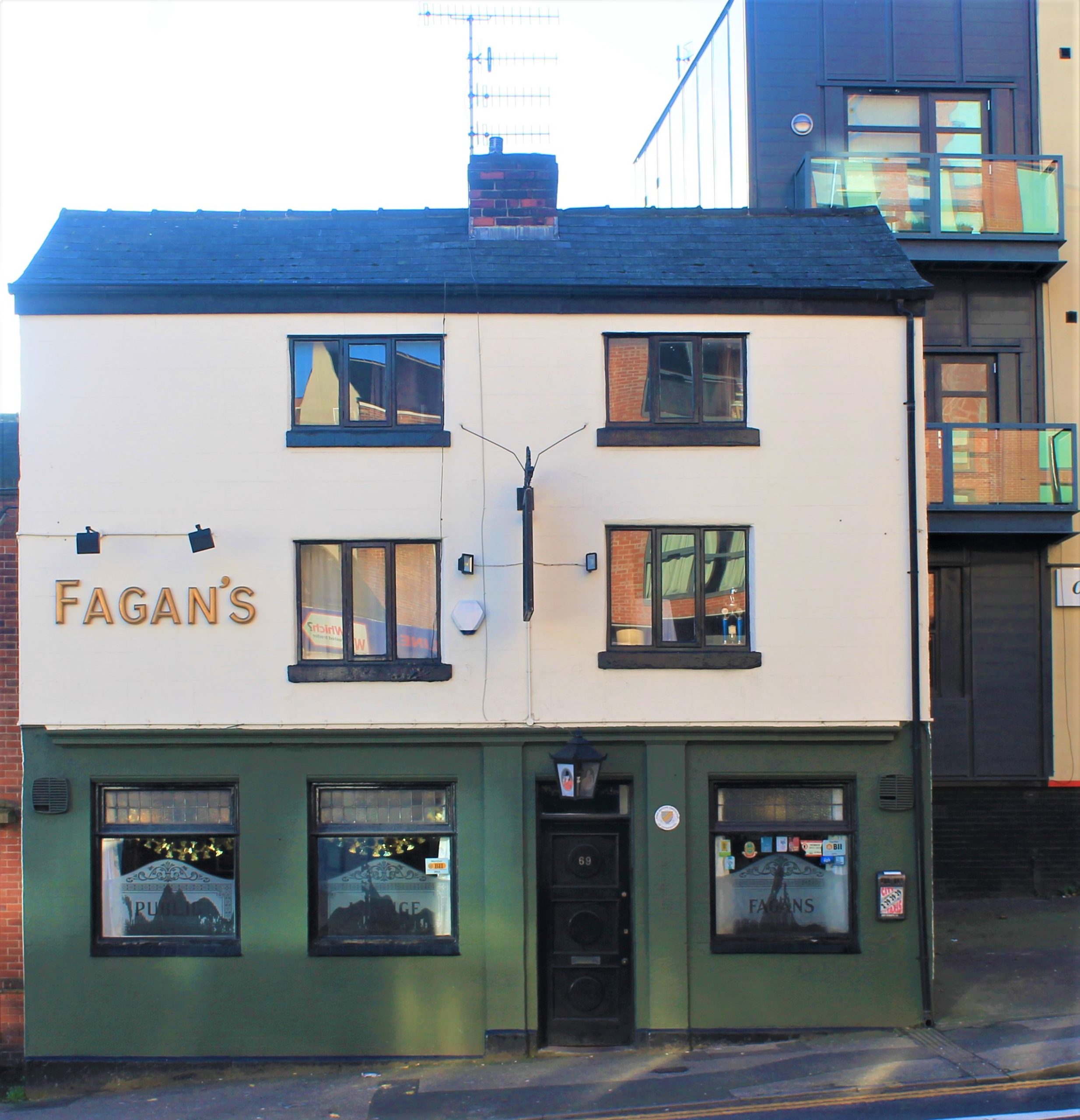
The first walk commenced in the lounge at Fagan’s, in a room which, 200 years ago was a tenement adjacent to the Rawsons-owned, Barrel pub. The name change came in 1985 when long serving landlord, Joe Fagan retired and current occupants, Barbara and Tom Boulding took over the reins. We then progressed along Bailey Lane to both the Dog & Partridge and the Grapes. The latter is the best remaining example of a Rawsons pub while the Dog has a small intimate snug which, in the 1974, almost became a gents toilet. Then it was the sights of West Street before finishing in the CAMRA National Inventory-listed, Bath Hotel: a pub which is (almost) unchanged since the 1931 Ind Coope renovation.
Bath Hotel plans
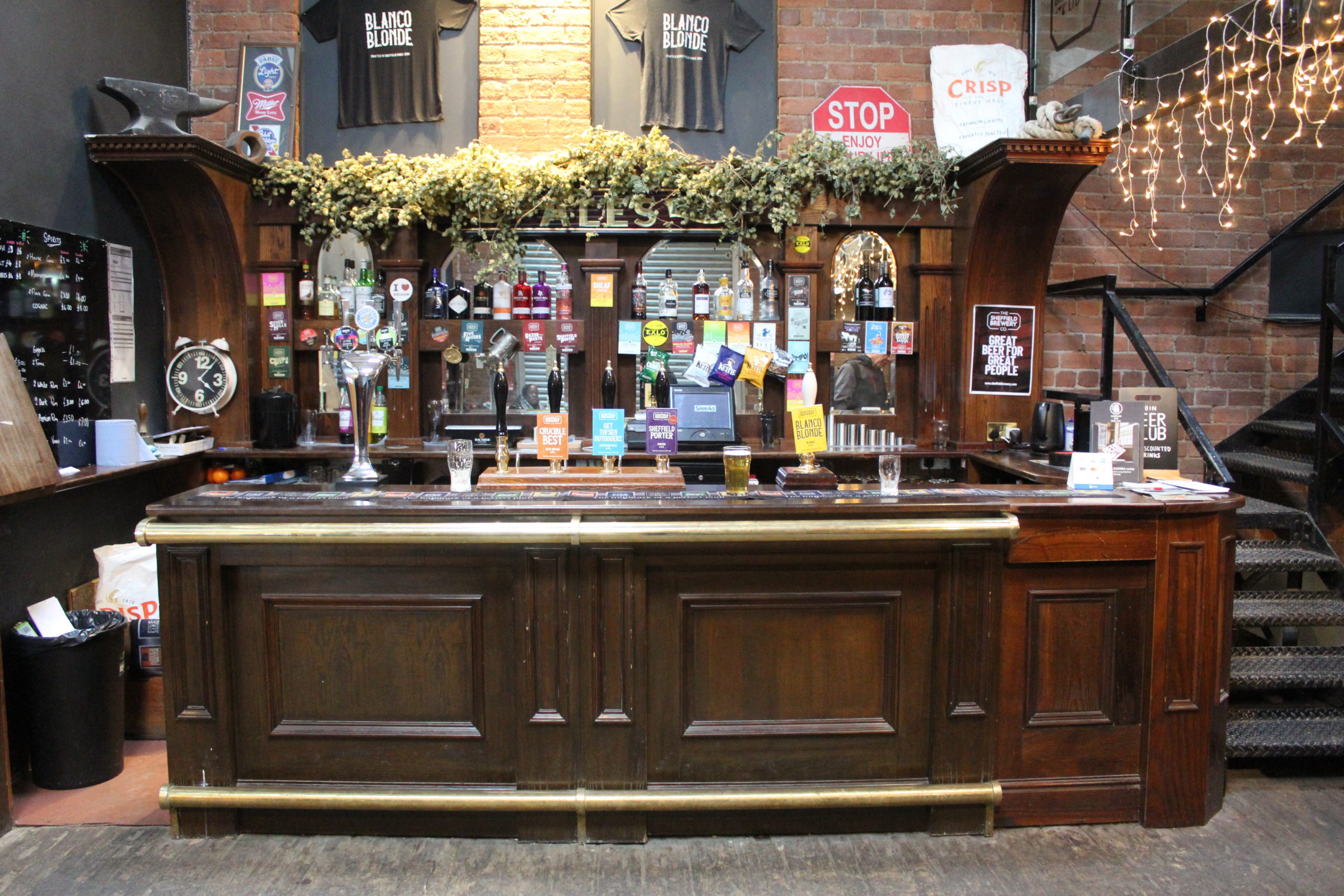
Two days later, we commenced in the Fat Cat, the pub that, when opened in 1981, doubled the number of different cask beers available in Sheffield. Then to Shalesmoor, passing both ex- and current pubs and breweries before finishing at the original home of ‘Blanco,’ Sheffield Brewery Company with both a brewery tour and a welcome drink. The latter was from the bar which was originally at the now-demolished Sheffield University Ranmoor Hall. They also have an interesting selection of branded bricks as part of the recent outside development.
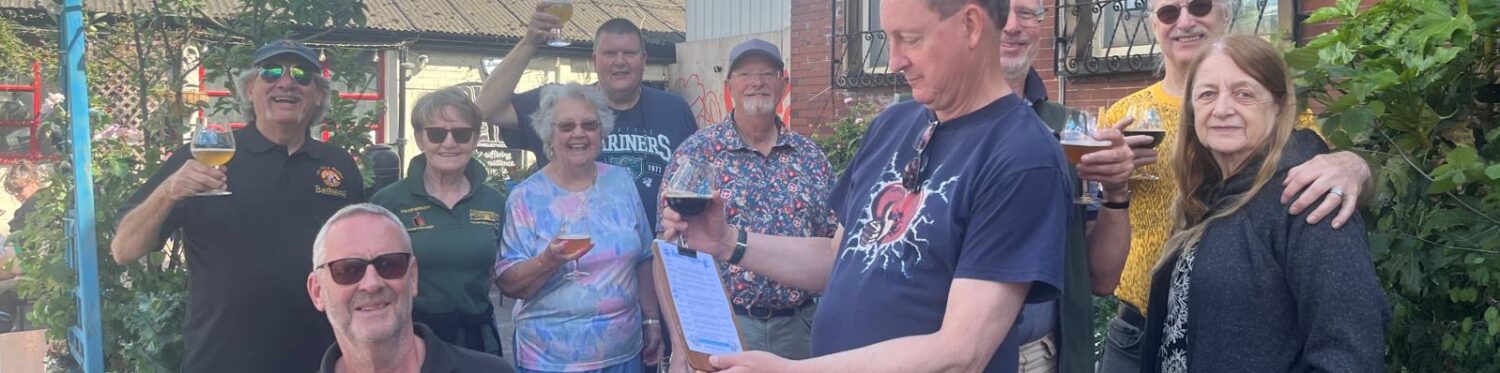
Thanks to the 37 participants and all who assisted. Future walks are planned for Sheffield Beer Week in March and again, next September.
The 4th edition of the Sheffield Real Heritage Pubs Book is now in print. 1000 copies of the 112-page A5 book (£6.99) are available both via mail and in an increasing number of local outlets.
Paul Ainsworth, the Chair of the National CAMRA Pub Heritage group says; ‘For almost forty years, CAMRA has developed its national inventory (NI) of historic pub interiors. This publication portrays the rich tapestry of Sheffield’s pubs: from the nationally important to those where what remains, even if fragmented, should be cherished.’
A recent series of book-signing events for four of our sponsors provided lots of positive feedback, as have responses from mail-order buyers. For example, Andy Brown, from Poole in Dorset commented: ‘I’ve received my book today …. it looks superb …. well done on the publication,’ while ex-CAMRA Good Beer Guide Editor, Jeff Evans commented, ‘Good to see this new edition celebrating the finest pubs in a great beer city.’
Local stockists include both beer-outlets and bookshops:
Abbeydale Brewery (mail order), Beer Central, Blind Monkey, Bradfield Brewery Shop, Chantry Inn, Coach and Horses (Barnburgh, Doncaster), Crow Inn, Dog and Partridge, Draughtsman (Doncaster), Fat Cat, Friendship (Stocksbridge), Samuels’ Kitchen (Stocksbridge), Maison du Biere (Elsecar), Princess Royal, White Lion
Beer Inn Print (mail order), Biblioteka (Kommune), Kelham Island Books & Music, Kelham Island Museum, Millennium Gallery, New Chapter Books, Rhyme and Reason, the Sheffield Shop, Watson Park Museum
Thanks again to all who assisted with this publication: many individuals, the National CAMRA Pub Heritage Group, Sheffield Archives and the sponsors for their help. Also to Andy Shaw for the design and Mick Slaughter for many of the photos.
Last month, we reported how the Royal Oak (Mosborough), was demolished. The owners, Bar 24 Ltd., have now applied for retrospective planning permission. Their assertion is that toxic waste was dumped in the car park, and the situation became so bad that the only option was to demolish the pub. The building dated from 1843, becoming a beerhouse in 1870.
Clive Betts, the local MP disagrees, ‘we should never have been in this position. An application should have gone in before the pub was demolished, and it’s disgraceful how the applicants have behaved. The application has to be treated as if the building is still there. There must be no advantage to the developer because they broke the rules and demolished the pub before they got permission.’
Sheffield and District CAMRA agree with Clive. In October, environmental experts assessed the situation and didn’t find anything to justify demolition. This suggests that the spillage has been used as a pretext for taking short cuts to potentially secure profitable redevelopment of the site. We also believe objections to the anticipated planning application should initially focus on the importance of retaining pub use on the site and the lack of any justification for the demolition. The Carlton Tavern (London) sets a clear precedent.
Sheffield and District CAMRA will comment on this planning application. We encourage you to do the same. Sheffield City Council planning, reference 21/03651/FUL.
The developers are proposing to replace the pub with a retail park.